Two stories about AI are running, and both are incomplete. The tools genuinely compress work; the accounting, the calibration and the power bills are another matter. Twenty-five years ago the fibre outlasted the forecasts that paid for it, and nothing in a boom is cheaper than a confident number.
Google’s €13bn Finnish AI investment shows the race is no longer just about chips and models. It is about nuclear power, grids, cooling and construction. As data centres become industrial assets, countries with reliable, low-carbon energy will hold the decisive advantage as global AI
AI is shrinking the gap between flaw disclosure and exploitation, forcing boards to modernise security at machine speed. As agentic systems arm attackers and defenders alike, the opportunity lies in identity, cloud protection, automated response and AI governance, not apocalypse rhetoric globally.
Apple’s Quiet AI Power Play Has Global Consequences
With 2.5bn active devices, Apple commands an AI footprint unmatched by any model laboratory or cloud provider. The company is converting hardware ubiquity into a competitive moat, bypassing the race for ever-larger models to integrate AI into a distribution network already serving billions.
Apple's record quarter bankrolls its belated AI offensive
iPhone sales surge provides firepower for long-awaited pivot to artificial intelligence.
Apple has delivered a pointed reminder to investors that its strength lies not in chasing technology trends but in controlling distribution at scale. A record holiday quarter driven by iPhone demand has handed chief executive Tim Cook both the financial headroom and strategic momentum to position the company as a late but formidable entrant to the artificial intelligence race.
The numbers behind the pivot
Revenues rose 16 per cent year on year to $143.8bn, with diluted earnings per share up 19 per cent, comfortably beating consensus forecasts. The iPhone accounted for roughly $85.3bn of that total, rising 23 per cent to mark the product's strongest quarter on record, with all-time highs across every geography. Services revenues climbed 14 per cent to a fresh peak, reinforcing the high-margin layer now wrapped around more than 2.5bn active devices worldwide.
'Fast Money' traders react to Apple's quarterly earnings beat. CNBC
Mr Cook's language was unusually emphatic. The company described it as "a remarkable, record-breaking quarter", driven by "unprecedented demand" — the sort of phrasing Apple typically reserves for product launches rather than quarterly earnings releases.
Distribution advantage meets AI ambition
What makes this quarter strategically significant is not simply the scale of iPhone sales, but what the installed base now represents: a guaranteed distribution channel for Apple Intelligence. With more than 2.5bn active devices, Apple commands an AI deployment footprint unmatched by any model laboratory or cloud provider.
The Gemini collaboration with Google is instructive. Apple is prepared to licence a 1.2tn-parameter model where necessary, but insists users will still "interact with Apple's models on-device and within Private Cloud Compute". The company is, in effect, converting hardware ubiquity into a competitive moat for AI.
Siri's long-awaited overhaul, tied to forthcoming Apple Intelligence releases later this year, sits at the heart of this strategy: a large language model-class assistant that operates on the device users already own, wrapped in Apple's privacy narrative rather than a hyperscaler's advertising infrastructure. The nearly $2bn acquisition of Israeli start-up Q.ai signals willingness to acquire foundational AI capabilities rather than rely solely on third-party models.
Supply chain rewiring for an AI future
Beneath the headline figures, Apple is reorganising its manufacturing footprint to support this AI-intensive roadmap. The company and its partners are accelerating efforts to shift 15-20 per cent of global iPhone production to India by 2026, supported by Foxconn's multibillion-dollar investments and India's production-linked incentive schemes. Multiple reports suggest most iPhones destined for the US market will be manufactured in India by the end of next year, a hedge against both tariff risk and over-concentration in China.
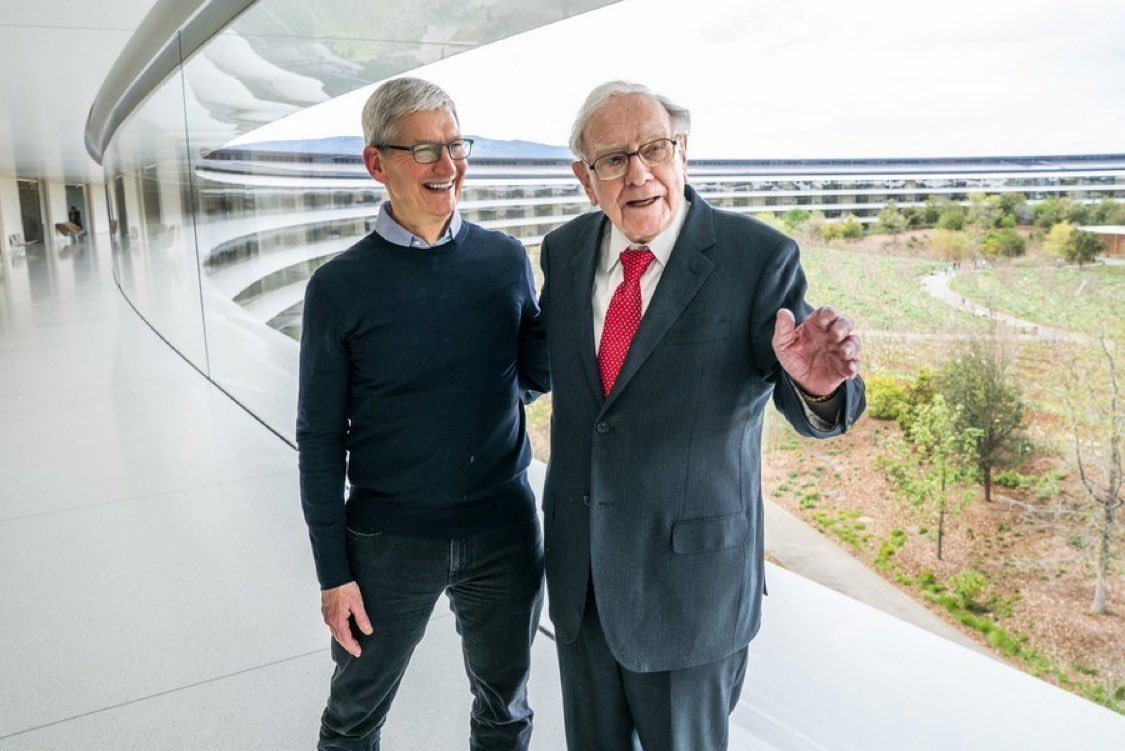
Images depict Tim Cook alongside Warren Buffett at Apple Park and a live stock chart showing AAPL surging 2.5% after hours to $264.76 from a $258.28 close, reflecting immediate market approval. Source: XAI
Simultaneously, Apple has outlined a US investment programme worth up to $500bn over four years, directed at advanced manufacturing, data centre construction, and workforce initiatives explicitly linked to Apple Intelligence. These commitments reflect operational necessity as much as political positioning: AI-infused features require local compute capacity, secure cloud infrastructure, and tighter integration between silicon design, operating systems, and model development teams based in Apple's US engineering centres.
Competing on Integration and the Broader Implications
Investors have spent much of the past two years questioning whether Apple missed the initial wave of generative AI development. The company's answer, made clearer by this quarter's results, is more subtle: Apple bypassed the race to showcase ever-larger models and instead waited until it could integrate AI into a distribution network already serving billions of users with industry-leading satisfaction metrics.
Gross margins of 48.2 per cent suggest the company can finance this transition without undermining its capital return programme, even as Mac and wearables sales soften. The strategic question is no longer whether Apple will compete in AI, but whether a tightly integrated, privacy-focused, hardware-anchored approach can challenge cloud-centric incumbents for market leadership.
This quarter's performance provides the foundation for that challenge. Apple is not attempting to win the race for the largest language model. Instead, it is leveraging assets that competitors cannot easily replicate: 2.5bn endpoints, a restructured India-US supply chain, and a chief executive now willing to describe quarterly results as "remarkable" because they provide the runway to rebuild Siri — and perhaps Apple's position atop the technology hierarchy — in the process.
The significance extends beyond product strategy. Apple is not merely upgrading a voice assistant; it is embedding AI into the daily routines of more than 2bn users whilst simultaneously reshaping the manufacturing infrastructure that serves them. By combining record iPhone demand with production shifts to India and substantial AI investment in the US, Apple is demonstrating how geopolitical risk management, supply chain resilience, and AI infrastructure can be interwoven.
For enterprises and regulators, this raises questions about governance and standards when a single company controls both the device and the default AI assistant. For competitors, it signals that the next phase of the AI contest will be determined not only by model benchmarks and parameter counts, but by control of endpoints, manufacturing capacity, and the narrative surrounding privacy and device integration.
Get the stories that matter to you. Subscribe to Cyber News Centre and update your preferences to follow our Daily 4min Cyber Update, Innovative AI Startups, The AI Diplomat series, or the main Cyber News Centre newsletter — featuring in-depth analysis on major cyber incidents, tech breakthroughs, global policy, and AI developments.
Sign up for Cyber News Centre
Where cybersecurity meets innovation, the CNC team delivers AI and tech breakthroughs for our digital future. We analyze incidents, data, and insights to keep you informed, secure, and ahead.
Two stories about AI are running, and both are incomplete. The tools genuinely compress work; the accounting, the calibration and the power bills are another matter. Twenty-five years ago the fibre outlasted the forecasts that paid for it, and nothing in a boom is cheaper than a confident number.
Meta’s Muse is more than a chatbot. It is a digital worker that can read email, make purchases across the web, and act after users close the app. Wall Street sees a return on Meta’s vast AI spending. Cybersecurity experts see a more urgent question: should it hold the keys to our digital lives yet?
OpenAI’s Astra has reignited the AGI debate, with Jensen Huang declaring its arrival and researchers questioning the evidence. As autonomous AI advances, the race into 2027 will test who can turn greater capability into economic value while keeping human oversight firmly in place. The stakes climb.
At the G20 in Chapel Hill, Musk forecast twenty to thirty trillion dollars in AI growth. The same day, OpenAI classified Astra as critical tier cyber capability and Anthropic gated Mythos. Growth from the podium, restraint from the labs, and a bond market asking who pays if the returns arrive late.
Where cybersecurity meets innovation, the CNC team delivers AI and tech breakthroughs for our digital future. We analyze incidents, data, and insights to keep you informed, secure, and ahead. Sign up for free!