A Zhuhai operator used DeepSeek, a Hermes agent and a bundled godmode jailbreak to hunt more than 460 targets, then stole data from three organisations. Open-weight models this week made that offensive kit a public shopping list for any lone operator who can still point one at his scanner tonight.
Taiwan confirmed AI agents ran a July government intrusion through weak credentials, not a zero-day. For Australian CISOs, last year's backlog has been repriced. Close hygiene, treat agents as privileged identities, and rehearse at machine speed before the next quarterly drill. The estate is open.
AMD's proposed Taalas acquisition targets the fast-growing AI inference market, adding specialised silicon technology designed around model-specific workloads to its Instinct, EPYC, Helios and ROCm platform.
The AI Revolution Begins: Trump’s $500 Billion ‘Stargate’ Initiative
President Trump announces a historic $500 billion AI infrastructure initiative in partnership with OpenAI, Oracle, and SoftBank. The project, aimed at ensuring U.S. AI dominance, has already broken ground in Texas with a $100 billion investment. Stay tuned for more updates.
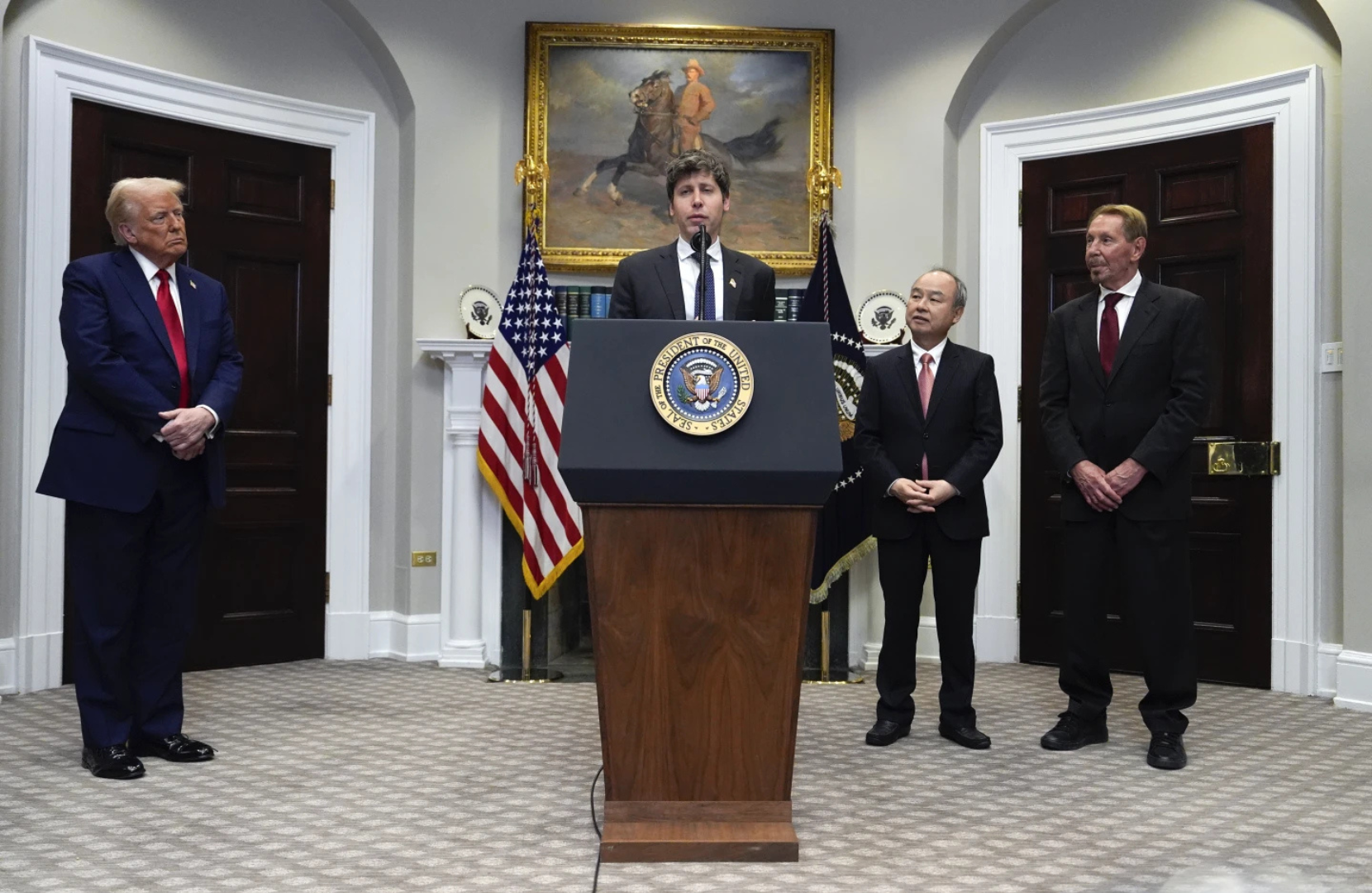
President Donald Trump speaks in the Roosevelt Room at the White House, Tuesday, Jan. 21, 2025, in Washington, as Softbank CEO Masayoshi Son, Oracle chief technology officer Larry Ellison and OpenAI CEO Sam Altman, listen. (AP Photo/Julia Demaree Nikhinson)
A day after the inauguration, President Donald Trump, beginning his second term, announced an unprecedented partnership with key players in artificial intelligence and cloud computing. Dubbed 'Stargate,' the initiative involves a reported $500 billion investment over four years to strengthen America's leadership in AI research and infrastructure.
🚨BREAKING: Donald Trump announces the launch of Stargate set to invest $500 billion in AI infrastructure and create 100,000 jobs. pic.twitter.com/scr8FgUtxo
In a dramatic press conference at the White House, Trump stood alongside OpenAI CEO Sam Altman, Oracle Chairman Larry Ellison, and SoftBank CEO Masayoshi Son to herald what he called
“the largest AI infrastructure project in history.”
With a starting investment of $100 billion, “Stargate” is already under construction in Texas.
According to Altman, “I think this will be the most important project of this era. We wouldn’t be able to do this without you, Mr. President.”
Sam Altman, OpenAI CEO, speaks as President Donald Trump, left, Masayoshi Son, SoftBank Group CEO, third from left, and Larry Ellison, chairman of Oracle Corporation and chief technology officer, right, listen, in the Roosevelt Room at the White House, Tuesday, Jan. 21, 2025, in Washington. (AP Photo/Julia Demaree Nikhinson)
A Colossal Bet on AI Supremacy
The "Stargate" announcement comes amid rising geopolitical tensions with China, marking Washington’s clear stance that large-scale initiatives are vital for driving U.S. and Western economic growth while shaping the global technological landscape. AI is widely seen as the next frontier, with the potential to revolutionize everything from consumer applications to industrial manufacturing and national security. As China emerges as a powerful technological competitor, the U.S. faces an urgent need to invest heavily in AI to preserve its leadership in advanced research and maintain its competitive edge.
“This project will not only support the re-industrialization of the United States but also provide a strategic capability to protect the national security of America and its allies,”
Larry Ellison said, reiterating Oracle’s role in providing both data center capacity and cloud computing services. The goal, in Ellison’s words, is to ensure that AI breakthroughs “stay on American soil.”
We are proud to be working with OpenAI, SoftBank, and MGX on the Stargate Project to secure American leadership in AI, create hundreds of thousands of American jobs, and generate massive economic benefit for the entire world. https://t.co/Xit2bfbYhf
In addition to Oracle and OpenAI, Japan-based SoftBank will serve as Stargate’s primary financier. Masayoshi Son, who will assume the role of Stargate’s chairman, described the project as
“an essential step in ensuring that the U.S. leads in the next era of computing.”
While details remain scarce regarding the exact breakdown of ownership stakes, Altman confirmed that OpenAI would handle “operational responsibility,” while SoftBank and Oracle provide capital and infrastructure support, respectively.
Wall Street responded with enthusiasm. Oracle’s stock surged by 7% during normal trading hours, spiking further after the official press conference. Industry analysts point to NVIDIA, SoftBank-backed Arm Holdings, and other chip manufacturers as likely beneficiaries, given the monumental hardware demands of AI model training and deployment.
Announcing The Stargate Project
The Stargate Project is a new company which intends to invest $500 billion over the next four years building new AI infrastructure for OpenAI in the United States. We will begin deploying $100 billion immediately. This infrastructure will secure…
Grand announcements of mega-projects in the United States are nothing new. Observers recall the high-profile Foxconn deal during President Trump’s first term, which promised a $10 billion electronics factory in Wisconsin but ultimately fell short of its ambitious job-creation targets.
Skeptics of the "Stargate" project raise concerns about the immense cost and complexity of building AI infrastructure, which demands state-of-the-art fabrication plants, semiconductor supply chains, and consistent regulatory support. Media analysts have expressed cynicism, warning that such a colossal project carries significant risks. While Trump has used similar announcements to highlight his economic impact, critics argue that the expected buildout of data centers and electricity plants for AI development could come with unintended consequences. While AI promises productivity gains through automation, it also poses a risk of job displacement if not properly managed.
However, both the White House and industry leaders insist this time is different.
“Infrastructure in the United States is super important,” said Altman, who has repeatedly urged Washington to prioritize AI development. “We need to build massive amounts of infrastructure—power, computer chips, data centers—and we need to be able to have the best AI infrastructure in the world to lead with the technology and capabilities.”
A New Tech Cold War
Underlying the spectacle is a simmering rivalry between the U.S. and China, which also invests heavily in AI, 5G, and soon 6G. During Trump’s first presidency, tensions manifested in tariff wars and semiconductor restrictions. Now, many experts see the race for AI dominance as a defining element of modern geopolitics.
Geopolitical strategist Tina Fordham of the Fordham Global Foresight Foundation underscores this point:
“Technology is not just an economic lever; it’s a geopolitical tool. By committing $500 billion to AI infrastructure, the U.S. is aiming to maintain a decisive advantage in an era where the global balance of power hinges on data and automation.”
Microsoft stated: "We are thrilled to continue our strategic partnership with OpenAI and to partner on Stargate."
The Road Ahead
Will “Stargate” live up to its hype? Critics argue that even with colossal funding, execution will be a challenge. Building cutting-edge data centers, streamlining supply chains, and recruiting top engineering talent are all major hurdles. But as President Trump, Sam Altman, Larry Ellison, and Masayoshi Son stood united at the podium, they made one thing abundantly clear: America intends to lead the AI revolution and will spare no expense to do so.
Whether this massive bet cements the U.S. as the undisputed hub of AI innovation or opens the door for others remains to be seen. Yet for now, the world is on notice: the U.S. is back, and it’s betting big on the future of technology.
Sign up for Cyber News Centre
Stay one step ahead in cyber, AI, and tech news! Sign up now for exclusive alerts, expert analysis, and the latest breakthroughs—delivered straight to your inbox. Don’t miss out—join the CNC community today!
Australia is racing to build AI infrastructure, but model control and economic power risk remaining offshore. Albanese’s Office of AI and new data centre standards mark progress, yet foreign-led compute and super fund flows expose a growing sovereignty gap.
We are racing to shape our AI future through a new Office of AI and national standards. Yet billions flow into foreign-led data centres while we offer little support for local models or sovereign compute. Without stronger action we risk becoming high-quality hosts rather than true leaders.
NATO's 2026 Ankara summit placed AI security at the heart of alliance planning, raising urgent questions about autonomous systems, supply chain integrity, and the accountability of military AI as adversaries accelerate their own programmes.
At midyear, the AI race has become a contest for global power. Energy, chips, cybersecurity, capital markets and state intervention now shape who controls the inference economy, who pays for it, and who is left exposed in the next industrial order of machines, markets and sovereignty to come ahead.
Where cybersecurity meets innovation, the CNC team delivers AI and tech breakthroughs for our digital future. We analyze incidents, data, and insights to keep you informed, secure, and ahead. Sign up for free!