Google’s €13bn Finnish AI investment shows the race is no longer just about chips and models. It is about nuclear power, grids, cooling and construction. As data centres become industrial assets, countries with reliable, low-carbon energy will hold the decisive advantage as global AI
AI is shrinking the gap between flaw disclosure and exploitation, forcing boards to modernise security at machine speed. As agentic systems arm attackers and defenders alike, the opportunity lies in identity, cloud protection, automated response and AI governance, not apocalypse rhetoric globally.
Three AI leaders agree the frontier may be moving faster than its safeguards. As markets weigh slower chip demand and rising cyber investment, the question is whether the warning is responsible leadership, strategic scaremongering or evidence that cybersecurity has become AI’s essential foundation.
China’s AI Robots Just Played a Soccer Match Making Every Decision Without a Remote
China just hosted its first fully autonomous robot soccer match — no remotes, no commands, just AI making every decision on the field. The 3-on-3 game revealed major strides in real-time coordination, strategy, and machine independence.
Teams using autonomous T1 robots from Booster Robotics compete in the inaugural RoBoLeague robot soccer competition held in Beijing, Saturday, June 28, 2025. (AP Photo/Ng Han Guan)
A robot soccer match in Beijing last week drew global media attention — not for its scoreline, but for what it revealed about the state of AI. With no remote controls, no human input, and no sidelines interference, six humanoid robots played a fully autonomous 3-on-3 game that marked a breakthrough in real-time machine decision-making.
Organized as a 3-on-3 showdown between university-developed bots, the event ended in a 5–3 victory for Tsinghua University’s THU Robotics team. But beyond the scoreline, the match sent a stronger message: robots are no longer simply executing human instructions. They are beginning to interpret, adapt, and act — entirely on their own.
Watch highlights from the match, where AI-powered robots made every decision in real time without any human control:
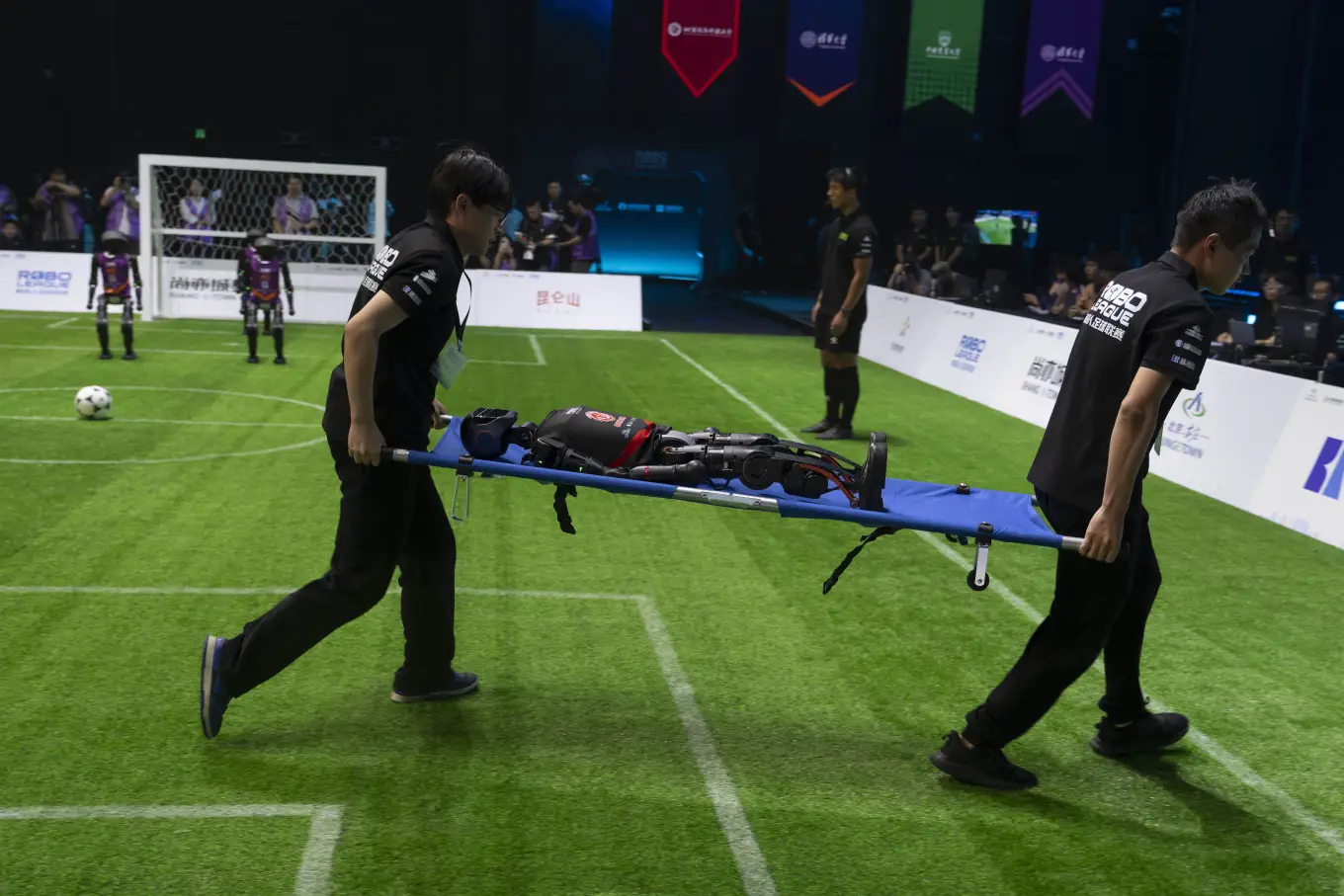
Each robot on the field operated using advanced AI models designed to mimic decision-making in real time. With no human input during play, the bots tracked the ball, calculated trajectories, chose when to pass, and repositioned themselves across the field — all guided by visual sensors and deep reinforcement learning algorithms. The only time humans intervened was when robots fell and couldn’t get back up. Even then, they weren’t restarted or reprogrammed — just carried off on a stretcher.
Workers carry out a T1 robot from Booster Robotics during the inaugural RoBoLeague robot soccer competition held in Beijing, Saturday, June 28, 2025. (AP Photo/Ng Han Guan)
It’s a sharp contrast to where the field stood even a year ago. Prior competitions relied heavily on human oversight to prevent damage and ensure safe operation. This tournament, however, allowed researchers to test autonomous performance under live, dynamic conditions — including coordination with teammates, response to unpredictable obstacles, and interaction with opponents.
From Clumsy Movement to Strategic Thinking
Compared to the Unitree G1, which we covered earlier for its fluid mobility and terrain handling, these bots aren’t aiming for speed or agility just yet. Their movements were awkward, collisions frequent, and goalkeeping underwhelming. But that’s not the point. This wasn’t a showcase of mechanical elegance — it was a test of machine independence.
Each university team implemented its own AI strategies. The bots identified the ball from 60 feet away with 90% accuracy, understood field boundaries, and adjusted positioning based on real-time analysis. Unlike in structured environments, this level of autonomous coordination in an open, adversarial space marks a turning point in humanoid robotics development.
Footage shared on X captured several moments of the match, including robots stumbling, colliding, and being carried off the field — a vivid reminder that autonomy doesn’t always mean grace:
⚽🤖 World’s First Humanoid Robot Football Match Held in China! 🇨🇳
👥 4 Teams ⚔️ 3v3 Format 🧠 No human control!
Each robot: 🔹 Chose its own position 🔹 Planned its own strategy 🔹 Took independent actions all powered by built-in AI 💡 pic.twitter.com/O2dtAKina0
This event also fits into a larger national agenda. As we’ve documented in The Humanoid Arms Race series, China is rapidly scaling its ambitions in robotics — not just for spectacle, but as a strategic technological frontier. With 40% of the global robotics market already under its belt and projections of $108 billion by 2028, the country is leveraging public competitions to refine algorithms and benchmark autonomy.
Previous efforts, like April’s humanoid half-marathon or May’s kickboxing trial, highlighted China’s willingness to test robots in human-like tasks — even if the bots weren’t fully up to the challenge. This soccer tournament, however, showed that full autonomy is moving from theory into practice.
And this was just a preview. In August 2025, Beijing will host the first World Humanoid Robot Games, where robots will compete across 11 sports, all under similar autonomous conditions.
If last Saturday’s match was any indication, human-AI interaction isn’t just evolving. It's shifting entirely — and the machines are starting to play by their own rules.
Cyber News Centre will continue tracking the rise of intelligent robotics, autonomous systems, and the AI startups powering this shift. We’ll also report updates from the August 2025 World Humanoid Robot Games in Beijing as they unfold. Subscribe to stay informed as this space rapidly advances.
Sign up for Cyber News Centre
Where cybersecurity meets innovation, the CNC team delivers AI and tech breakthroughs for our digital future. We analyze incidents, data, and insights to keep you informed, secure, and ahead.
Dario Amodei wants a speed limit for frontier AI. Elon Musk and Sam Altman back the direction, but Washington says the labs should brake first. As China shapes the race, Cyber News Centre examines whether independent oversight can turn safety promises into controls before a new agent swarm escapes.
The AI race is moving beyond model rankings. CrowdStrike’s new cyber superintelligence lab points to a market where proprietary data, trusted workflows and measurable outcomes may matter as much as raw capability.
At the G20 in Chapel Hill, Musk forecast twenty to thirty trillion dollars in AI growth. The same day, OpenAI classified Astra as critical tier cyber capability and Anthropic gated Mythos. Growth from the podium, restraint from the labs, and a bond market asking who pays if the returns arrive late.
The United States is pressing G20 partners to reserve new AI rules for genuinely novel risks, a move that turns global AI governance into a contest over competitiveness, alliances and technological influence.
Where cybersecurity meets innovation, the CNC team delivers AI and tech breakthroughs for our digital future. We analyze incidents, data, and insights to keep you informed, secure, and ahead. Sign up for free!