This week’s tech earnings put Nvidia back under the spotlight, as blockbuster AI-driven results clashed with a skittish market that still sold the stock off—capturing the tension between hard data on acceleration and deep-seated fears of an AI overreach.
Hazeldenes, a major Australian poultry processor, has halted production after a cyberattack, triggering chicken shortages across Victoria and underscoring how digital threats can disrupt the nation’s food supply chain. The incident remains under investigation.
Vienna-based Flinn.ai has secured $20 million in a Series A round led by HV Capital to automate regulatory and quality compliance for medical device and pharmaceutical companies. The funding will fuel its expansion into the US market and extend its AI platform across the entire product lifecycle.
AI Doomsday vs AI Abundance: Why 2026’s Market Panic May Be the Start of a New Super‑Cycle
This week’s tech earnings put Nvidia back under the spotlight, as blockbuster AI-driven results clashed with a skittish market that still sold the stock off—capturing the tension between hard data on acceleration and deep-seated fears of an AI overreach.
What another week it has been in the AI race. Quarter one of 2026 is not even over, yet markets have already lurched from euphoria to existential dread and back again as Wall Street tries to price not just earnings, but the future of work itself.
The viral “AI Doomsday” memo, hand‑wringing remarks from OpenAI’s Sam Altman and Anthropic’s leadership about large‑scale white‑collar displacement, and Jamie Dimon’s warnings from JPMorgan about millions of jobs at risk sit in stark contrast to Nvidia CEO Jensen Huang’s almost missionary case for an era of abundance powered by accelerated computing and agentic AI.
It has been an intense month, and this week may be remembered as the moment the market realised that the AI debate is no longer academic – it is now a live catalyst for real-world price action. Altman, Anthropic’s leadership and Dimon are not Luddites; they are true believers worried about the speed, not the direction, of change.
“I see a couple people doing some dumb things," - Jamie Diamon told investors
Altman has spoken openly about the possibility that advanced AI could “eliminate a lot of current jobs” and that society may need new social contracts to cope with that disruption.
JPMorgan CEO Jamie Dimon, when asked about fierce competition across the financial industry, said he’s starting to see parallels to the era before the 2008 financial crisis, when a rush to make loans ended disastrously.
Anthropic’s team has echoed similar concerns, highlighting scenarios where highly capable models hollow out middle-income roles long before institutions can adjust. Dimon has been equally blunt, telling investors that AI could replace roles “from the front office to the back office” and that tens of millions of jobs globally could be transformed or displaced over time. For policymakers, unions and HR departments, these are not theoretical risks; they are planning assumptions.
Yet this chorus of concern has not fully taken hold in markets because it collides with a different, equally powerful narrative: Huang’s thesis that AI is less a job-destroyer than a force multiplier. Nvidia’s latest quarter, with record data-centre revenue and a blowout outlook, gives him unusual credibility when he argues that we are at “the beginning of true acceleration” rather than the end of a cycle. His message is that agentic AI will not simply automate away tasks; it will create an explosion of new software, virtual employees and digital workflows that make existing tools more valuable, not obsolete. In that framing, AI is not a guillotine hanging over knowledge workers – it is an exoskeleton.
“Markets got it wrong”
Huang was direct. “I think the markets got it wrong,” he said, dismissing concerns that AI agents will “eat” traditional software businesses.
The tension between these visions is precisely what rattled markets when a fictional 2028 “AI crisis” memo went viral and contributed to a sharp sell-off in software and financial stocks. Altman- and Anthropic-style caution gave the memo intellectual cover; Dimon’s comments about job losses gave it macro plausibility.
The market briefly behaved as if the doomsday scenario had already begun: IT services and SaaS names were treated as if they were structurally impaired, and payments stocks were marked down as though consumption were on the brink of collapse. For a few sessions, the dystopian narrative had the upper hand.
This week’s tech earnings once again put Nvidia back under the brightest of spotlights, and yet the market still chose to punish the stock. Nvidia, Salesforce and Snowflake collectively reminded investors that, for now at least, AI remains a revenue story rather than a recession story. Salesforce is already monetising agentic features embedded into its core CRM platform, Snowflake is positioning itself as the data backbone for AI applications, and Nvidia’s guidance suggests the hyperscalers see years of incremental demand for compute ahead.
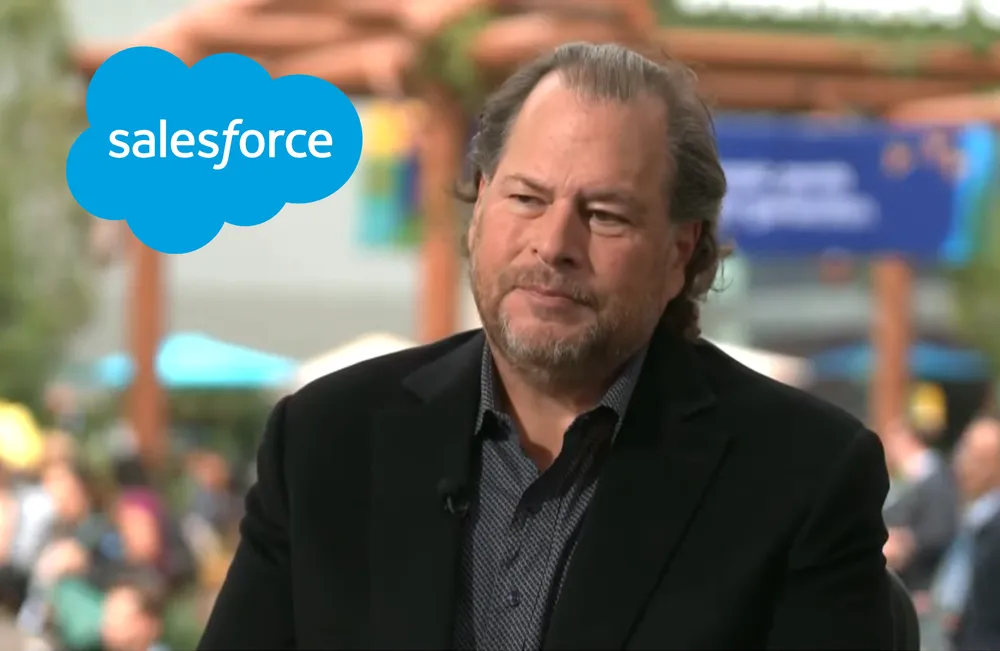
Sales Force CEO, Marc Benioff Source: Bloomberg
The week’s “phenomenal” rebound in parts of the Nasdaq was not merely a technical bounce; it was a repricing of the idea that AI disruption is uneven, sector-specific and, in many cases, accretive to earnings rather than dilutive.
Huang’s media rounds, particularly his extended interview on CNBC, sharpened that reframing for a jittery market. He dismissed the notion that AI is an existential threat to software vendors, arguing instead that AI agents will use tools such as ERP, CAD and collaboration suites at machine speed and scale, amplifying rather than eroding their value. In his telling, a single human analyst supported by hundreds of AI agents will generate more queries, dashboards and workflows than an entire pre-AI department could ever manage. That view does not wish away displacement risk; it insists, more provocatively, that value creation will outpace value destruction if companies and workers move quickly enough to adapt.
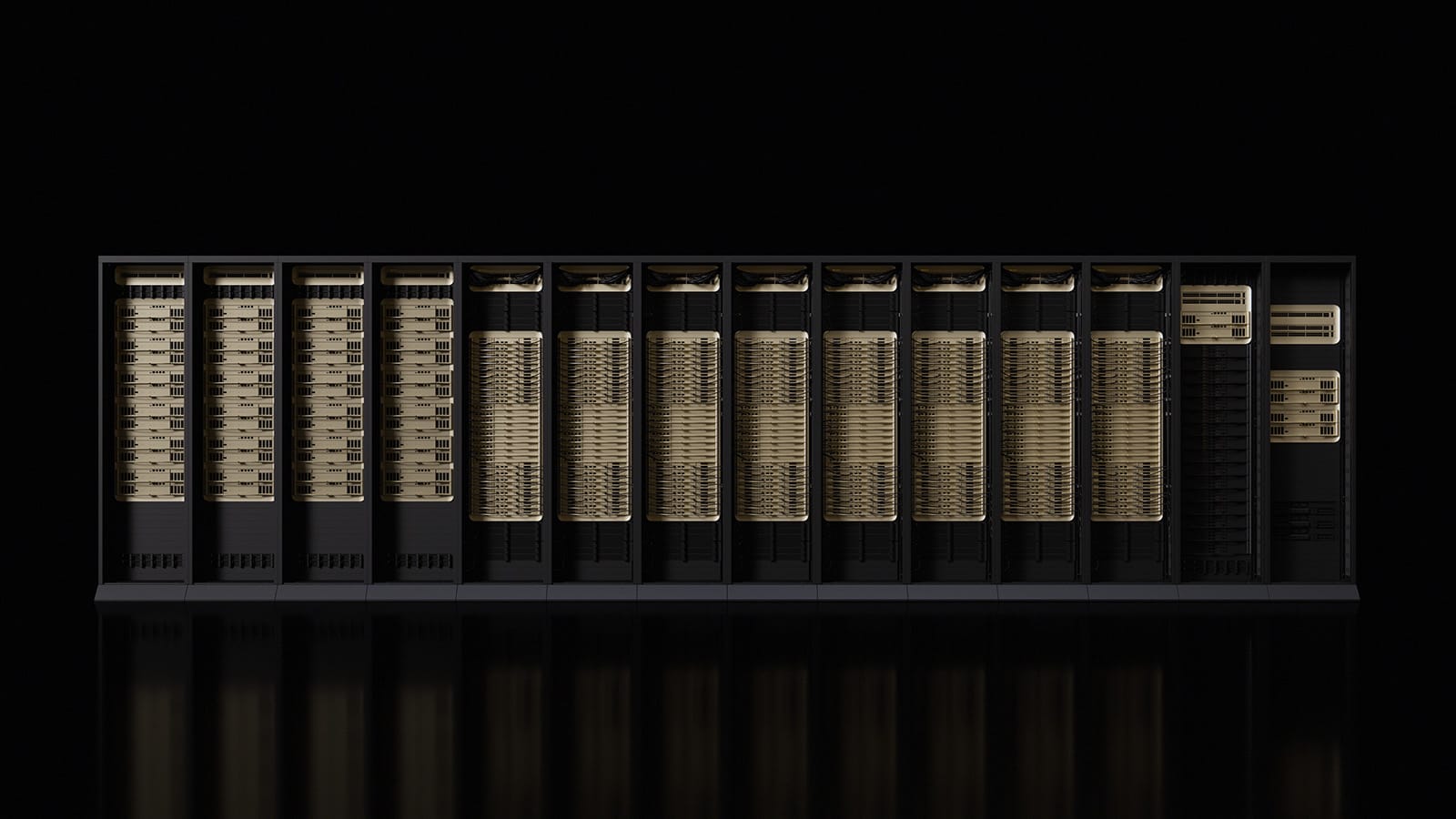
The Rubin platform. Source Nvidia
But for all the praise lavished on Nvidia’s numbers, the market’s reaction was brutal. After a fourth-quarter earnings print that comfortably beat analysts’ expectations, the stock still plunged around 5.5% in a single session. It was the largest one-day percentage decline since mid‑April 2025, wiping well over $200 billion from Nvidia’s market capitalisation and ranking among the biggest one-day value losses ever recorded for a US company. The wider indices followed the mood music: the S&P 500 slipped, and the tech-heavy Nasdaq Composite fell more than 1% as investors again dumped the megacap growth names that have led the AI trade.
Analysts, notably, were reading a very different tape. One prominent broker described Nvidia’s quarter as a “notable beat over expectations” and said there was “no reason to doubt compute demand given the accelerating trajectory of AI progress,” reiterating a positive rating and a punchy upside target.
Another highlighted a roughly three‑quarters surge in data‑centre revenue, far ahead of Wall Street forecasts, and likewise kept an overweight stance with a higher price objective. On the numbers, the message was consistent: demand for AI infrastructure is not rolling over, it is compounding.
The sell‑off, then, probably says more about broader market psychology than about Nvidia’s fundamentals. Investors have spent the opening months of 2026 agonising over how AI could upend software, services and even consumer demand, while simultaneously fretting over the sheer scale of Big Tech’s capital spending on data centres, chips and networks.
Nvidia sits at the fault line of those concerns: it is the prime beneficiary of the AI build‑out, but also the lightning rod for every doubt about over‑investment, bubbles and the sustainability of AI‑driven margins.
This week’s price action captures that contradiction perfectly. The earnings tape and the CEO narrative say acceleration; the share price, at least for now, still reflects a market that is not quite ready to believe its own AI success story.
This is where the philosophical split with Altman, Anthropic and Dimon becomes most interesting. The doomsday camp stresses the gap between technological and institutional adaptation; they fear that labour markets, education systems and safety nets will lag so far behind that a decade of painful dislocation is unavoidable.
Huang’s abundance thesis leans on a different kind of confidence: that accelerated learning – of models, organisations and individuals – can compress that adaptation window. In other words, the same tools that threaten to disrupt jobs can also retrain and redeploy workers faster than any previous technological wave.
This week’s price action captures that contradiction perfectly. The earnings tape and the CEO narrative say acceleration; the share price, at least for now, still reflects a market that is not quite ready to believe its own AI success story.
The AI Diplomat’s task, in this environment, is not to declare a winner between doomsday and abundance, but to recognise that both forces are real and priced, often chaotically, into every earnings print and policy headline. If this is only quarter one, investors should prepare for a year – and a decade – in which the most valuable skill is not forecasting AI itself, but navigating the psychological whiplash it inflicts on Wall Street.
Get the stories that matter to you. Subscribe to Cyber News Centre and update your preferences to follow our Daily 4min Cyber Update, Innovative AI Startups, The AI Diplomat series, or the main Cyber News Centre newsletter — featuring in-depth analysis on major cyber incidents, tech breakthroughs, global policy, and AI developments.
Sign up for Cyber News Centre
Where cybersecurity meets innovation, the CNC team delivers AI and tech breakthroughs for our digital future. We analyze incidents, data, and insights to keep you informed, secure, and ahead.
Hand coded robotics is fading as Figure AI replaces C++ with neural networks running pixels to torque control. Brett Adcock’s bet on Hark reframes humanoids as infrastructure, where robot fleets learn collectively and the real value shifts to the model layer powering physical autonomy.
The AI race in 2026 has shifted from "who has the smartest model" to "who can afford the power and capital to run them at scale." When Google issues century bonds and Musk eyes orbital data centres, the $700 billion question is whether anyone can sustain this pace.
Artificial Labs has raised $45M in Series B funding to expand its AI-driven underwriting platform across global insurance markets. Backed by CommerzVentures, the London insurtech aims to modernise specialty insurance through automation, data intelligence, and scalable digital trading.
Where cybersecurity meets innovation, the CNC team delivers AI and tech breakthroughs for our digital future. We analyze incidents, data, and insights to keep you informed, secure, and ahead. Sign up for free!