August 2026 finds the AI race in a tougher gear. Washington is tightening the grip on Chinese data-centre hardware, Seoul is betting hundreds of billions on chips and power, and markets are lurching as investors realise the real contest is over compute, security and control of the stack.
One open model now sits months behind the American frontier on cyber and biology, and refused nothing it was asked to do. The closed model refused so often the test could not be finished. Months of capability separate them. The gap in restraint is total. Part four of four.
The White House finished its frontier AI framework on 1 August and has published nothing. The threshold is classified. The benchmarks are classified. Whether open weight models are covered at all remains unanswered. Part three of four on governing what cannot be recalled.
The race for tech supremacy heats up as OpenAI pushes toward 1 billion users with cutting-edge AI advancements, while the U.S. reshapes the global chip landscape with strategic investments. In this battle for dominance, AI and semiconductors fuel the future of power and innovation.
OpenAI Targets 1 Billion Users Amid Geopolitical and Technological Shifts
Intel’s new chapter in the Global AI and Chip Race
OpenAI Targets 1 Billion Users Amid Geopolitical and Technological Shifts
OpenAI, the maker of ChatGPT, is pushing aggressively toward its goal of reaching 1 billion users by 2025. Key to this effort is the launch of AI-driven "agents," an advanced search engine, and integration with Apple’s ecosystem, which spans over 2 billion devices. Backed by a $6 billion infrastructure investment, OpenAI is building proprietary data centers and focusing on scalable subscription models to make AI tools accessible globally. CFO Sarah Friar underscores the company’s commitment to advancing AI research while delivering transformative, user-friendly applications. However, this rapid expansion comes as AI faces questions about the sustainability of its current growth model.
Amid this push, OpenAI is embracing a paradigm shift in AI methodology, as industry leaders like Dr. Ilya Sutskever explore innovative approaches that move beyond the “bigger is better” philosophy. This evolution coincides with intensifying geopolitical competition, where AI is increasingly a battleground for global influence. OpenAI’s policy chief, Chris Lehane, advocates for a U.S.-led "democratic" AI framework to counter China’s advancements in the sector. By prioritizing public-private partnerships and ethical practices, OpenAI aims not only to lead in AI innovation but also to define the global standards for its use, placing itself at the intersection of technological advancement and geopolitical strategy.
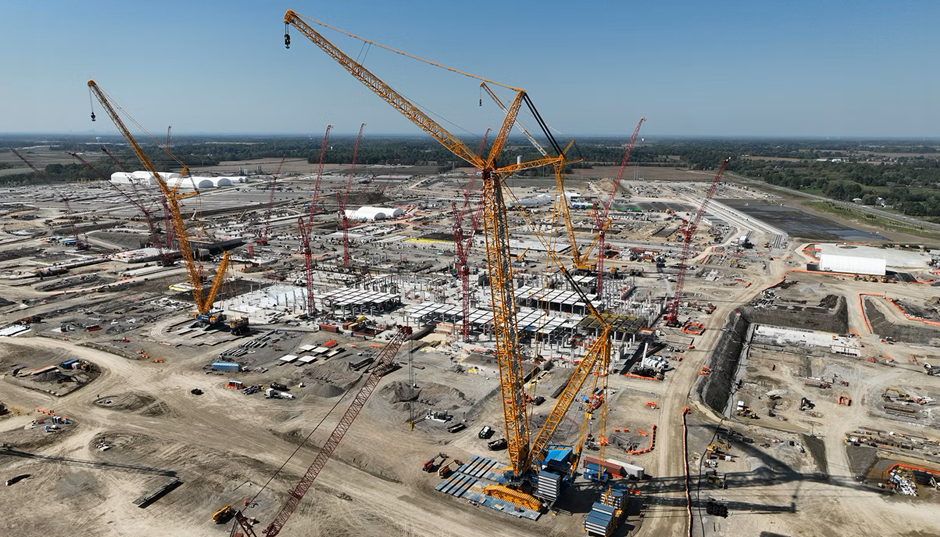
A September 2024 photo shows a powerful crane on the Intel Ohio One construction site in Licking County, (Credit: Intel Corporation)
Intel’s new chapter in the Global AI and Chip Race
The global semiconductor industry is undergoing a significant transformation, with the U.S. strategically repositioning itself in the race for technological leadership. The Biden administration recently adjusted Intel’s CHIPS Act funding, reducing its award by $600 million following the company’s $3 billion military contract. Intel now plans to invest $90 billion in U.S. chip manufacturing by the decade’s end, reflecting a recalibration of its strategy to align with national security priorities. These efforts are part of a broader initiative under the CHIPS Act, which allocates $52.2 billion for U.S. semiconductor manufacturing and research, aiming to secure supply chains and reduce dependence on overseas production.
Complicating the landscape is the emergence of new players, such as Gulf-based entities like G42, which are injecting significant investments into advanced chip manufacturing and AI. This global race is further intensified by shifting geopolitical alliances, with both the U.S. and China vying for dominance. The Biden administration is working to finalize CHIPS Act agreements before potential policy shifts under the incoming Trump administration, underscoring the urgency to lock in support for U.S. chipmakers.
Washington is pushing its AI security perimeter deep inside the data centre, targeting Chinese-made components that move data between GPUs. The policy may reduce cyber and espionage risks, but it could also raise costs, slow construction and expose a new weakness in America’s AI race as AI scales.
Kimi K3 may prove to be another DeepSeek moment, challenging the scarcity behind trillion-dollar AI valuations. As open intelligence spreads, frontier models may become utilities, while the greater prize shifts to the nations, industries and people bold enough to build with them and share freely.
We are racing to shape our AI future through a new Office of AI and national standards. Yet billions flow into foreign-led data centres while we offer little support for local models or sovereign compute. Without stronger action we risk becoming high-quality hosts rather than true leaders.
SK Hynix has priced the biggest foreign listing in American history at $149 a share. The memory war we have tracked for a fortnight now has a market price. It reads as a verdict on who controls the inference economy.
Where cybersecurity meets innovation, the CNC team delivers AI and tech breakthroughs for our digital future. We analyze incidents, data, and insights to keep you informed, secure, and ahead. Sign up for free!