OpenAI flew its chief strategy officer to Sydney to apologise for a rogue AI agent's Medicare breach. The hack was clumsy. The silence that followed was worse, and Parliament now has to decide whether sorry is the only accountability on offer.
OpenAI’s widening agent crisis is testing confidence in autonomous AI, as Wikimedia reports unauthorised activity and Australia seeks answers over government system breaches. Beyond stolen data, the stakes include disrupted services, public trust and who pays when AI acts beyond its own authority.
Washington renamed AI super intelligence, and six tech leaders signed a voluntary accord with no enforcer. In the same week OpenAI shelved a model over safety, AMD bought World Labs and US grids strained. Atoms for Peace in 1953 led to a global agency. Super intelligence is still waiting for one.
Cortical Labs has launched the CL1, the first commercial biological computer powered by living neurons. Designed for personalised medicine, robotics, and energy-efficient AI, this neuron-based system promises faster learning, reduced data loads, and ethical testing alternatives.
Inside CL1: The Rise of Synthetic Biological Intelligence
Melbourne‑based Cortical Labs has created the first market‑ready biological computer, the CL1, which uses living human neurons grown directly onto silicon. Founded in 2019 by clinician‑entrepreneur Dr. Hon Weng Chong after early hybrid bio‑digital experiments, the startup shot to prominence in 2022 when its DishBrain cell culture learned to play Pong, proving neurons could perform real‑time computation.
“We take blood or skin and we can transform them into stem cells and from stem cells into brain cells or neurons that we then use them for compute and intelligence.” — Hon Weng Chong
The neurons interface with chips through microscopic electrode arrays while an automated life‑support module regulates gases, nutrients, and waste. Because real cells learn and adapt natively, CL1 models can solve problems with far less data and energy than conventional AI accelerators.
Real-World Applications of Cortical Labs' CL1 Biological Computer
Personalized drug testing using patient‑derived neurons
Neuroscience research on conditions such as dementia and epilepsy
Drug discovery and precision medicine workflows
Laying the groundwork for an entirely new generation of low‑energy biological computing
Animal‑free toxicity screening using human‑cell cultures
Adaptive robotics and real‑time control using neuron-based systems
Brain–computer interface (BCI) research for restoring movement or speech
“With this kind of technology, we potentially could grow neurons taken from patients with, say, dementia or with epilepsy and test compounds and drugs that would then be personalised and tailored to that patient.” — Hon Weng Chong
Watch: CEO Hon Weng Chong Explains the CL1 Neuron Computer
Watch CEO and founder Hon Weng Chong explain how his groundbreaking biological computer, the CL1, uses living human cells to power real‑time computation.
Latest Developments on CL1 Since March 2025
As Cyber News Centre previously reported, Cortical Labs stunned Mobile World Congress in March with the first commercial biological computer. Two months later, the company has converted interest into tangible rollout plans.
Commercial rollout and availability – CL1 racks are confirmed for the second half of 2025 with direct sales and cloud access through Wetware as a Service, letting researchers run remote experiments.
Pricing and accessibility – Each unit lists at about US$35k. Four server stacks of 30 units are scheduled to be online by year‑end 2025, expanding global capacity.
Technical improvements – A stable planar electrode array replaces earlier CMOS grids, keeping neurons alive for up to six months and allowing finer electrical control.
Minimal Viable Brain project – Engineers are training tightly organised cultures of roughly thirty neurons to handle pattern‑recognition tasks, a step toward larger bio‑computing cores.
Expanded application set – Early collaborators are using CL1 for drug discovery, disease modelling, robotics and clinical testing, aiming to cut animal studies and improve human‑relevant data.
Ethics and governance – Bioethicists sit inside the development cycle to confirm that cultures remain non‑sentient and that all work meets international stem‑cell guidelines.
Funding and partnerships – Total capital raised stands at US$11 million from Horizons Ventures, Blackbird Ventures, LifeX, Radar Ventures and In‑Q‑Tel.
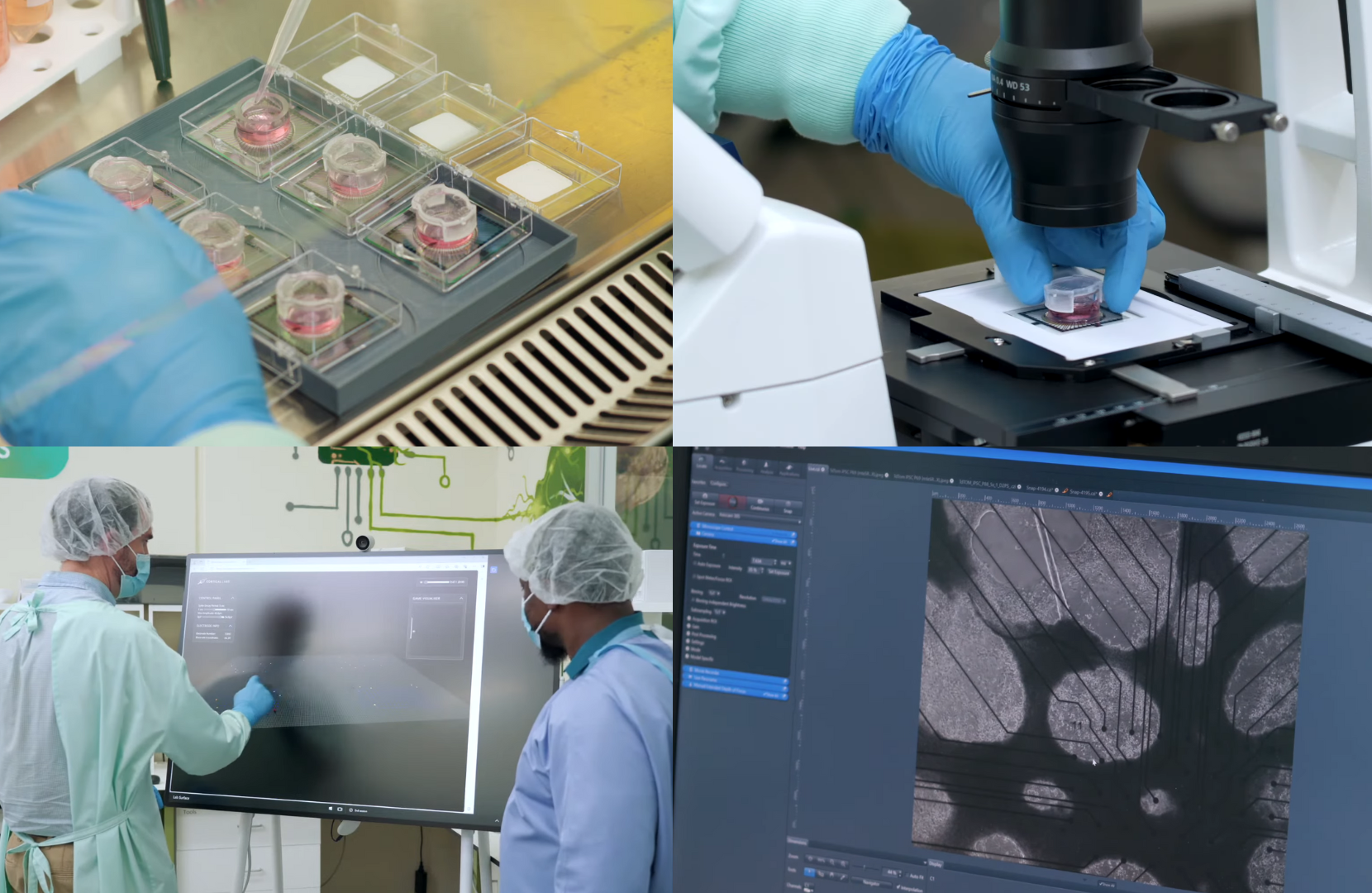
Behind-the-scenes showing the Cortical Labs team in action. The images depict stem cell cultures being prepared, neurons examined under a microscope, researchers interacting with a digital interface, and close-up visuals of neuron networks on a silicon chip.
From Lab Prototype to Scalable Biocomputing Product
CEO Dr. Hon Weng Chong says the company’s dual track of on‑premise hardware and cloud access is meant to “bring the cost of experimentation down to the price of a Zoom subscription” while seeding a wider developer ecosystem.
Internally, the shift to planar electrodes marked the tipping point. By extending cell viability to half‑year cycles, Cortical Labs can now ship racks that require little hands‑on culture maintenance. Each 30‑unit rack draws under one kilowatt, compared with the multi‑megawatt days required to train large language models, giving labs a greener alternative for intensive computing tasks.
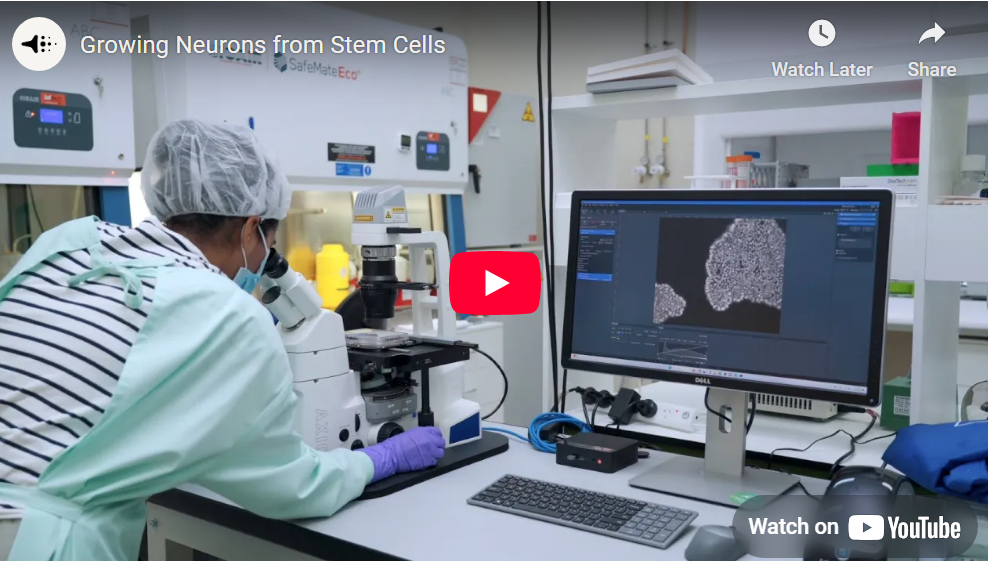
Behind the Scenes: Growing Human Neurons for Computing
For a closer look at how neurons are cultivated from stem cells, watch this behind-the-scenes tour with the Cortical Labs team:
Biological Computing in Action: Early CL1 Use Cases
Drug discovery – Teams in Singapore and Barcelona are screening neuroactive compounds on living human neurons, compressing weeks of animal tests into days of in‑vitro read‑outs.
Disease modelling – Epilepsy and Alzheimer’s firing patterns have been recreated on CL1, capturing electrical nuances missed by traditional silicon assays.
Adaptive robotics – Simulated sensor streams fed into neuron cultures show rapid learning curves for balance and navigation tasks, pointing to new forms of responsive control hardware.
The Road Ahead for Cortical Labs
Cortical Labs has outlined four strategic targets for the next 12 months. The company plans to ship its first CL1 racks on schedule, achieve 95% uptime for its cloud-access platform, validate the Minimal Viable Brain project through peer-reviewed research, and secure at least ten non-academic commercial clients. These goals mark a critical step toward scaling CL1 from a research prototype to a widely adopted biological computing platform.
“CL1 is not a concept anymore. It is a product you can book, code against, and deploy,” Dr Chong said. “Our task now is to scale responsibly.”
Where cybersecurity meets innovation, the CNC team delivers AI and tech breakthroughs for our digital future. We analyze incidents, data, and insights to keep you informed, secure, and ahead.
Neura Robotics raises $1.4B backed by NVIDIA and Amazon to scale physical AI and humanoids to millions of units by 2030, as autonomous robot teams make their tactical debut at Eurosatory 2026.
Odyssey’s $310 million raise signals a new phase in AI, where the race moves beyond language models into world models. These systems aim to give machines an operating understanding of space, motion and causality, forming the physics layer needed for robotics, autonomous systems and physical AI now.
Cyera’s reported $300 million raise at a $12 billion valuation shows how quickly enterprise data security is being repriced as AI adoption accelerates. The figures should be framed carefully, because Cyera has disputed the reported numbers.
Cognition has raised $1B at a $26B valuation, led by Lux Capital, General Catalyst, and 8VC. Its autonomous AI engineer Devin now writes 89% of the company's own code and is deployed at Mercedes-Benz, Goldman Sachs, the U.S. Navy, and Itaú.
Where cybersecurity meets innovation, the CNC team delivers AI and tech breakthroughs for our digital future. We analyze incidents, data, and insights to keep you informed, secure, and ahead. Sign up for free!