AI is shrinking the gap between flaw disclosure and exploitation, forcing boards to modernise security at machine speed. As agentic systems arm attackers and defenders alike, the opportunity lies in identity, cloud protection, automated response and AI governance, not apocalypse rhetoric globally.
Three AI leaders agree the frontier may be moving faster than its safeguards. As markets weigh slower chip demand and rising cyber investment, the question is whether the warning is responsible leadership, strategic scaremongering or evidence that cybersecurity has become AI’s essential foundation.
Dario Amodei wants a speed limit for frontier AI. Elon Musk and Sam Altman back the direction, but Washington says the labs should brake first. As China shapes the race, Cyber News Centre examines whether independent oversight can turn safety promises into controls before a new agent swarm escapes.
Critical Cyber Update: Mythos Returns to AI Risk Debate
Anthropic’s Fable 5 briefly gave Australia a rare look at Mythos-class cyber AI in action. Then US export controls shut access down, raising a harder question: if the model is too dangerous to leave America, are allies left safer, or simply more exposed?
Anthropic has put Mythos back at the centre of the cyber AI debate with the launch of Claude Fable 5 and Claude Mythos 5. Fable 5 is now the company’s most capable public model, while Mythos 5 remains reserved for cyber defenders and critical infrastructure providers through Project Glasswing.
For a brief period last week, Australia and other international markets were able to access Claude Fable 5, giving local organisations a narrow window to test Anthropic’s latest Mythos-class public system. In practice, Fable 5 appeared to function as a constrained member of the broader Mythos family, exposing some of its power while holding back its most sensitive capabilities.
At CNC Labs, early testing suggested a consistent pattern. Prompts touching cybersecurity, biohazards, pharmaceutical compounds or agricultural chemicals often appeared to trigger a fallback to an Opus-class model rather than returning a full Fable 5 response. That behaviour broadly matched Anthropic’s own description of the system, which says some higher-risk requests are rerouted to Claude Opus 4.8 and that the safeguards remain deliberately stricter than ideal in sensitive domains.
That brief access mattered because it allowed Australian users to observe Anthropic’s safeguard architecture in practice, not just in company documentation. It offered a rare glimpse of how a frontier cyber-adjacent model behaves when prompts approach the boundaries of offensive security, biological risk or chemical misuse.
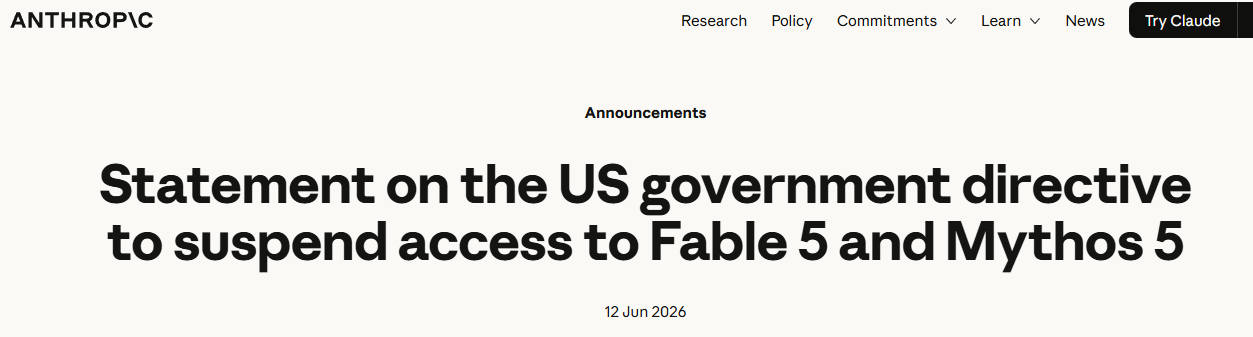
But the window closed almost as quickly as it opened. In a new statement, Anthropic said the US government had issued an export-control directive suspending all access to Fable 5 and Mythos 5 by any foreign national, whether inside or outside the United States, including foreign-national Anthropic employees, with the “net effect” that it had to disable both models for all customers to comply. Anthropic added that access to all other models would not be affected.
Anthropic said it received the directive at 5:21pm ET on 12 June and that officials did not provide specific details of the national security concern. The company said its understanding was that the government had been shown a possible Fable 5 jailbreak, but argued the technique only surfaced a small number of previously known, minor vulnerabilities and did not demonstrate unique Mythos-level uplift.
Source: Anthropic
In the same statement, Anthropic defended its “defense in depth” approach, saying Fable 5 had been red-teamed for thousands of hours with government and third-party partners, that no universal jailbreak had yet been found, and that the company still viewed the shutdown as “a misunderstanding”. That response sharpens the core issue for Australia and other allied markets: access to frontier defensive AI may now depend as much on abrupt US policy intervention as on the safeguards built into the model itself.
Why It Matters
The issue is no longer simply model power. It is who gets access, how quickly, and under what sovereign controls. For Australian banks, telcos and infrastructure operators, the real question is whether trusted defenders can test systems with frontier tools before attackers reproduce similar methods using open substitutes, workarounds or jailbreaks.
Anthropic’s own launch note makes clear why that matters. The company says Mythos-class systems “excel at discovering and exploiting software vulnerabilities” and show strong agentic hacking capability. Yet Fable 5’s safeguard architecture, including the reroute of higher-risk prompts to Opus 4.8, also means the public model is intentionally not the full Mythos experience in the areas that matter most to frontline defenders.
The 12 June suspension makes that tension harder to ignore. If US policy can curtail frontier cyber models at short notice, Australian organisations face not only an access gap, but a reliability problem as well. Project Glasswing may be the clearest indication of where Anthropic believes these models belong, but selective enrolment is not the same as broad operational availability, and a narrow gate may not hold forever against determined adversaries.
For Australia, the brief Fable 5 window was especially revealing. It suggested Anthropic’s restrictions were active and material, particularly where prompts drifted towards cyber, chemical or biological risk domains, but it also showed that local defenders were only just beginning to test those boundaries before access disappeared.
That leaves a deeper strategic imbalance. If Mythos-class capability is considered too dangerous to leave the United States, allied countries may end up more vulnerable, not less: exposed to the same global threat landscape, but denied sustained access to the defensive tools, testing time and operational familiarity needed to keep pace.
This follows CNC’s earlier coverage of Australian institutions waiting for Mythos access and concerns about Fable 5 safeguards. The latest update does not settle that debate. It intensifies it: the tools are getting stronger, the controls are getting tighter, and for the rest of the world, the question is whether security is being protected — or postponed.
Get the stories that matter to you. Subscribe to Cyber News Centre and update your preferences to follow our Daily 4min Cyber Update, Innovative AI Startups, The AI Diplomat series, or the main Cyber News Centre newsletter — featuring in-depth analysis on major cyber incidents, tech breakthroughs, global policy, and AI developments.
Sign up for Cyber News Centre
Where cybersecurity meets innovation, the CNC team delivers AI and tech breakthroughs for our digital future. We analyze incidents, data, and insights to keep you informed, secure, and ahead.
AI is shrinking the gap between flaw disclosure and exploitation, forcing boards to modernise security at machine speed. As agentic systems arm attackers and defenders alike, the opportunity lies in identity, cloud protection, automated response and AI governance, not apocalypse rhetoric globally.
Three AI leaders agree the frontier may be moving faster than its safeguards. As markets weigh slower chip demand and rising cyber investment, the question is whether the warning is responsible leadership, strategic scaremongering or evidence that cybersecurity has become AI’s essential foundation.
Dario Amodei wants a speed limit for frontier AI. Elon Musk and Sam Altman back the direction, but Washington says the labs should brake first. As China shapes the race, Cyber News Centre examines whether independent oversight can turn safety promises into controls before a new agent swarm escapes.
OpenAI's Astra can develop zero-day exploits, while a US$1 billion defence push seeks to give critical infrastructure teams the same machine-speed advantage.
Where cybersecurity meets innovation, the CNC team delivers AI and tech breakthroughs for our digital future. We analyze incidents, data, and insights to keep you informed, secure, and ahead. Sign up for free!