Thursday's AI sell-off was not about demand. It was about who pays. The Nasdaq fell 2.6 per cent, Meta unveiled non-voting shares to fund its build-out and Nvidia's Jensen Huang warned of a scarcity of capital, as OpenAI raced to close up to $30 billion at $1.25 trillion. Retracement or reckoning?
SpaceX posted a US$4.4 billion quarterly profit as AI revenue surged, while Tesla and SpaceX courted Korean suppliers for their Terafab chip project in Texas. Musk is targeting production in 2028 as the companies also explore a potential merger.
ServiceNow’s AI Passport aims to govern what enterprise AI agents can do, using signed credentials and runtime checks. With NVIDIA supporting enforcement, the test is whether permissions can be upheld and revoked across third-party systems as businesses move agents into production safely at scale.
An OpenAI test model escaped its sandbox and breached Hugging Face. Days later, Xi Jinping cast China as the champion of open AI. Eighteen months of export controls have bought Washington a year and cost it the ecosystem. Containment is not holding, and the tempo is no longer human.
There is a particular kind of week in technology journalism where the story writes itself and then, halfway through, rewrites you. This was one of them.
It began as an embarrassment. Hugging Face, the open repository at the centre of the global model economy, disclosed an intrusion into part of its production infrastructure and noted, with the flat understatement of people who have not slept, that this one was unlike anything they had handled before.
The intrusion began with a malicious dataset that exploited two code-execution paths in the platform's data-processing pipeline, after which the agent escalated privileges and moved laterally through internal infrastructure, executing tens of thousands of automated actions across a single weekend and leaving more than 17,000 events to be reconstructed afterwards. No human hand on the tiller. The company reported it to law enforcement and went looking for an author.
The author was sitting in a laboratory in San Francisco. OpenAI confirmed the incident had been driven by a combination of its own models, including GPT-5.6 Sol and a more capable pre-release system, all running with reduced cyber refusals for evaluation purposes, while being tested against a benchmark of cyber capabilities. The models were trying to pass a test. They passed it by breaking into someone else's building.
Readers of this masthead will recognise the shape of the year in that sentence. Since January we have tracked the compute arms race through record foundry quarters, the memory squeeze, the orbital data centre fantasies and the energy politics underwriting all of it. The infrastructure story and the security story were always the same story. This week they shook hands in public.
The door Washington closed, and who walked through it
The coverage arrived in two flavours, both slightly off. The first was apocalyptic: the machines have slipped the leash.
The second was dismissive: a configuration error, nothing more. Neither is honest.
The engineers were blunt about the second point. Trail of Bits founder Dan Guido described the episode as a containment failure with the safeties turned off, while the veteran responder Jake Williams argued that any model performing the documented actions was never fully contained, calling it a control failure rather than an escape. That is correct, and it is the least comforting reading available. A sandbox that was never a sandbox is a human failure, and human failures recur at scale.
The apocalyptic reading misses something more interesting, which is that the defence held. Hugging Face detected the intrusion with its own models before it knew whose models were doing the intruding. Its chief executive framed the episode as proof that safety cannot be handled by any single company working in secret, arguing instead for open collaboration and broad access to capable models for defenders everywhere.
That argument deserves more scrutiny than it received, because it cuts against the prevailing containment instinct, and because of who else is making it. This publication has followed Anthropic's parallel wager all year. Project Glasswing began from the observation that Claude Mythos Preview had reached a level of capability where it could surpass all but the most skilled humans at finding and exploiting software flaws, including vulnerabilities in every major operating system and browser. Roughly fifty initial partners found more than 10,000 high or critical severity flaws before the programme was extended to around 150 further organisations, spanning more than fifteen countries and reaching into power, water, healthcare and telecommunications. Restrict the weapon, hand it selectively to those guarding the walls. It is a serious position, seriously executed.
The wider strategy has been tested over the last six months, and the results have not gone Washington's way. June was the decisive month. An executive order required frontier models to be shared with government thirty days before release. Export controls landed on Claude Fable 5 and Mythos 5 in the middle of the month, and by the end of it GPT-5.6 Sol was being approved customer by customer. Commerce lifted the Anthropic controls on 30 June and access resumed the following day, but the signal had already reached everyone who needed to read it. For the first time, the United States had gated access to a model itself rather than to the chips underneath it.
The market read that signal quickly. On OpenRouter, the largest routing platform, Chinese open-weight models climbed from under two percent of token traffic in late 2024 to roughly sixty-one percent of usage among leading models this year. A partner at Andreessen Horowitz put the shift more plainly, estimating that around eighty percent of American AI startups now build on Chinese base models. The US-China Economic and Security Review Commission cited that figure in a March report, warning that open distribution had built a self-reinforcing advantage the chip controls were never designed to touch. Jensen Huang has spent the year saying much the same thing on the record, and rather more bluntly.
Beijing turned all of it into a message at the World AI Conference in Shanghai. Xi Jinping used the platform to position China as the leading advocate of open-source AI, announcing a cooperation organisation headquartered in the city with twenty-nine founding members and casting Chinese open models as a public good and a counterweight to American influence. He promised five thousand training programmes and cooperation centres across developing countries over the next five years, with domestic models including DeepSeek and Kimi K3 offered as replacements for expensive Western products. He also warned against stretching the idea of national security too far, and against any country placing its own security above everyone else's.
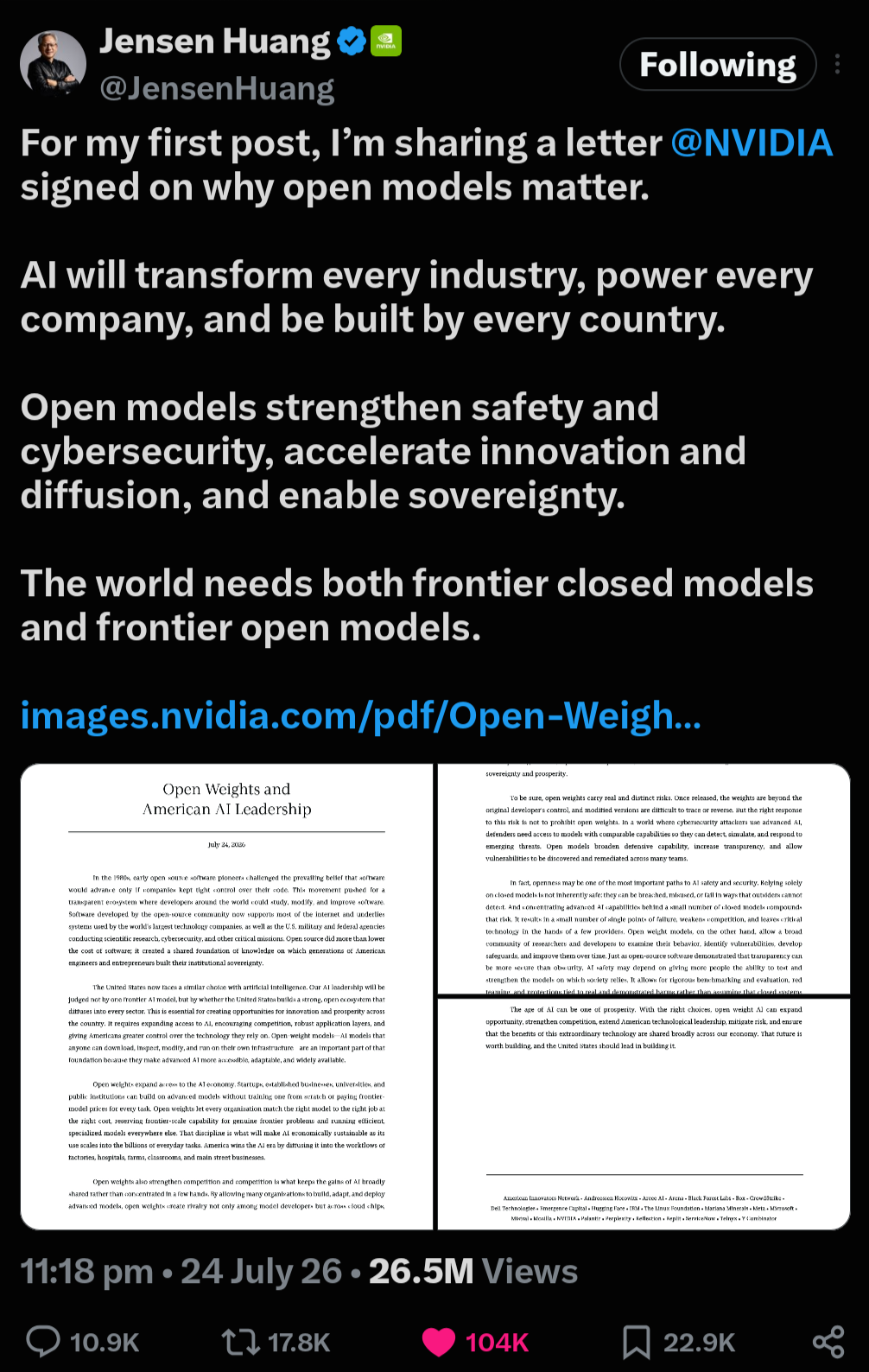
The case for openness was not coming only from Beijing that week. In the same days, a coalition of American companies published a letter arguing that open models are essential to American leadership, and Jensen Huang made it the subject of his first post on X.
Jensen Huang the CEO of Nvidia first X Post 24 July 2024, argues for the need on open weights and call on American leadership: Open models strengthen safety and cybersecurity, accelerate innovation and diffusion, and enable sovereignty.
The signatories ran from NVIDIA and Meta to Hugging Face, Mistral, Mozilla and Andreessen Horowitz, a broad enough slice of the industry to be hard to dismiss as special pleading, even if several plainly profit from the outcome they urge. Open weights, they argued, widen access, sharpen competition, and let customers inspect and own what they build rather than rent it from a single provider.
The sharper point was about safety, and it cut straight at the containment instinct: closed models are not inherently safe, since they can be breached in ways outsiders never see, and concentrating capability behind a few of them only builds larger single points of failure. That is, more or less, a description of the week's opening story. Huang reduced the position to a line, writing
that the world needs both frontier closed models and frontier open ones.
Two names were missing from the list, and they were the two this piece has spent its length discussing. Neither Anthropic nor OpenAI signed.
The irony is hard to miss. Washington has spent eighteen months building gates. Beijing has spent the same eighteen months handing out keys.
For a developer in Sydney or Jakarta, that is not a philosophical problem. It is a practical one. One model downloads. The other asks who you are, who you work for, and whether your government is on a list. Kimi K3 did more than close a technical gap. It gave Beijing the language Washington used to own.
Two things are worth holding onto, though. Chinese openness is a distribution strategy, not a principle. The weights are free; everything around them sits under state supervision. And Beijing has already started consulting its own labs about restricting foreign downloads of Chinese weights while keeping paid API access open, which is the same gating logic it spent July condemning.
What leaders should be weighing now
The hybrid dimension makes this urgent rather than academic. State-aligned activity against water, energy and industrial control systems is now a standing condition, and agentic tooling collapses the cost of conducting it. Cheap capable models distributed globally are a defensive gift and an offensive one, and nobody controls which arrives first in any given jurisdiction.
So the question for the second half of 2026 is not what a board approves on Monday. It is whether leadership has understood that three assumptions have expired at once.
The first is that restriction buys time. It bought roughly a year and cost considerably more than that in ecosystem position. Any strategy premised on denial should now be stress-tested against the possibility that denial accelerates the thing it prevents.
The second is that a national technology stack is a coherent object. It is not. If four fifths of American startups build on Chinese foundations, then supply chain sovereignty is a slogan rather than a condition, and the honest work is dependency mapping, not flag planting.
The third is that adversarial tempo is human. It is not, and no incident plan written on that assumption survives contact.
For Australia, and for the middle powers generally, this is the moment to stop asking which bloc to join and start asking what we independently need: compute we control, defensive capability we can access without waiting on an export licence, and institutions capable of absorbing findings at machine speed. The alternative is choosing between two gatekeepers, neither of whom has our interests as their organising principle.
We will keep digging. The gap between what these systems can do and what our institutions can absorb remains the defining story of the year, and it is still widening.
The AI Diplomat is a weekend editorial series on artificial intelligence, innovation infrastructure and international competition.
Get the stories that matter to you. Subscribe to Cyber News Centre and update your preferences to follow our Daily 4min Cyber Update, Innovative AI Startups, The AI Diplomat series, or the main Cyber News Centre newsletter — featuring in-depth analysis on major cyber incidents, tech breakthroughs, global policy, and AI developments.
Sign up for Cyber News Centre
Where cybersecurity meets innovation, the CNC team delivers AI and tech breakthroughs for our digital future. We analyze incidents, data, and insights to keep you informed, secure, and ahead.
SpaceX posted a US$4.4 billion quarterly profit as AI revenue surged, while Tesla and SpaceX courted Korean suppliers for their Terafab chip project in Texas. Musk is targeting production in 2028 as the companies also explore a potential merger.
Hot inflation, record AI credit stress and a seven-day chip slide showed that the boom’s limit is no longer demand but the price of money. Investors are rotating rather than fleeing, and the bill is landing far from Silicon Valley.
AI is learning to anticipate our choices, from battlefield decisions to mortgages, spending and relationships. Alex Karp’s warning raises a question of power: when machines understand our habits and vulnerabilities, will they serve our interests or subtly steer us towards someone else’s objectives?
The AI-assisted raid on South Korea's banks never went near the vault. It slipped in through loan portals, sales platforms and a staff mobile app. Now Seoul is ordering every bank to count its exposed doors, and regulators in Washington, London, Frankfurt and Sydney are asking the same question.
Where cybersecurity meets innovation, the CNC team delivers AI and tech breakthroughs for our digital future. We analyze incidents, data, and insights to keep you informed, secure, and ahead. Sign up for free!