Nvidia's board reinstated Jensen Huang on 23 November after the White House intervened, and the shares had their best day since 2003. Two sessions later much of the gain had gone, and next week Huang faces Congress. The comeback the AI race wanted has met its questions.
Microsoft says a flaw in its Entra Connect Health service gave unauthorised, read-only access to tenant data, including administrator and technical contact emails. It says no passwords or tokens were exposed and the fix is server-side, but the details could help attackers aim phishing at admins.
Washington now requires licences for advanced AI chips bound for Indonesia, Malaysia, Singapore, Thailand and Brazil, and for data centres renting large-scale compute to Chinese firms. The contest has moved from chip to server hall, and for the Global South, hosting the future now needs permission.
Huang's comeback rally fades as Congress lines up its questions
Nvidia's board reinstated Jensen Huang on 23 November after the White House intervened, and the shares had their best day since 2003. Two sessions later much of the gain had gone, and next week Huang faces Congress. The comeback the AI race wanted has met its questions.
Jensen Huang is back running Nvidia, but the euphoria that greeted his return has already cooled. Nvidia's board reinstated its co-founder as president, chief executive and director on 23 November (US time), eleven days after he resigned over affairs, one of them with a woman US intelligence suspects of spying for Beijing. By Wednesday's close the shares had given back a large part of their record surge, and the questions that forced him out are heading to Capitol Hill.
How he got back
The board's vote was unanimous. Its filing said input from senior levels of the US Government left it confident Huang posed no national security risk. President Trump enlisted Vice President JD Vance to appeal to directors in person, and that the decision was taken on a Sunday afternoon without consulting Nvidia's senior management. Trump then told CNBC he had made the deal and that Huang had done nothing wrong.
"I take this responsibility with the greatest humility and renewed commitment." - Jensen Huang, President and CEO, NVIDIA
The rally, then the reckoning
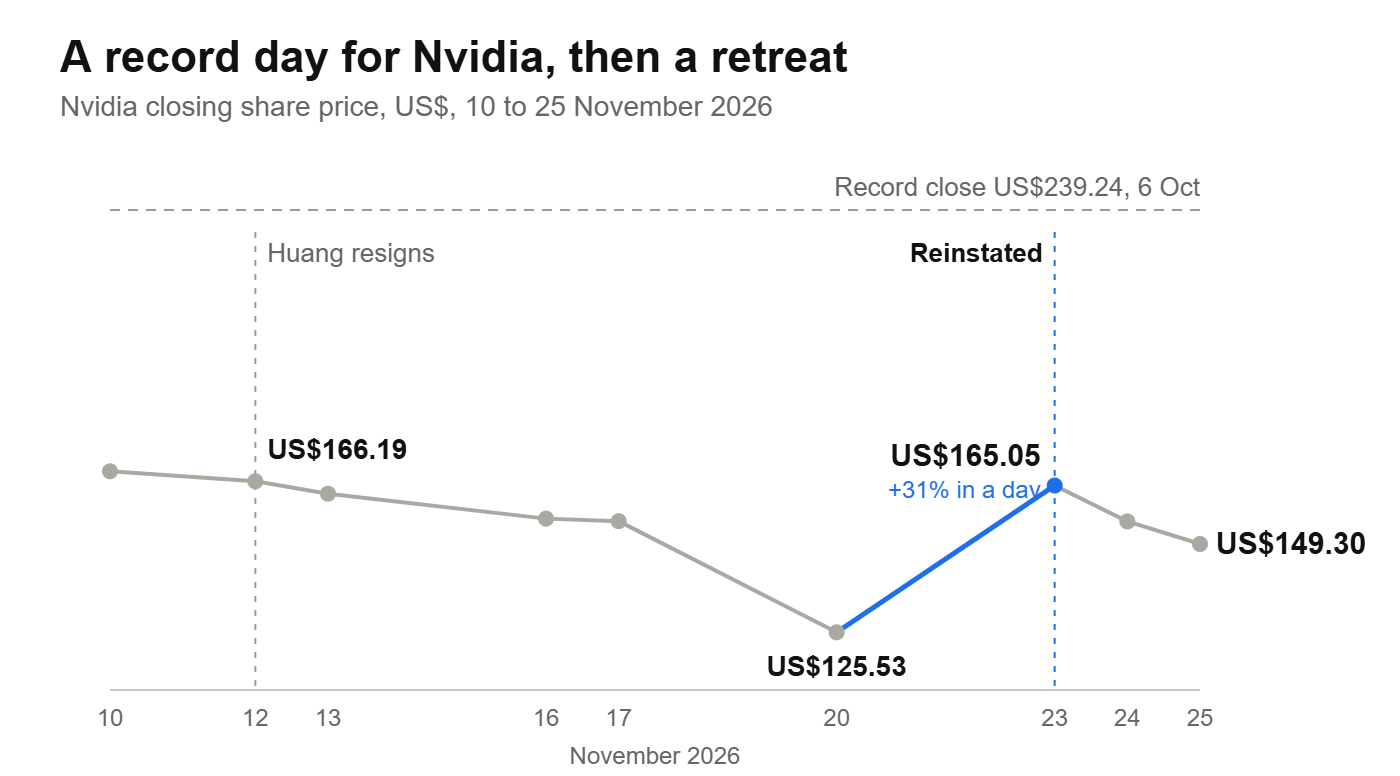
Monday's 31 per cent jump was Nvidia's best session since 2003 and added about US$950 billion in value, most of the US$1.16 trillion the Financial Times calculated was lost while Huang was away. It did not hold. The stock fell almost 6 per cent on Tuesday and a further 3.9 per cent on Wednesday to close at US$149.30, as new tariff announcements, hot economic data and fresh doubts about AI spending weighed on the sector. It still sits about 19 per cent above its last close before the reinstatement. US markets are closed on Thursday for Thanksgiving.
Nvidia's closing share price, 10 to 25 November 2026.
The mood inside the company has shifted too. Three floors of staff cheered Huang back into Santa Clara on Monday; by Tuesday, he struck a sombre tone at an employee meeting and acknowledged the toll of his actions.
Why does it matter?
Huang now answers to Washington as well as his board. He faces a closed-door interview with three House committees early next week and is the sole witness at a Senate Banking Committee hearing on 3 December, the same day Nvidia unveils new products at GTC. The chairs of the House committees have said the board's brief internal review does not erase the national security questions, and Democrats, who take control of Congress in January, have vowed to investigate. House Minority Leader Hakeem Jeffries called the reinstatement indefensible.
For the AI race, the comeback restores the one figure whose relationships run through Washington, Taipei and every major cloud buyer. Whether it restores confidence in Nvidia's governance will be decided next week, in hearing rooms rather than on trading screens.
Sign up for Cyber News Centre
Where cybersecurity meets innovation, the CNC team delivers AI and tech breakthroughs for our digital future. We analyze incidents, data, and insights to keep you informed, secure, and ahead.
Washington now requires licences for advanced AI chips bound for Indonesia, Malaysia, Singapore, Thailand and Brazil, and for data centres renting large-scale compute to Chinese firms. The contest has moved from chip to server hall, and for the Global South, hosting the future now needs permission.
Jensen Huang’s departure puts Nvidia’s leadership and the sovereign AI ambitions of its customers under scrutiny. As governments build on its chips, the question is whether they understood the risk of relying so heavily on one company, and the founder whose judgement has shaped its future.
Nvidia’s dependence on Jensen Huang is becoming a test of governance, trust and market value. As its board investigates a possible foreign intelligence effort, investors face a harder question: can the company powering the AI surge be separated from the man who built it — and at what cost?
IBM survived Washington and still lost the layer that mattered. Wall Street now fears the same fate for AI: the Nasdaq in correction, Seoul halting trades, CoreWeave’s default insurance at a record. Congress may not stop the race. Whoever controls the power, chips and credit may decide it instead.
Where cybersecurity meets innovation, the CNC team delivers AI and tech breakthroughs for our digital future. We analyze incidents, data, and insights to keep you informed, secure, and ahead. Sign up for free!