Jensen Huang's GTC 2026 reframed the AI race entirely: agentic AI, physical intelligence, orbital data centres and self-driving platforms have replaced benchmark wars. On the All-In podcast he tackled AI's PR crisis head-on. NVIDIA is building the infrastructure backbone of the next global economy.
Stryker is rebuilding after a cyberattack that wiped about 80,000 devices via a compromised Intune admin account, with up to 50TB of data reportedly exfiltrated. As US systems face similar probes, Australia is exposed, increasing pressure on boards to tighten cyber controls and readiness.
Amsterdam-based Wonderful has raised $150M in a Series B round led by Insight Partners, valuing the enterprise AI agent platform at $2B. The funding will scale its hyper-local deployment model, which embeds teams with clients to accelerate AI adoption in complex industries across 30+ countries.
Jensen Huang's Big Reframe: The AI Race Just Changed Its Rules
Jensen Huang's GTC 2026 reframed the AI race entirely: agentic AI, physical intelligence, orbital data centres and self-driving platforms have replaced benchmark wars. On the All-In podcast he tackled AI's PR crisis head-on. NVIDIA is building the infrastructure backbone of the next global economy.
The biggest AI yarn this week had one man at the centre: Jensen Huang.
At NVIDIA's GTC 2026 in San Jose, the world's most closely watched chip executive used his stage to reframe the entire AI race — away from model sizes, benchmark wars and hype cycles, and squarely onto agentic AI, physical AI, and the kind of infrastructure scale that makes data centres look small.
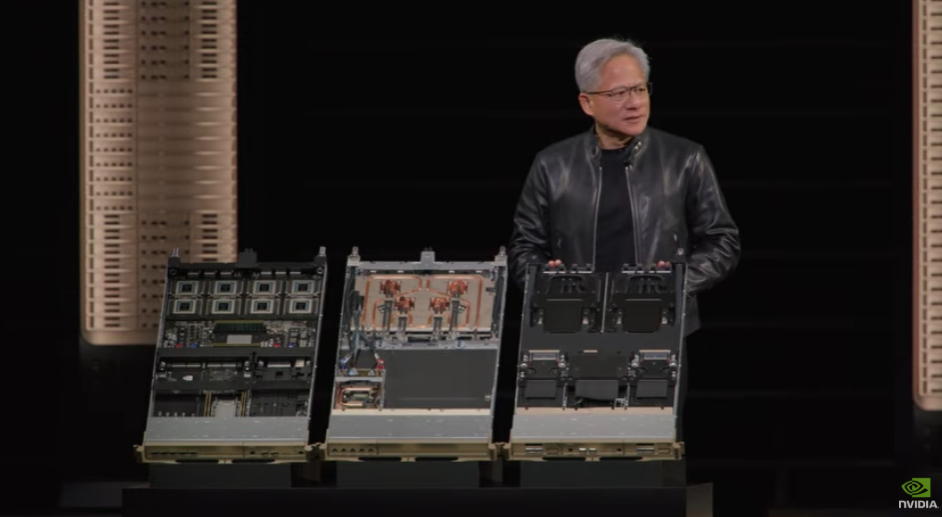
Huang took the stage to unveil what he called the dawn of the agentic AI era, announcing the Vera Rubin GPU platform, new NIM microservices, and a sweeping set of enterprise AI factory blueprints designed to industrialise the deployment of autonomous agents at scale.
Vera Rubin GPU platform: 100% Liquid Cooled at 45°
He confirmed partnerships spanning healthcare, manufacturing, robotics and autonomous vehicles, while revealing NVIDIA's Space Computing initiative, which includes purpose-built AI chips designed for orbital data centres, alongside an open physical AI data factory blueprint to accelerate robotics and vision AI.
The keynote was less a product launch and more a manifesto: AI is no longer a software experiment but a physical, industrial buildout, and NVIDIA intends to supply every layer of it.
CEO Jensen Huang’s GTC keynote as he unveils the latest breakthroughs in AI and accelerated computing. See how agentic AI, AI factories, and physical AI are powering the next generation of intelligent systems.
Then he sat down with the All-In podcast and doubled down, wading into the industry's festering PR crisis, NVIDIA's open-source play, the self-driving platform battle, and a vision of compute that doesn't stop at Earth's atmosphere.
Jensen Huang outlines Nvidia's Future. Source: You Tube
What Huang is arguing
Huang’s core message is that AI demand is exploding because the industry has moved from training to inference, and from chatbots to systems that can reason and act. At GTC he said computing demand had risen by 1 million times over the last few years and pointed to a long runway for AI infrastructure investment. He also framed NVIDIA as a full-stack platform company spanning chips, software, networking, simulation and deployment, not just a GPU supplier.
Jensen Huang: Discusses Decision making at the world's most valuable company. Source: You Tube
The “$50 trillion” style market language is part of that pitch: physical AI, robotics, autonomous vehicles and industrial automation are being positioned as the next giant compute markets, with NVIDIA’s stack sitting underneath them. In practical terms, that means a larger share of the AI economy shifts from model demos to factories, warehouses, vehicles, robots and edge devices.
All-In interview themes
The All-In conversation focused heavily on the shift from experimental AI to enterprise-ready agents. The episode summary highlights OpenClaw, Nebula-style agent stacks, OpenAI’s internal “code red” focus on enterprise and coding, and Huang’s claim that the market is converging on production-grade agents. That is consistent with NVIDIA’s GTC messaging around NemoClaw and OpenShell, which are meant to add guardrails, policy enforcement and enterprise controls to autonomous agents.
Another big theme was Huang pushing back on scepticism and “doomer” narratives. The All-In summary says he addressed AI’s PR crisis directly, including the perception that the industry is overpromising or under-delivering, and argued that the real story is still accelerating deployment and monetisation. That matters because NVIDIA is trying to keep the conversation centred on infrastructure demand, not model hype cycles.
GTC’s headline ideas
GTC 2026 was dominated by three ideas: agentic AI, physical AI and AI factories. NVIDIA’s own event coverage says Huang launched Vera Rubin, DSX factory blueprints, new open models and agent stacks, while also extending the company’s ambition into robotics and space computing. The “physical AI” storyline is especially important because it connects digital intelligence to robots, factories, autonomous driving and industrial systems.
Jensen Huang Discusses Physical AI's $50T market, OpenClaw's future, the new operating system for modern AI computing
The open-source angle is more nuanced. NVIDIA is embracing open models and open agent tooling, but it is doing so in a way that keeps the enterprise layer tightly wrapped around its own hardware and software ecosystem. So when Huang talks about openness, it is less about weakening NVIDIA’s moat and more about broadening adoption while anchoring the workflow on NVIDIA infrastructure.
Space and self-driving
The most attention-grabbing extension of the pitch is space-based compute. NVIDIA says it is designing future Space-1 Vera Rubin systems to bring AI data centres into orbit, and GTC coverage says the company views this as an extension of accelerated computing from Earth to space.
That is still an emerging concept, but it fits the broader story: if power, cooling and land become bottlenecks on Earth, the next frontier is off-planet infrastructure.
On autonomous vehicles, Huang is still treating self-driving as part of physical AI rather than a separate vertical. NVIDIA’s GTC material highlights robotaxi partners, simulation, edge AI and the move from perception to reasoning-based driving systems. In that framing, autonomy is not just a car problem; it is one more proof point for the larger AI factory thesis.
Why it matters
The strategic takeaway is that Huang is trying to anchor the AI race in infrastructure rather than headlines. If he is right, the winners are the firms that can supply compute, networking, power efficiency, simulation and deployment tooling at industrial scale. That is why GTC 2026 feels less like a product launch and more like a bid to define the operating system of the next AI economy.
Get the stories that matter to you. Subscribe to Cyber News Centre and update your preferences to follow our Daily 4min Cyber Update, Innovative AI Startups, The AI Diplomat series, or the main Cyber News Centre newsletter — featuring in-depth analysis on major cyber incidents, tech breakthroughs, global policy, and AI developments.
Sign up for Cyber News Centre
Where cybersecurity meets innovation, the CNC team delivers AI and tech breakthroughs for our digital future. We analyze incidents, data, and insights to keep you informed, secure, and ahead.
The Iran Israel confrontation is expanding into cyberspace. A cyberattack linked to pro Iran hackers disrupted medical technology giant Stryker, highlighting how geopolitical conflict can now spill directly into hospitals, businesses and supply chains across the connected global economy.
This week’s tech earnings put Nvidia back under the spotlight, as blockbuster AI-driven results clashed with a skittish market that still sold the stock off—capturing the tension between hard data on acceleration and deep-seated fears of an AI overreach.
Hand coded robotics is fading as Figure AI replaces C++ with neural networks running pixels to torque control. Brett Adcock’s bet on Hark reframes humanoids as infrastructure, where robot fleets learn collectively and the real value shifts to the model layer powering physical autonomy.
The AI race in 2026 has shifted from "who has the smartest model" to "who can afford the power and capital to run them at scale." When Google issues century bonds and Musk eyes orbital data centres, the $700 billion question is whether anyone can sustain this pace.
Where cybersecurity meets innovation, the CNC team delivers AI and tech breakthroughs for our digital future. We analyze incidents, data, and insights to keep you informed, secure, and ahead. Sign up for free!