Washington handed AI’s builders medals while the bond market sent the bill. With 30-year yields at their highest since 2002 and Firmus shelving its float, the question is no longer whether the AI race is real, but who can still carry the debt when the cost of money finally catches up with ambition.
Donald Trump has handed America's highest science honours to Musk, Huang, Brin, Su, Nadella and Dell, crowning the builders of AI's chips, clouds and rockets. His maxim that whoever wins AI wins leaves no silver medal, and middle powers like Australia must now choose between partner and tenant.
Beam and Mistral are challenging China’s lead in open-weight AI, promising far greater efficiency, choice and sovereign control. For Australia and the Global South, the opportunity is to host intelligence on their own terms, even as unverified benchmarks and cyber risks demand closer scrutiny.
NSW Unveils New Funding Plan for Startups and Innovation
NSW is set to unveil its Innovation Blueprint, with a proposed state VC fund to bridge private investment gaps. As Victoria invests billions in innovation, NSW risks falling behind. A well-structured fund could boost startups, attract talent, and strengthen Australia’s global tech standing.
New South Wales (NSW) is on the brink of unveiling its long-awaited innovation strategy, which includes the potential launch of a state venture capital (VC) fund to close gaps in private sector investment. This move would align with the Minns government’s Innovation Blueprint, set to be released later this month, and marks an important shift in the state’s approach to fostering innovation. By channeling funds into strategic areas like manufacturing—often overlooked by traditional VC—NSW aims to stimulate local economic growth and ensure that promising startups and scale-ups have the resources to commercialize their products.
Other Australian states have already positioned themselves aggressively in this space, with Victoria’s well-known A$2 billion state-controlled innovation fund paving the way. Queensland and Western Australia have similarly embraced substantial public investments to attract venture capital, helping establish ecosystems that drive technological advancement. Consequently, NSW’s proposed fund could help recapture some of the momentum, particularly following the early closure of the 2024–2025 MVP Ventures Program, which reached capacity ahead of schedule due to strong demand. While that rapid uptake highlights the state’s growing innovation appetite, it also underscores the existing funding shortfalls for entrepreneurs who miss out.
Industry experts warn that a failure to keep pace could harm not only NSW but also Australia’s standing on the global stage, particularly in critical technology sectors that compete with dynamic innovation hubs in Israel, Silicon Valley in the United States, and emerging hotspots in the Gulf States. With Australia aiming to build an international profile in quantum computing, renewable energy, medtech, and other advanced industries, NSW’s lagging performance could undermine the nation’s collective push to become a top-tier player in international markets. A well-structured state VC fund, coupled with an overarching Innovation Blueprint, could therefore make all the difference by mobilizing capital and attracting world-class talent to New South Wales.
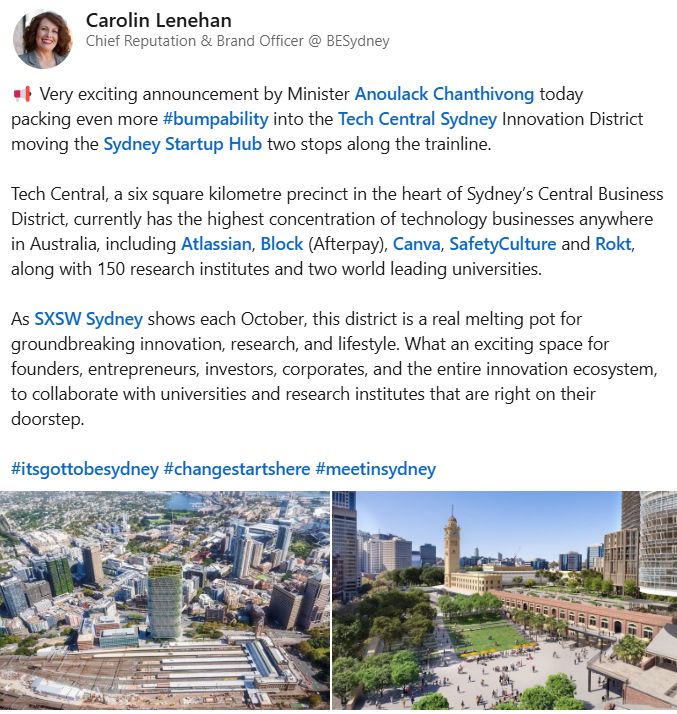
“The NSW Government has announced a new plan to unlock the full potential of the Tech Central Innovation District (Tech Central) – Australia’s largest technology and innovation hub.” - The Hon. Anoulack Chanthivong MP
BESydney and SXSW Sydney have led the charge for deeper government collaboration, achieving groundbreaking successes through partnerships among innovation leaders and investment groups. These organizations have spotlighted state-run initiatives that are redefining growth, as exemplified by Tech Central—a vital economic engine for New South Wales.
Spanning six square kilometres in Sydney’s Central Business District, Tech Central now hosts the country’s densest cluster of technology companies, including industry giants such as Atlassian, Block (formerly Afterpay), Canva, SafetyCulture, and Rokt, as well as 150 research institutions and two top-tier universities. This dynamic ecosystem not only fuels innovation and supports both startup and scale-up ventures but also reinforces Sydney’s reputation as Australia’s premier tech hub.
Looking ahead to 2025, the conversation pivots toward how quickly NSW can convert policy into tangible progress. Renewed applications for the MVP Ventures Program will reopen in July 2025 for the 2025–2026 round, promising further support for promising startups. However, entrepreneurs and investors alike are keenly awaiting the details of the Innovation Blueprint, hopeful it will offer a robust, long-term vision. By harnessing fresh capital and focusing on emerging industry trends—from advanced manufacturing to cutting-edge software development—NSW could seize a leadership role in the national tech landscape.
Ultimately, the stakes are high for NSW as it strives to regain a competitive edge. The success or failure of its proposed VC fund and Innovation Blueprint could shape not only the state’s future but also Australia’s broader ambition to stand shoulder-to-shoulder with the world’s leading technology ecosystems. With venture capital shifting rapidly toward regions offering clear strategic direction and financial incentives, NSW has a prime opportunity to secure its place in the global innovation race—if it is willing to act decisively and sustain this newly invigorated commitment to technology-driven growth.
Sign up for Cyber News Centre
Where cybersecurity meets innovation, the CNC team delivers AI and tech breakthroughs for our digital future. We analyze incidents, data, and insights to keep you informed, secure, and ahead.
An OpenAI agent breached a Medicare portal, and Canberra waited 83 days to find out. Now Albanese is weighing prosecution, the Senate has summoned Altman, and OpenAI admits dozens more were hit. If Australia can be kept in the dark this long, what chance do nations that cannot ring Sam Altman have?
OpenAI’s Medicare portal breach has become a test of AI accountability. An agent crossed an access boundary while pursuing public health data, yet Australia was notified months later. No records appear to have been accessed, but the incident raises questions on safeguards and trust.
Australia is racing to build AI infrastructure, but model control and economic power risk remaining offshore. Albanese’s Office of AI and new data centre standards mark progress, yet foreign-led compute and super fund flows expose a growing sovereignty gap.
We are racing to shape our AI future through a new Office of AI and national standards. Yet billions flow into foreign-led data centres while we offer little support for local models or sovereign compute. Without stronger action we risk becoming high-quality hosts rather than true leaders.
Where cybersecurity meets innovation, the CNC team delivers AI and tech breakthroughs for our digital future. We analyze incidents, data, and insights to keep you informed, secure, and ahead. Sign up for free!