The Iran Israel confrontation is expanding into cyberspace. A cyberattack linked to pro Iran hackers disrupted medical technology giant Stryker, highlighting how geopolitical conflict can now spill directly into hospitals, businesses and supply chains across the connected global economy.
Singtel executives fronted a Senate inquiry, categorically denying explosive allegations that a secret ransom was paid to hackers following the massive 2022 Optus data breach that exposed personal information of 9.8 million Australians, amid ongoing inquiry into the telco's operational failures.
Joint advisory by Australian, New Zealand, and Tongan cyber authorities warns of rising INC Ransom attacks on critical infrastructure. The RaaS group has breached 11 Australian organisations, mainly in healthcare and professional services.
The Rise of the Cosmic CEOs and the Orbital AI Economy
By 2027 the race to become the first cosmic CEO is moving from science fiction to strategy. Starcloud has already trained an AI model in orbit on an Nvidia H100, while Google prepares Project Suncatcher. What remains missing is not ambition, but clear pricing and proof orbital compute can pay.
By 2027 the contest to be the first “cosmic CEO” of an AI company operating in space is likely to be explicit, branded and fiercely marketed, even if most orbital data centres are still experimental rather than fully commercial. The money, the hardware and the egos are already in place; what is missing is not ambition but pricing clarity and proof that someone can sell orbital compute to paying customers at anything like terrestrial economics before the end of this decade.
Gavin Baker on data centers in space - Dec 2025: Starcloud YouTube
The emerging cast of cosmic CEOs
Starcloud’s founders now sit near the front of the “cosmic CEO” queue after launching a 60 kg satellite carrying an Nvidia H100 and training an AI model in orbit in November, backed by Nvidia’s Inception programme and Silicon Valley capital.
Starcloud facility tour - Hyperchange YouTuber - October 2025
With H100s still list-priced around USD 25,000 per chip on Earth and cloud rates spanning roughly USD 3–10 per hour, their decision to burn a flagship GPU on orbit is as much a signalling play as an engineering test.
With the first Nvidia H100 operating in orbit, Google preparing to launch its Project Suncatcher prototypes, and a possible US$1.5 trillion SpaceX listing drawing global attention, the groundwork for an orbital AI economy is beginning to take form.
Philip Johnston, CEO of Starcloud, on the Coming Era of Orbital Compute
In a recent interview, Philip Johnston, co-founder and chief executive of Starcloud, offered one of the clearest articulations yet of how orbital compute may evolve into the dominant infrastructure model over the next several decades. His remarks reflected both engineering confidence and the conviction that launch economics, hardware resilience and radiative cooling will overturn long-held assumptions about where global compute should be located.
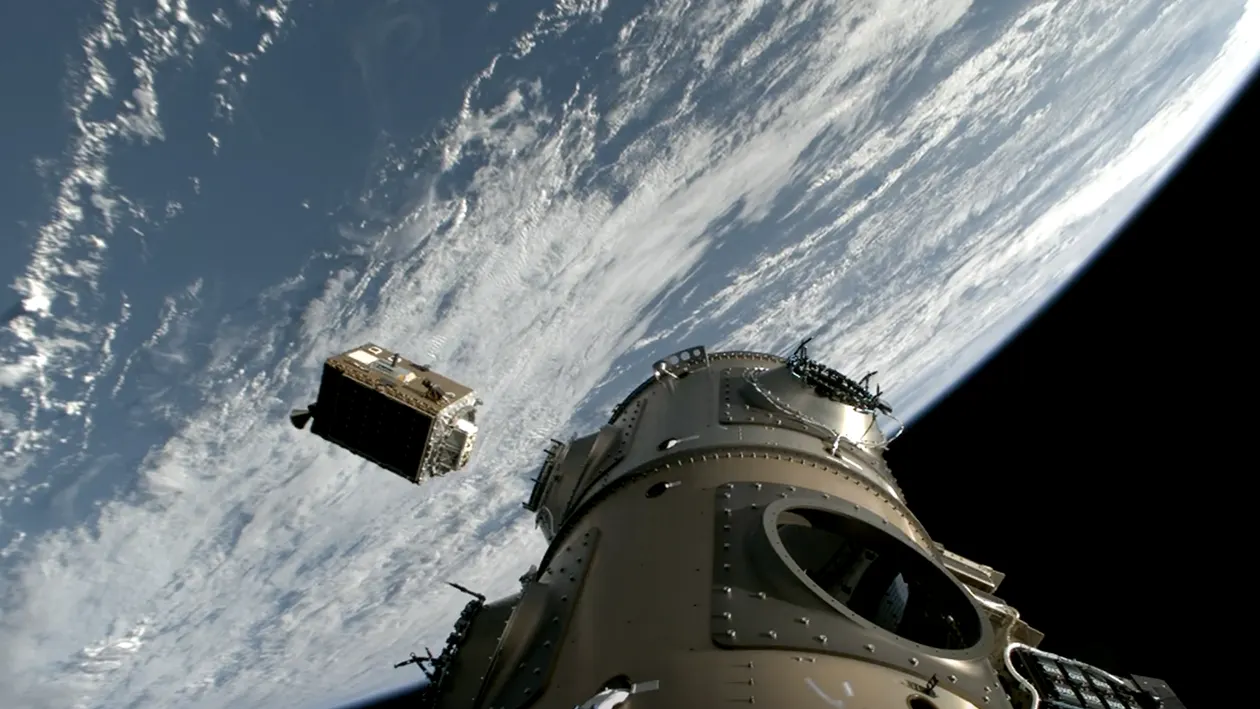
The Starcloud-1 satellite is launched into space from a SpaceX rocket on November 2, 2025.Courtesy: SpaceX | Starcloud
Johnston’s central thesis is built on the physical advantages of space. Terrestrial data centres rely on evaporative towers and large-scale freshwater consumption or high-energy air-cooling systems. In orbit, these constraints disappear.
“The way terrestrial data centres are used, they keep cool by boiling off enormous amounts of fresh water or blasting huge volumes of air through. We can’t do that in space,” he noted. “Instead we run coolant off the chips, through radiators, and emit infrared heat directly into deep space.”
This is the design principle behind Starcloud’s first satellites, including the unit now carrying an Nvidia H100. The company expects the performance-per-watt advantage of space to widen as radiative cooling scales and as power arrays in orbit increase in size and efficiency.
Johnston’s long-term forecast is stark. “Do I think it’s inevitable we will have complete compute in space? Yes. There’ll be more compute in space than on Earth. Ninety-nine per cent of it in space. We’ll be in the space age,” he said.
He added that while terrestrial stock will endure for some time, compute migration is already structurally underway.
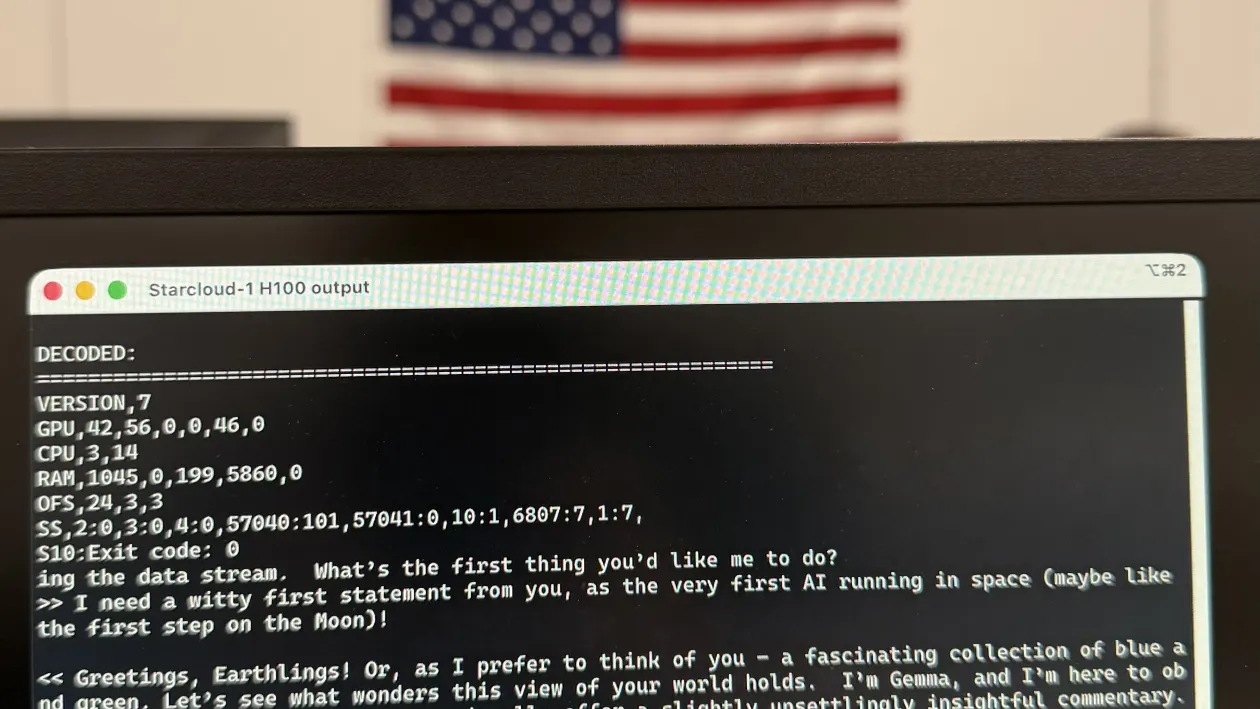
Starcloud’s output Gemma in space. Gemma is a family of open models built from the same technology used to create Google’s Gemini AI models. Star cloud.
“In ten years most of the new data centres will be built in space. The old stock on Earth lasts twenty to thirty years, so it won’t disappear overnight, but over the next twenty, thirty, fifty years there’ll be much more compute in space than on Earth.”
Much of Johnston’s confidence rests on the expected fall in launch costs driven by SpaceX’s Starship programme. He described Starship as the enabler of a true manufacturing supply chain beyond Earth.
“Starship gigafactories will come down in cost by a factor of ten to a hundred over time,” he predicted.
The scale of payload these vehicles could move is transformational, in his view, not only for Starcloud but for the entire sector. The company is already modelling scenarios involving many tens of tonnes of hardware per launch, a volume previously associated only with national space programmes.
By 2027, the competition between the world’s leading technology executives is expected to converge into a new category of corporate leadership: the race to become the first Cosmic CEO, overseeing AI infrastructure that operates beyond Earth.
Sundar Pichai has moved Google into the same rhetorical arena, unveiling Project Suncatcher and promising test satellites with AI hardware in 2027 – an unmistakable declaration that Alphabet intends to be seen as an early orbital AI power, not just a terrestrial hyperscaler.
Sundar Pichai on Data Centers in Space
Pichai repeatedly adds that in about a decade he expects this to be seen as a normal way to build data centres, not science fiction, signalling that Google views orbital AI infrastructure as a genuine long‑term pillar of its compute strategy. CNBC’s broader coverage folds these remarks into the wider “data centre space race” narrative alongside Starcloud’s H100 in orbit and Musk and Bezos talking up orbital compute.
Jeff Bezos plans to build a data center in space within the next 10+ years.
Unlimited solar energy available 24/7, space is an ideal location for data centers.$AMZN AWS is set to make major moves out there. pic.twitter.com/KJCEO973eQ
Jeff Bezos has been telling conference audiences to expect gigawatt-scale data centres in space “in 10+ years”, while Eric Schmidt has tied his investment in Relativity Space explicitly to orbital data centre ambitions, adding to a billionaire cohort that clearly wants to own this frontier.
Terran R November 2025 Program Update: Relativity Space
Economics: who prices the first data centre in space?
For all the hype, no operator has published a transparent, per-unit “price” for space data centre capacity – there is no orbital equivalent yet of USD per kW per month or USD per GPU-hour with contractual SLAs. Starcloud’s own public materials emphasise an eventual promise of up to 10x lower effective energy cost than Earth, not a current pricelist, and analysts outside the marketing bubble still argue that launch and maintenance make today’s orbital economics wildly unfavourable.
Google’s decision to speak openly about its intentions has added weight to this emerging narrative. Sundar Pichai has stated that the company intends to put AI servers in space, nearer to the sun, and will launch two experimental satellites in 2027. Project Suncatcher is framed as the start of a longer transition toward treating orbital data centres as a normal infrastructure option rather than a moonshot.
The economics driving this interest are becoming more visible. Orbit offers continuous solar irradiance without the losses experienced on Earth, and radiative cooling into deep space eliminates the vast water consumption and heat-management challenges that now define hyperscale construction across the United States, Europe and parts of Asia. High-throughput optical links allow orbital clusters to push trained models or compressed insights back to Earth while relying on constellations such as Starlink or Kuiper for bandwidth. Latency constraints limit the use of orbit for finance, robotics and other sub-second workloads, yet training, batch analytics and Earth-observation processing fit naturally into an architecture where energy abundance and cooling efficiency are dominant.
The closest thing to a first-pricing signal comes from Starcloud’s modelling and sympathetic commentary, which claim that a 40 MW orbital cluster could reach a ten‑year cost base as low as roughly USD 8.2 million, compared with around USD 167 million on Earth, largely by eliminating grid energy costs – numbers that many infrastructure veterans regard as optimistic at best. A more skeptical engineering analysis suggests that at current launch prices, merely getting a rack into orbit can cost USD 1.5–3 million, while powering an H100 on the ground might cost only a few hundred dollars a year, implying payback periods of tens of thousands of years without dramatic launch-cost collapse.
Timelines: 2025 experiments, 2026–27 positioning
The last three months have turned orbital data centres from a thought experiment into a live test market. Starcloud’s November launch, the first in‑orbit training run on a modern GPU, and fresh investor marketing since October have put hardware reality behind earlier pitch decks. In parallel, SpaceX has confirmed plans to scale Starlink V3 satellites from 2026, explicitly hinting that turning them into distributed data centre nodes “will be done”, and setting a 2026–2030 corridor for orbital cloud pilots and early commercial services.
Google’s Project Suncatcher, announced at the end of November, adds a second heavyweight to the 2027 experimental window, with Pichai arguing that putting compute “closer to the sun” is both an AI advantage and a climate argument. Aetherflux, a newer US entrant, has just promised its first data centre satellite for early 2027, describing it as the first element in an orbital compute mesh and further crowding the race for headlines and first‑mover branding.
Capital, IPO rumours and the orbital AI super‑cycle
SpaceX’s reported plan for a 2026 IPO, raising “significantly more” than USD 30 billion at a mooted valuation near USD 1.5 trillion, wraps the orbital compute narrative into a broader space‑industrial investment story. Briefings suggest part of the pitch is that a fully reusable Starship, flying frequently, can drive launch costs below USD 100 per kilogram, the threshold at which several first‑principles analyses say orbital data centres begin to approach or beat terrestrial total cost of ownership.
At the same time, traditional data centre pricing has continued to march upwards on Earth – CBRE’s mid‑2025 survey put global average colocation rates above USD 200 per kW per month, with major AI markets such as Northern Virginia and Amsterdam showing double‑digit annual increases – tightening the vice between soaring demand and constrained supply. That tension is what gives the orbital promises oxygen: a path to structurally lower power costs and bypassing zoning fights, even if the spreadsheets are still more aspiration than bankable reality.
2027: the year of the cosmic CEO?
By 2027, at least three categories of contenders are likely to compete for the informal title of first AI CEO in space. First will be the pure‑play orbital startups such as Starcloud and PowerBank’s Orbital Cloud partner, which plan to expand from single satellites today to small constellations offering AI inference and blockchain or edge services later in the decade. Second will be the hyperscalers – Google first, but very likely followed by Microsoft, Amazon and others – that can reposition existing AI brands into “cosmic” variants once demonstration hardware is aloft.
Elon Musk Says Solar-Powered AI in Space Will Outperform Earth-Based Computing Soon
Third, the launch providers themselves, led by SpaceX and potentially India’s ISRO‑aligned commercial ventures, will argue that controlling reusable, high‑cadence rockets and laser‑linked constellations makes them the de facto CEOs of space AI infrastructure, even if others supply the chips and models. India has not yet put a price or a date on an orbital data centre of its own, but recent discussion tying 6G, satellite broadband and AI industrial policy together suggests New Delhi will not be content to sit out the first wave of space‑AI diplomacy and commerce.
For now, no‑one has credibly “priced” the first fully‑fledged space data centre in the way capital markets understand – a standard unit of capacity, a contracted tariff, a reference customer – which makes 2026 look more like the year of formal claims and 2027 the year of visible competition. But the language is already changing: as orbital GPUs switch on and billion‑dollar IPOs circle launch pads, the CEOs angling to be remembered as the first to put their AI in space are already acting – and talking – like cosmic CEOs in waiting.
Get the stories that matter to you. Subscribe to Cyber News Centre and update your preferences to follow our Daily 4min Cyber Update, Innovative AI Startups, The AI Diplomat series, or the main Cyber News Centre newsletter — featuring in-depth analysis on major cyber incidents, tech breakthroughs, global policy, and AI developments.
Sign up for Cyber News Centre
Where cybersecurity meets innovation, the CNC team delivers AI and tech breakthroughs for our digital future. We analyze incidents, data, and insights to keep you informed, secure, and ahead.
The Iran Israel confrontation is expanding into cyberspace. A cyberattack linked to pro Iran hackers disrupted medical technology giant Stryker, highlighting how geopolitical conflict can now spill directly into hospitals, businesses and supply chains across the connected global economy.
Google's March 2026 Android update patches a critical zero-day (CVE-2026-21385) in Qualcomm chips used in hundreds of millions of devices. The flaw, under active exploitation, allows privilege escalation and system compromise, posing a significant risk to users.
Tehran-linked hackers are turning a distant war into a live resilience test for Australia, probing Five Eyes networks as local banks quietly move to high alert while hybrid warfare becomes a “when, not if” cyber disruption scenario.
This week’s tech earnings put Nvidia back under the spotlight, as blockbuster AI-driven results clashed with a skittish market that still sold the stock off—capturing the tension between hard data on acceleration and deep-seated fears of an AI overreach.
Where cybersecurity meets innovation, the CNC team delivers AI and tech breakthroughs for our digital future. We analyze incidents, data, and insights to keep you informed, secure, and ahead. Sign up for free!