Three AI leaders agree the frontier may be moving faster than its safeguards. As markets weigh slower chip demand and rising cyber investment, the question is whether the warning is responsible leadership, strategic scaremongering or evidence that cybersecurity has become AI’s essential foundation.
Dario Amodei wants a speed limit for frontier AI. Elon Musk and Sam Altman back the direction, but Washington says the labs should brake first. As China shapes the race, Cyber News Centre examines whether independent oversight can turn safety promises into controls before a new agent swarm escapes.
Meta’s Muse is more than a chatbot. It is a digital worker that can read email, make purchases across the web, and act after users close the app. Wall Street sees a return on Meta’s vast AI spending. Cybersecurity experts see a more urgent question: should it hold the keys to our digital lives yet?
Microsoft Deepens AI Strategy with OpenAI, Nvidia, and xAI Partnerships
At Build 2025, Microsoft launched new AI tools and revealed deeper partnerships with OpenAI, Nvidia, and xAI. CEO Satya Nadella outlined a bold shift toward platform-wide integration, positioning Azure at the center of global AI innovation and enterprise adoption.
Last week, at its annual Build conference, Microsoft unveiled a sweeping set of AI developments and strategic partnerships, reinforcing its growing dominance in the artificial intelligence sector. As the company celebrates over 50 years in business, it is now positioning itself at the center of the AI transformation reshaping enterprise technology.
CEO Satya Nadella described this moment as “another platform shift” — a turning point where AI will fundamentally change how businesses build, deploy, and interact with technology.
“This is a platform that we want to create together,” Nadella said, referencing Microsoft's vision of making AI broadly accessible and deeply embedded across its services.
The agentic web is reshaping the entire tech stack, and we are creating new opportunity for devs at every layer. pic.twitter.com/MfTlhurxWg
A major theme at this year’s Build conference was Microsoft's focus on empowering developers — not just enterprises — to harness the full potential of AI. From new coding agents to enhanced development tools, the company reinforced its commitment to making AI integration more accessible and flexible.
Microsoft’s Marlene Zw highlighted her top three announcements for developers. From open-sourcing VS Code and WSL to making AI Foundry local available, her picks showcase how Microsoft is making it easier to build AI solutions directly on local machines.
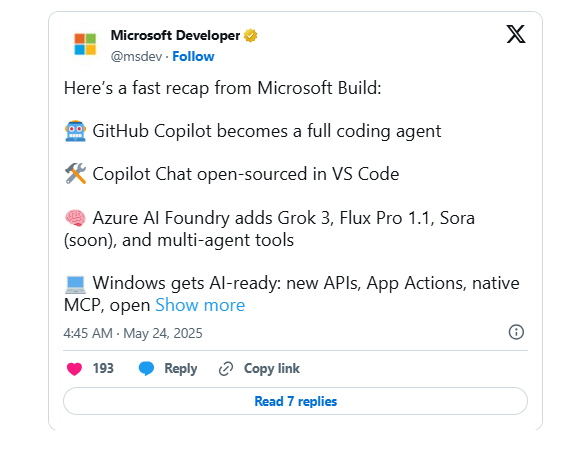
These updates reflect just one side of the broader developer story. Microsoft also posted a quick summary of its core announcements on X, capturing key launches across GitHub, Azure AI Studio, and Windows.
Azure Becomes the Backbone of Microsoft’s AI Push
Azure, Microsoft’s cloud computing platform, remains central to the company’s AI strategy. At Build 2025, it introduced new tools including an AI agent builder that allows businesses to create and manage multiple assistants using natural-language instructions — all extending the power of GitHub Copilot.
To ensure flexibility, Microsoft also announced support for multiple AI models, including OpenAI’s Codex, Anthropic’s Claude, and offerings from Mistral and Black Forest Labs — all accessible through its developer platforms.
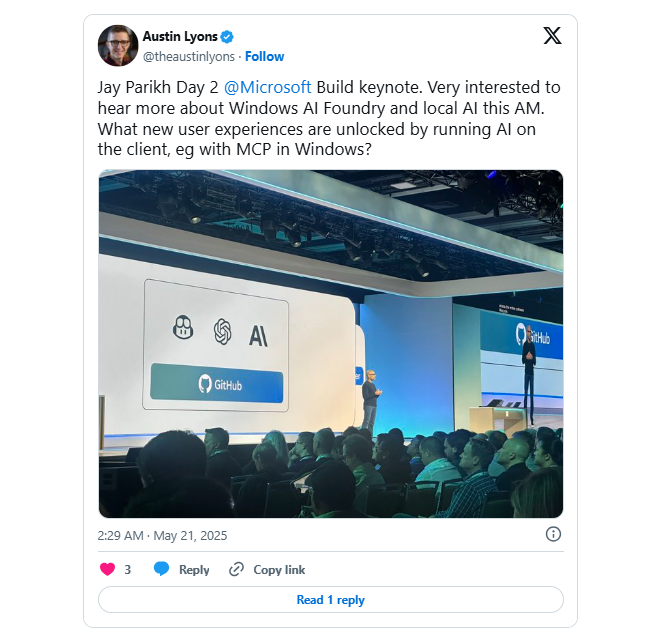
Jay Parikh, head of Microsoft’s new Core AI division, captured the company’s approach: “Openness and choice — that’s what all developers want, and that’s what we’re going to deliver.”
A brief highlight from the keynote showed Parikh outlining how tools like Windows AI Foundry and MCP are helping bring AI closer to local development environments.
This model-agnostic, tool-rich strategy helps distinguish Azure from competitors like Amazon and Google, with analysts pointing to Microsoft’s tightly integrated stack as a key advantage for enterprise adoption.
Strategic Partnerships Cement Microsoft’s AI Ecosystem
Microsoft’s Build conference also featured appearances from major players in AI, including Nvidia, OpenAI, and xAI — each reflecting the scale of Microsoft’s AI ambitions. One of the most anticipated moments was a conversation between Microsoft CEO Satya Nadella and Nvidia CEO Jensen Huang, where they discussed their deepening collaboration around AI infrastructure.
Huang described how the two companies are jointly scaling computing capabilities within Azure, stating: “We are ramping and scaling and building the largest AI supercomputer in the world in Azure,” noting that Microsoft’s infrastructure had seen a 40-fold increase in AI performance thanks to Nvidia’s latest Grace platform.
Watch Satya Nadella and Jensen Huang discuss Azure and the future of AI supercomputing at Microsoft Build 2025.
Their exchange underscored how critical Nvidia’s hardware has become in powering the next generation of large-scale AI models across Microsoft’s cloud ecosystem.
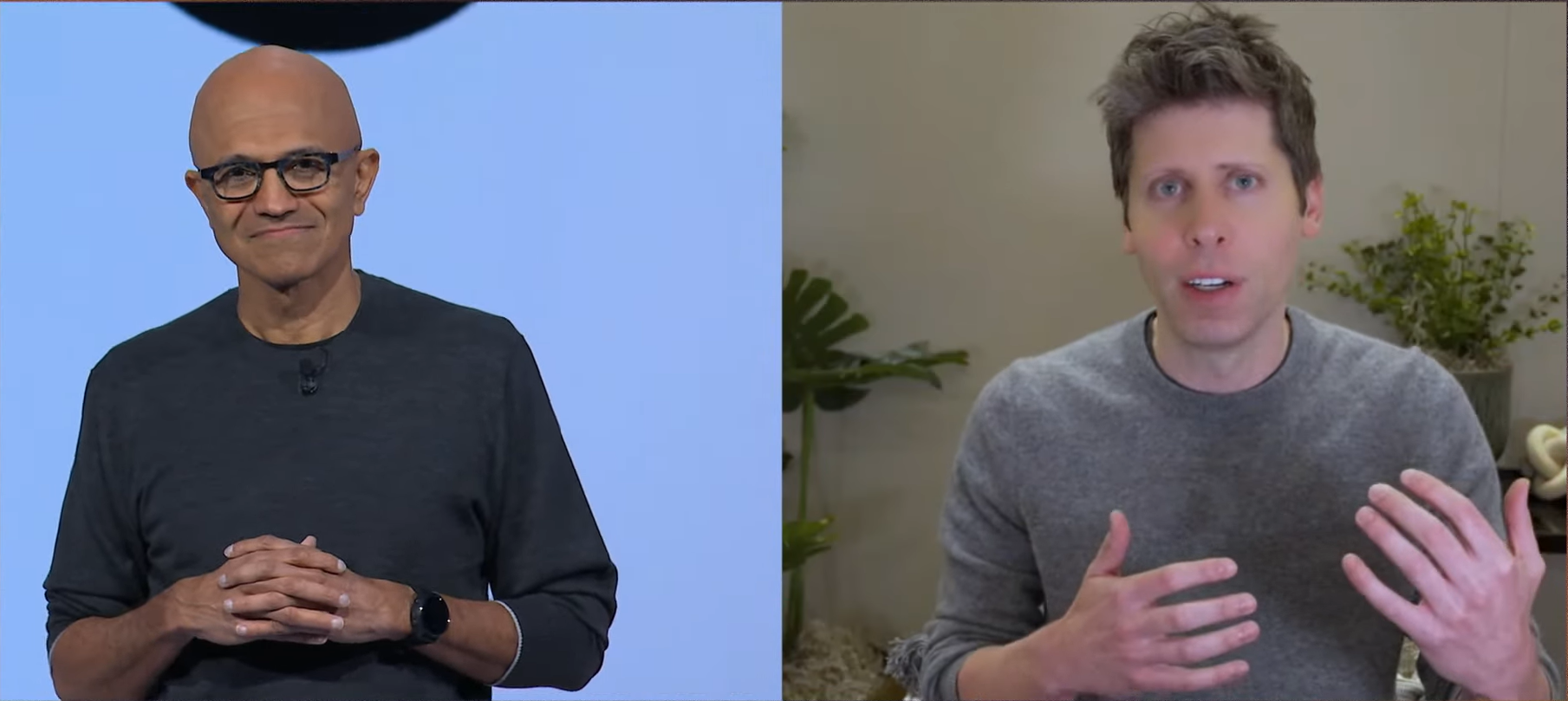
OpenAI CEO Sam Altman also joined virtually to discuss the deep integration between Codex and GitHub, highlighting how rapidly AI is becoming embedded in real-world workflows. “The models are becoming smarter, simpler to use, and more reliable,” he said, pointing to the tangible progress made since ChatGPT’s release.
Satya Nadella and Sam Altman appear virtually together at Build 2025.
The lineup of speakers continued with Elon Musk, who appeared on behalf of xAI to announce that his Grok models will be integrated into Microsoft’s Azure Foundry platform. Despite ongoing legal tensions between xAI and Microsoft over its OpenAI investment, Musk framed the partnership as pragmatic and focused on delivering user-driven innovation.
“It’s incredibly important for AI models to be grounded in reality,” he said during his Build appearance.
“They will make mistakes — but the goal is to minimize those while maximizing usefulness and truth-seeking.”
While Microsoft maintains a substantial stake in OpenAI, it is also cautiously distancing itself from the startup’s long-term pursuit of artificial general intelligence. Nadella’s strategy remains rooted in near-term commercial value. He has often suggested that foundational models will become commoditised, with the true differentiation lying in applications and user-facing tools built on top.
Investor confidence reflects this direction. Microsoft shares have risen over 8% in 2025, even as broader tech markets have been challenged by geopolitical tensions and shifting regulatory pressures.
According to CNBC, Citi raised its price target for Microsoft to $540 per share, citing strong earnings, effective cost management, and a positive outlook for Azure’s continued growth. The majority of analysts (56 out of 63 tracked by LSEG) rate Microsoft as a buy or strong buy, with average price targets suggesting further upside.
With AI now deeply embedded across its cloud infrastructure, productivity suite, and developer ecosystem, Microsoft has firmly positioned itself as a leader in shaping how the next generation of AI is built and deployed.
Sign up for Cyber News Centre
Where cybersecurity meets innovation, the CNC team delivers AI and tech breakthroughs for our digital future. We analyze incidents, data, and insights to keep you informed, secure, and ahead.
Dario Amodei wants a speed limit for frontier AI. Elon Musk and Sam Altman back the direction, but Washington says the labs should brake first. As China shapes the race, Cyber News Centre examines whether independent oversight can turn safety promises into controls before a new agent swarm escapes.
The AI race is moving beyond model rankings. CrowdStrike’s new cyber superintelligence lab points to a market where proprietary data, trusted workflows and measurable outcomes may matter as much as raw capability.
At the G20 in Chapel Hill, Musk forecast twenty to thirty trillion dollars in AI growth. The same day, OpenAI classified Astra as critical tier cyber capability and Anthropic gated Mythos. Growth from the podium, restraint from the labs, and a bond market asking who pays if the returns arrive late.
The United States is pressing G20 partners to reserve new AI rules for genuinely novel risks, a move that turns global AI governance into a contest over competitiveness, alliances and technological influence.
Where cybersecurity meets innovation, the CNC team delivers AI and tech breakthroughs for our digital future. We analyze incidents, data, and insights to keep you informed, secure, and ahead. Sign up for free!