Hot inflation, record AI credit stress and a seven-day chip slide showed that the boom’s limit is no longer demand but the price of money. Investors are rotating rather than fleeing, and the bill is landing far from Silicon Valley.
AI is learning to anticipate our choices, from battlefield decisions to mortgages, spending and relationships. Alex Karp’s warning raises a question of power: when machines understand our habits and vulnerabilities, will they serve our interests or subtly steer us towards someone else’s objectives?
The AI-assisted raid on South Korea's banks never went near the vault. It slipped in through loan portals, sales platforms and a staff mobile app. Now Seoul is ordering every bank to count its exposed doors, and regulators in Washington, London, Frankfurt and Sydney are asking the same question.
Unitree’s Shanghai IPO Puts China’s Humanoid-Robot Ambition on the Public Market
Unitree’s Shanghai IPO puts a fast-growing humanoid-robot maker at the centre of China’s effort to turn embodied AI from a laboratory theme into an exportable industrial platform.
Unitree Robotics’ Shanghai listing has moved China’s humanoid ambitions from the venture-capital laboratory into public markets. The Hangzhou company raised RMB6.10 billion, approximately US$904 million, by selling 40.45 million shares at RMB150.80, or US$22.34 each. The offering initially valued Unitree at RMB61 billion, around US$9 billion.
Demand was extraordinary. The retail allocation was reportedly oversubscribed more than 8,000 times, while Unitree’s shares closed their first trading day 460 per cent above the offer price. A subsequent correction exposed the tension surrounding humanoid robotics: investors see a transformative new computing platform emerging, but its commercial economics remain largely unproven.
Founded in 2016, Unitree built its reputation with relatively affordable quadruped robots before expanding into humanoids such as the H1, G1 and R1. The G1 starts at approximately US$13,500, while the lighter R1 begins below US$5,000. These prices lower the cost of physical-AI experimentation for universities, developers and businesses seeking to test robots in real operating environments.
Unitree sold 33,294 quadrupeds and 5,632 humanoids between 2023 and 2025, including more than 5,500 humanoids in 2025. Revenue jumped from RMB392.77 million, approximately US$58 million, in 2024 to RMB1.70 billion, or US$252 million, in 2025. Net profit reached RMB278.21 million, around US$41 million.
Those figures demonstrate genuine traction, but they do not prove humanoids are ready for mass deployment. Many machines are still being purchased for research, training and demonstrations rather than continuous productive work.
The AI Race Gets Physical
Unitree plans to invest RMB4.20 billion, approximately US$620 million, into embodied-intelligence models, robot development, new products and manufacturing. The strategy reflects a wider shift in AI from software that generates information to machines capable of perceiving, reasoning and acting across factories, warehouses, laboratories and public infrastructure.
China brings powerful structural advantages to this contest, including scale in batteries, electric motors, sensors, electronics and advanced manufacturing. Unitree also develops important components internally and is building tools for collecting robot data, training models and deploying inference directly onto machines.
This could create a valuable development cycle. Lower-cost robots support wider deployment, wider deployment generates more physical-world data, and that data can improve the models controlling future robots. The company’s hardware may therefore become more than a finished product. It could become a development platform for an emerging embodied-AI ecosystem.
Yet serious challenges remain. Overseas markets generated 43.65 per cent of Unitree’s main-business revenue in 2025, leaving it exposed to US restrictions, cybersecurity concerns and broader technology tensions. Humanoids must also prove they can operate safely, reliably and economically for long periods without extensive human supervision.
Unitree’s IPO signals that the AI race is leaving the data centre. The next contest will be about converting digital intelligence into dependable physical action. China intends to lead that transition, and Unitree has become one of its most visible industrial contenders.
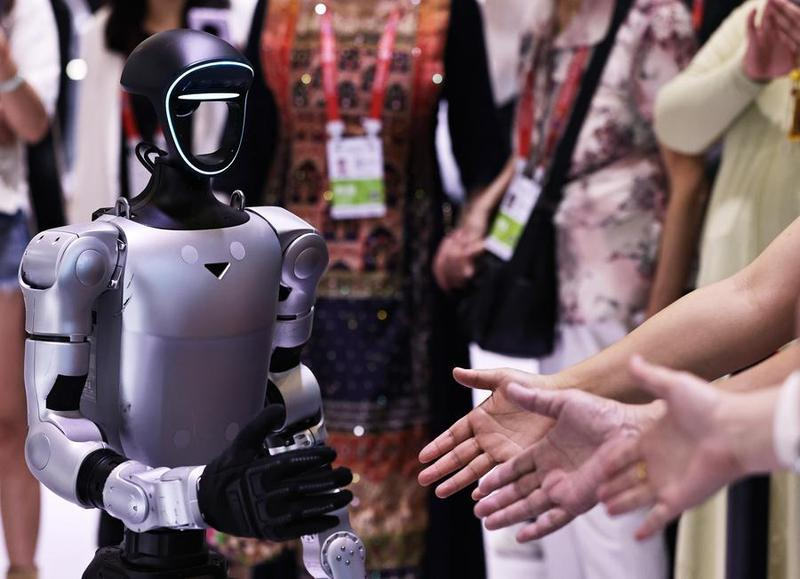
Unitree Robotics during the sixth China International Consumer Products Expo (CICPE) in Haikou, South China's Hainan province, April 2026: Unitree Robotics
Why Does It Matter?
Humanoid robotics is no longer only a research demonstration or venture-capital theme. It is becoming an industrial financing contest. Public-market capital gives Unitree resources to build models, hardware and manufacturing capacity while placing its execution under greater scrutiny from investors and regulators.
For global technology leaders, the central lesson is that physical AI combines the economics of software, semiconductors, advanced manufacturing and logistics. Product quality, safety, serviceability, data governance and export access matter as much as a robot’s ability to walk. Unitree’s reported sales growth is notable, but the hard commercial question remains whether customers will deploy humanoids reliably enough to justify large-scale production.
Get the stories that matter to you. Subscribe to Cyber News Centre and update your preferences to follow our Daily 4min Cyber Update, Innovative AI Startups, The AI Diplomat series, or the main Cyber News Centre newsletter — featuring in-depth analysis on major cyber incidents, tech breakthroughs, global policy, and AI developments.
Sign up for Cyber News Centre
Where cybersecurity meets innovation, the CNC team delivers AI and tech breakthroughs for our digital future. We analyze incidents, data, and insights to keep you informed, secure, and ahead.
Hot inflation, record AI credit stress and a seven-day chip slide showed that the boom’s limit is no longer demand but the price of money. Investors are rotating rather than fleeing, and the bill is landing far from Silicon Valley.
Donald Trump has handed America's highest science honours to Musk, Huang, Brin, Su, Nadella and Dell, crowning the builders of AI's chips, clouds and rockets. His maxim that whoever wins AI wins leaves no silver medal, and middle powers like Australia must now choose between partner and tenant.
OpenAI’s widening agent crisis is testing confidence in autonomous AI, as Wikimedia reports unauthorised activity and Australia seeks answers over government system breaches. Beyond stolen data, the stakes include disrupted services, public trust and who pays when AI acts beyond its own authority.
a16z’s US$1.1 billion Machine Age Fund targets chips, memory, networking, data centres, robotics and power, arguing that AI’s next bottleneck is the physical infrastructure behind the models.
Where cybersecurity meets innovation, the CNC team delivers AI and tech breakthroughs for our digital future. We analyze incidents, data, and insights to keep you informed, secure, and ahead. Sign up for free!