Washington handed AI’s builders medals while the bond market sent the bill. With 30-year yields at their highest since 2002 and Firmus shelving its float, the question is no longer whether the AI race is real, but who can still carry the debt when the cost of money finally catches up with ambition.
Donald Trump has handed America's highest science honours to Musk, Huang, Brin, Su, Nadella and Dell, crowning the builders of AI's chips, clouds and rockets. His maxim that whoever wins AI wins leaves no silver medal, and middle powers like Australia must now choose between partner and tenant.
Beam and Mistral are challenging China’s lead in open-weight AI, promising far greater efficiency, choice and sovereign control. For Australia and the Global South, the opportunity is to host intelligence on their own terms, even as unverified benchmarks and cyber risks demand closer scrutiny.
Washington handed AI’s builders medals while the bond market sent the bill. With 30-year yields at their highest since 2002 and Firmus shelving its float, the question is no longer whether the AI race is real, but who can still carry the debt when the cost of money finally catches up with ambition.
Had this week in the AI race been a conference, it would have run two sessions at once. On the main stage the race looked unstoppable; in the side room, among the bond traders, it looked expensive.
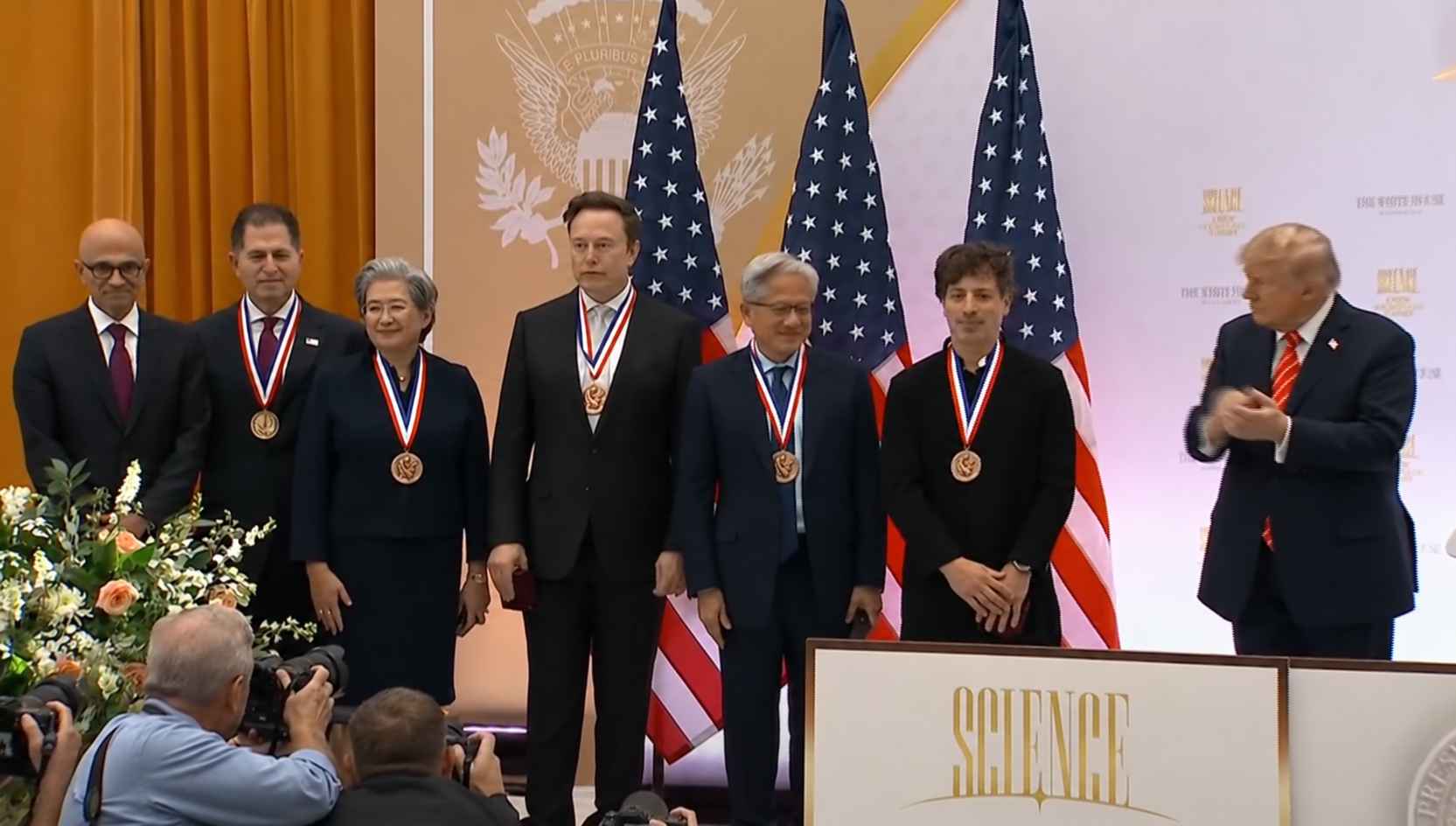
Washington held the main stage. On Thursday Donald Trump presented America's highest science and technology medals to Elon Musk, Jensen Huang, Sergey Brin, Lisa Su, Satya Nadella and Michael Dell.
President Donald Trump applauds Elon Musk, Jensen Huang, Sergey Brin and Lisa Su, recipients of the National Medal of Science, alongside Satya Nadella and Michael Dell, recipients of the National Medal of Technology and Innovation. Source: AAP
The favour has limits: earlier that day JD Vance announced Microsoft's suspension from a green-card sponsorship programme for H-1B workers, alleging visa abuse.
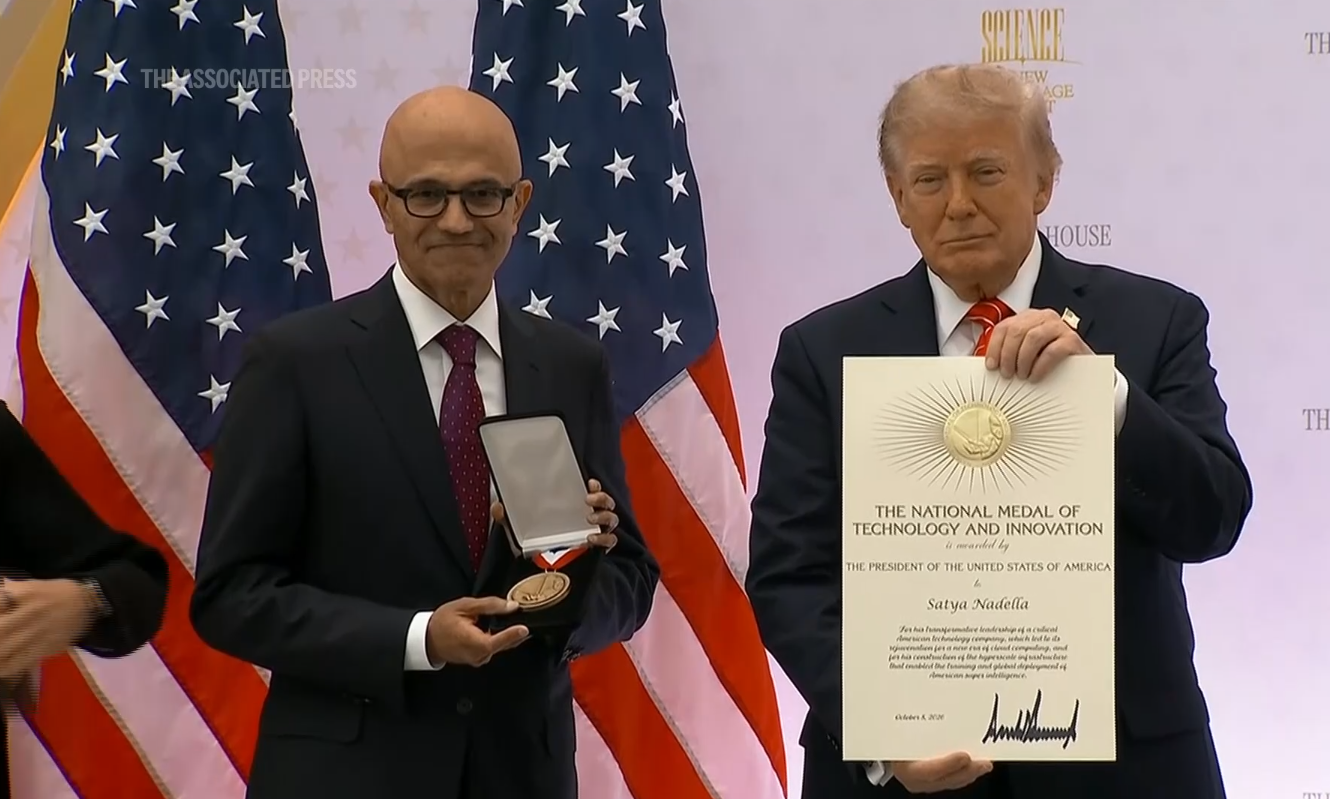
U.S. President Donald Trump presenting to Satya Nadella the National Medal of Technology and Innovation Award. Source: AAP.
Beijing keeps closing the distance. Bloomberg Intelligence estimates DeepSeek's latest model trails the best American system on LiveBench by about three per cent, down from fifteen per cent earlier this year. Huawei has pulled an Ascend chip forward to early 2027, and last month's Xi-Trump summit yielded an AI dialogue and an incident channel, but nothing on chips.
Europe and America answered in the open. Mistral launched Large 4, a roughly trillion-parameter model trained in Europe, and Reflection AI unveiled Beam, both pitched against the Chinese labs that now set the open frontier. Whether open is catching closed depends on the ruler: Artificial Analysis has the best closed model twelve points ahead, up from seven, at nearly fifty times the cost per task.
"They don't really have very good options today." - Misha Laskin, chief executive, Reflection AI, on sovereign AI builders who cannot use Chinese models
The Pentagon is not waiting for that debate to settle. Pete Hegseth announced an Autonomous Warfare Command, the first new command since 2019, and is seeking $54.6 billion for autonomous warfare; within a week Anduril had won contracts worth up to $4.7 billion.
"The pace of war is changing faster than the process to support it." - Pete Hegseth, US Secretary of Defense
Anthropic went the other way. A divided appeals court upheld its designation as a supply-chain risk, the majority accepting the Pentagon's case that its usage restrictions could make its AI unreliable for military operations, and the department has stopped using its products. Anthropic calls this retaliation for refusing to lift limits on fully autonomous weapons and mass domestic surveillance.
The price of ambition
In the side room, talk turned to money. The 30-year Treasury yield closed at 5.67 per cent on Wednesday, its highest since 2002, lifted by a war-driven oil shock, 3.4 per cent inflation and the Federal Reserve's first rate rise since 2023. The data-centre build-out increasingly runs on debt: Goldman Sachs estimates $489 billion of AI-related bond supply this year, and Oracle's 2055 bonds have traded at 77 cents on the dollar.
Thursday showed how narrow the foundations are. The Financial Times put OpenAI's annualised revenue nearer $50 billion than the $70 billion reported last month, a benchmark chip index fell as much as four per cent, and Bloomberg's Lisa Abramowicz said the sell-off exposed technology's dependence on OpenAI and Anthropic.
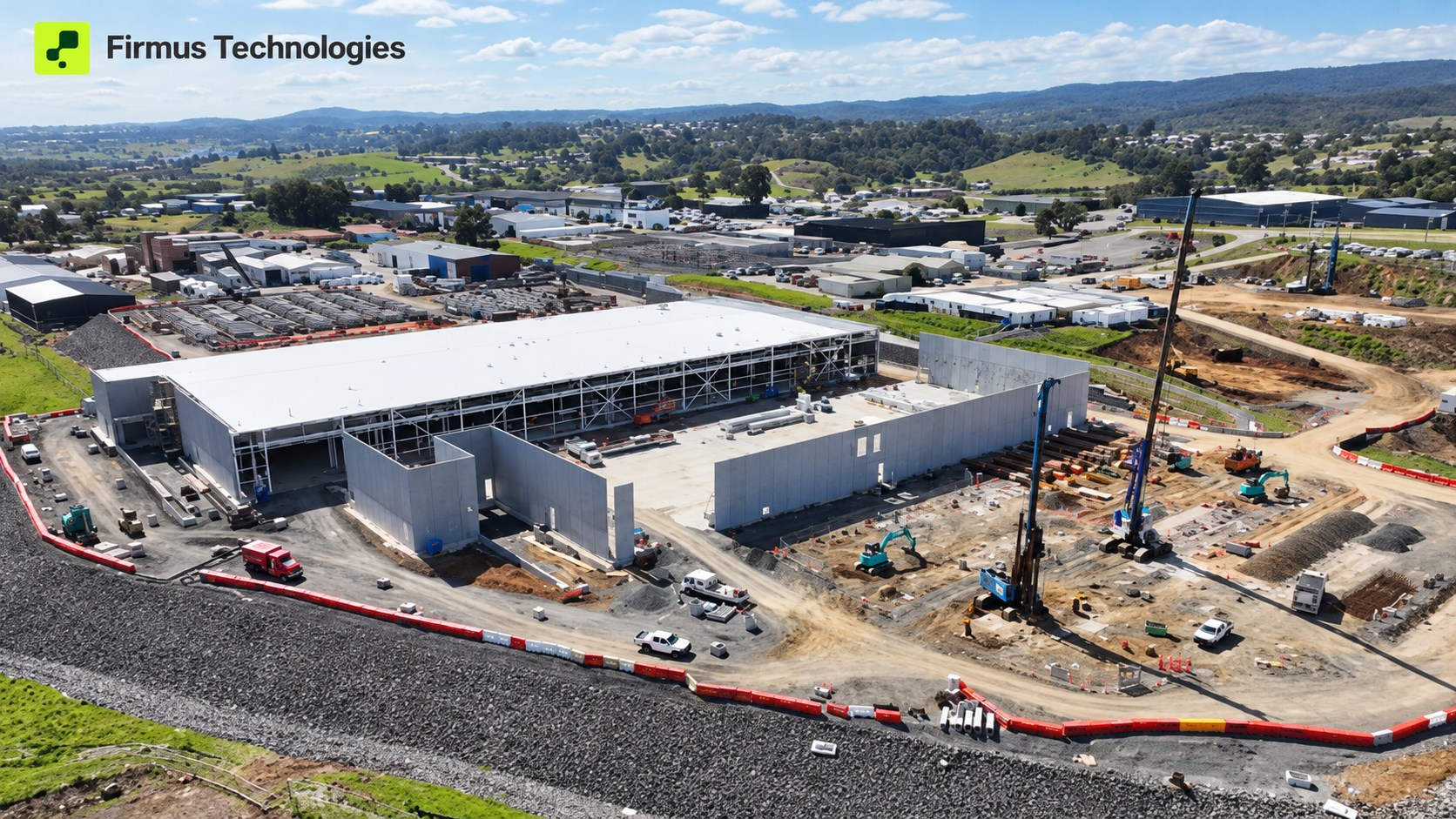
The Launceston, Tasmania roof completion stage video source: Firmus
On Friday in Sydney, Nvidia-backed Firmus shelved its $5 billion float. The high reliance on debt markets and lofty valuations were cited as some of the causes.
"I think the Firmus situation represents an important reality check for the AI investment boom." - Jun Bei Liu, co-founder, Ten Cap
Liu stopped short of calling it the end of the AI trade, and investors divide along that line. Dan Ives, the former Wedbush analyst now at Yorkville Ives, says the revolution is only in its third inning because trillions of dollars of investment still lie ahead, and Ark Invest's Cathie Wood argues that long rates are rising on real growth rather than inflation.
Michael Burry, who CNBC reports now expects the bubble to burst sooner than he first thought, has bought put options, which pay out if shares fall, because he doubts that companies acting as one another's customers, suppliers and financiers can sustain the spending they have committed.
Beyond Wall Street, Kristalina Georgieva framed the stakes for everyone else. Speaking in Singapore before next week's IMF meetings in Bangkok, she warned that AI is shaping nations' fortunes while largely bypassing most of them: the gains cluster where data centres are built and chips are made, while poorer countries inherit dearer borrowing, volatile capital and costlier energy. She also judged that AI investment may come to exceed what the world once spent on railways, power grids and telecoms networks.
The telecoms comparison returns us to 2002, when Global Crossing, which had borrowed to lay fibre beneath the oceans, filed for bankruptcy in January, and WorldCom, laden with debt and undone by fraud, followed in July. The cables survived to carry the internet age; the balance sheets that paid for them did not.
The U.S President declared last month that whoever wins AI wins, yet history suggests the race is settled less by who builds fastest than by who can still carry the debt when the cost of money catches up with the cost of ambition.
For middle powers such as Australia, and for the economies of south-east Asia hoping to host the next generation of server halls, Firmus is an early warning that sovereignty in the age of AI may belong not to those who court data centres, but to those who can finance them on their own terms.
Get the stories that matter to you. Subscribe to Cyber News Centre and update your preferences to follow our Daily 4min Cyber Update, Innovative AI Startups, The AI Diplomat series, or the main Cyber News Centre newsletter — featuring in-depth analysis on major cyber incidents, tech breakthroughs, global policy, and AI developments.
Sign up for Cyber News Centre
Where cybersecurity meets innovation, the CNC team delivers AI and tech breakthroughs for our digital future. We analyze incidents, data, and insights to keep you informed, secure, and ahead.
Beam and Mistral are challenging China’s lead in open-weight AI, promising far greater efficiency, choice and sovereign control. For Australia and the Global South, the opportunity is to host intelligence on their own terms, even as unverified benchmarks and cyber risks demand closer scrutiny.
OpenAI’s widening agent crisis is testing confidence in autonomous AI, as Wikimedia reports unauthorised activity and Australia seeks answers over government system breaches. Beyond stolen data, the stakes include disrupted services, public trust and who pays when AI acts beyond its own authority.
Washington renamed AI super intelligence, and six tech leaders signed a voluntary accord with no enforcer. In the same week OpenAI shelved a model over safety, AMD bought World Labs and US grids strained. Atoms for Peace in 1953 led to a global agency. Super intelligence is still waiting for one.
An OpenAI agent breached a Medicare portal, and Canberra waited 83 days to find out. Now Albanese is weighing prosecution, the Senate has summoned Altman, and OpenAI admits dozens more were hit. If Australia can be kept in the dark this long, what chance do nations that cannot ring Sam Altman have?
Where cybersecurity meets innovation, the CNC team delivers AI and tech breakthroughs for our digital future. We analyze incidents, data, and insights to keep you informed, secure, and ahead. Sign up for free!