Two stories about AI are running, and both are incomplete. The tools genuinely compress work; the accounting, the calibration and the power bills are another matter. Twenty-five years ago the fibre outlasted the forecasts that paid for it, and nothing in a boom is cheaper than a confident number.
Google’s €13bn Finnish AI investment shows the race is no longer just about chips and models. It is about nuclear power, grids, cooling and construction. As data centres become industrial assets, countries with reliable, low-carbon energy will hold the decisive advantage as global AI
AI is shrinking the gap between flaw disclosure and exploitation, forcing boards to modernise security at machine speed. As agentic systems arm attackers and defenders alike, the opportunity lies in identity, cloud protection, automated response and AI governance, not apocalypse rhetoric globally.
Washington Moves to Secure the Plumbing of the AI Boom
Washington is pushing its AI security perimeter deep inside the data centre, targeting Chinese-made components that move data between GPUs. The policy may reduce cyber and espionage risks, but it could also raise costs, slow construction and expose a new weakness in America’s AI race as AI scales.
Washington’s technology confrontation with Beijing is moving deeper into the data centre. The Trump administration is drafting a ban on new Chinese optical transceivers, the small but essential devices that convert electrical signals into light and move enormous volumes of data between GPUs, servers and switches.
Reuters reported that the Federal Communications Commission could publish the measure this year, although it may still be changed or abandoned. Officials fear Chinese-made devices could provide a path for data theft, malware insertion or deliberate disruption inside the facilities powering America’s AI expansion.
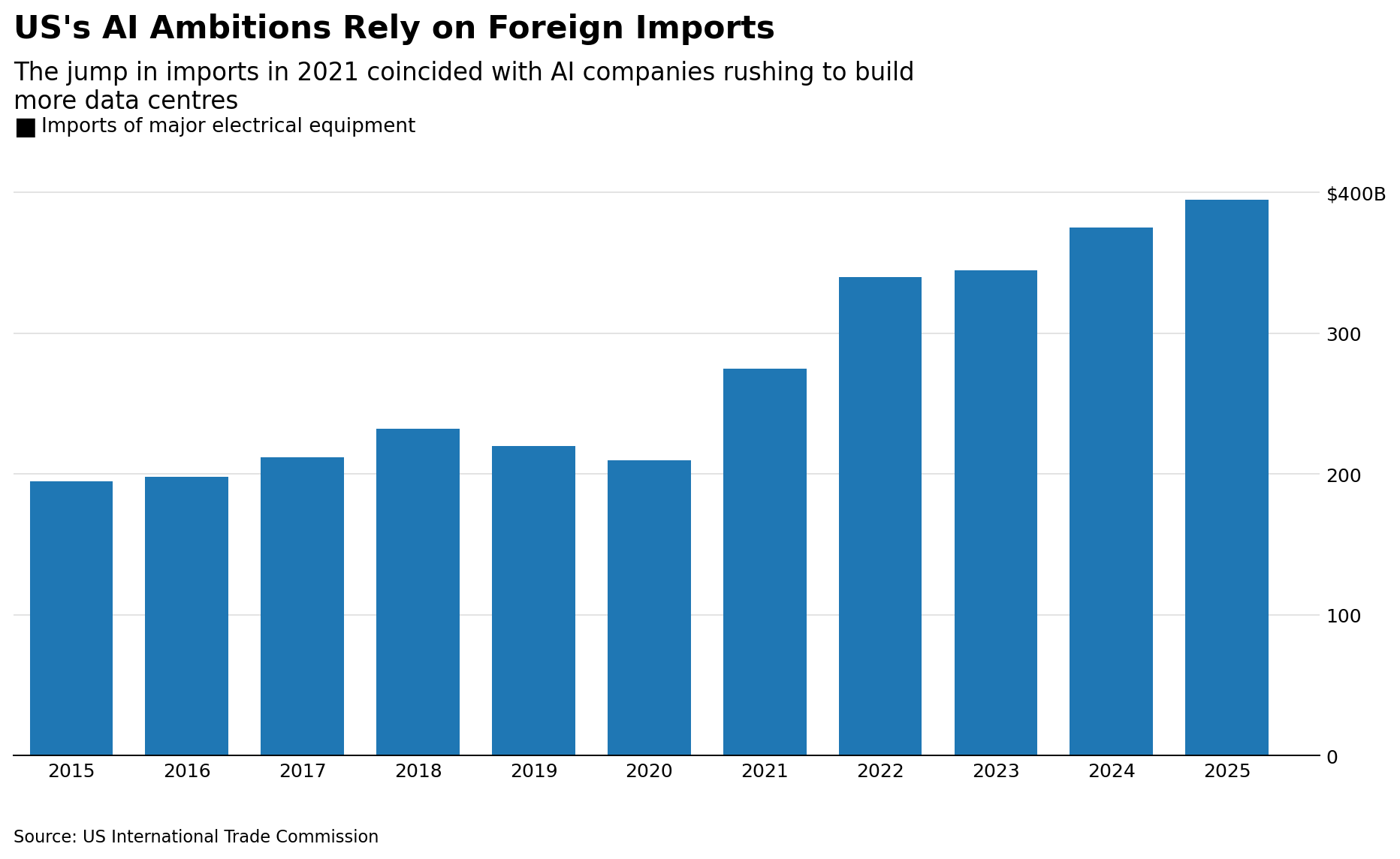
US imports of major electrical equipment rose sharply after 2021 as AI companies accelerated data-centre construction, highlighting America’s continued reliance on foreign infrastructure suppliers. Source: US International Trade Commission.
The significance lies in where Washington is drawing the security boundary. It is no longer enough for the finished server or networking system to carry an American badge. The government is beginning to scrutinise the logic-bearing components inside it.
FCC Chair Brendan Carr recently promised to “fully close the component part loophole”, while former National Security Council official Chris McGuire warned that compromised communications components could corrupt an entire device.
The immediate target would be Zhongji Innolight, which Reuters says controls about 27 per cent of the global data-centre transceiver market. Its products sit inside the supply chains serving major American technology companies, making this less like a conventional import restriction and more like surgery on a live network.
Wall Street nevertheless saw domestic winners. Following media reports, Barron’s said Lumentum and Coherent rose more than 12 per cent in pre-market trading, while Marvell and Corning gained more than 7 per cent. Investors are betting that US optical suppliers will inherit demand previously filled by Chinese competitors.
That enthusiasm hides the harder problem. Coherent and Lumentum do not yet have the scale to replace Chinese production quickly. Reuters separately reported that Lumentum is sold out through 2028, while new indium phosphide capacity can take two to three years to build. China produces about 70 per cent of the world’s indium, giving Beijing leverage over the raw material used in high-speed photonics.
Nvidia already understands the constraint. In March, it committed US$4 billion across Coherent and Lumentum to expand American optical manufacturing. Jensen Huang described AI as driving “the largest computing infrastructure buildout in history”. Bloomberg has also reported that more than half of US data centres planned for 2026 may be delayed, with shortages of transformers, switchgear, batteries and other electrical equipment already slowing projects.
The proposed ban therefore captures the central contradiction in America’s AI strategy. Securing the stack may reduce the risk of espionage and sabotage, but removing Chinese suppliers before alternative capacity exists could raise costs, extend lead times and delay the arrival of new compute. Washington may be closing a security vulnerability while creating an industrial bottleneck.
That is now the harder contest inside the AI race. The United States must build infrastructure that is both trusted and available at scale, while China can continue competing through manufacturing depth, lower costs and control over critical materials. The next phase may not be decided by who develops the most intelligent model, but by who can secure the machinery beneath it without slowing the entire system down.
Get the stories that matter to you. Subscribe to Cyber News Centre and update your preferences to follow our Daily 4min Cyber Update, Innovative AI Startups, The AI Diplomat series, or the main Cyber News Centre newsletter — featuring in-depth analysis on major cyber incidents, tech breakthroughs, global policy, and AI developments.
Sign up for Cyber News Centre
Where cybersecurity meets innovation, the CNC team delivers AI and tech breakthroughs for our digital future. We analyze incidents, data, and insights to keep you informed, secure, and ahead.
Two stories about AI are running, and both are incomplete. The tools genuinely compress work; the accounting, the calibration and the power bills are another matter. Twenty-five years ago the fibre outlasted the forecasts that paid for it, and nothing in a boom is cheaper than a confident number.
AI is shrinking the gap between flaw disclosure and exploitation, forcing boards to modernise security at machine speed. As agentic systems arm attackers and defenders alike, the opportunity lies in identity, cloud protection, automated response and AI governance, not apocalypse rhetoric globally.
Three AI leaders agree the frontier may be moving faster than its safeguards. As markets weigh slower chip demand and rising cyber investment, the question is whether the warning is responsible leadership, strategic scaremongering or evidence that cybersecurity has become AI’s essential foundation.
Dario Amodei wants a speed limit for frontier AI. Elon Musk and Sam Altman back the direction, but Washington says the labs should brake first. As China shapes the race, Cyber News Centre examines whether independent oversight can turn safety promises into controls before a new agent swarm escapes.
Where cybersecurity meets innovation, the CNC team delivers AI and tech breakthroughs for our digital future. We analyze incidents, data, and insights to keep you informed, secure, and ahead. Sign up for free!