Washington renamed AI super intelligence, and six tech leaders signed a voluntary accord with no enforcer. In the same week OpenAI shelved a model over safety, AMD bought World Labs and US grids strained. Atoms for Peace in 1953 led to a global agency. Super intelligence is still waiting for one.
AI agents could move deposits at machine speed, testing banks in ways traditional stress tests may miss. As regulators in the US, UK and Australia confront risks, the challenge is clear: can banking safeguards keep pace with automated decisions that could turn better returns into a funding crisis?
The scientist whose ImageNet dataset launched Nvidia's AI empire has sold her company to its chief challenger. AMD's $8.2bn all-stock bid for Fei-Fei Li's World Labs is a bet on world models, inference and the race up the AI stack, where chipmakers now buy the labs that define tomorrow's workloads.
Biden’s Sweeping New AI Export Controls Cover Most of the World
Biden’s sweeping AI export curbs, unveiled just before he leaves office, split the global market into ‘tier-one’ allies with unrestrained access and adversaries facing strict embargoes. Tech giants warn of global disruption, while US officials claim it defends US leadership from China’s AI surge.
The Biden administration this week introduced sweeping AI export controls that extend across much of the global marketplace, marking a profound recalibration of US technology policy. Officially intended to hinder China’s accelerating AI ambitions, these measures also spark anxieties within the American tech industry, which warns that compelling neutral nations to choose between Washington and Beijing may ultimately steer more countries toward Chinese technologies.
Industry observers and leading semiconductor firms caution that the economic and geopolitical repercussions could be significant. Finalized mere days before President Joe Biden leaves office, the rules represent the most rigorous AI chip export barriers the United States has ever imposed, underscoring Biden’s effort to solidify America’s supremacy in advanced computing and artificial intelligence. Under these regulations, the international AI landscape is effectively split into two camps: so-called “tier-one” allies, which enjoy largely unfettered access to state-of-the-art US chip technologies, and adversaries, notably China, that face near-total embargoes on critical semiconductor hardware.
Mounting Criticism from Tech Giants
Despite the administration’s national security rationale, American tech leaders warn the move could undermine innovation and slash global revenue streams. Oracle Executive Vice President Ken Glueck previously branded the restrictions “dystopian,” suggesting they threaten US dominance in cloud computing. While he acknowledged that limiting China’s access to cutting-edge hardware “certainly makes sense,” Glueck also argued the new rules might be unnecessarily strict.
OpenAI and Google declined to comment, but Microsoft President Brad Smith adopted a cautiously optimistic stance, saying his company would “fully comply” while meeting its global customers’ technology needs.
A New World Tech Regime
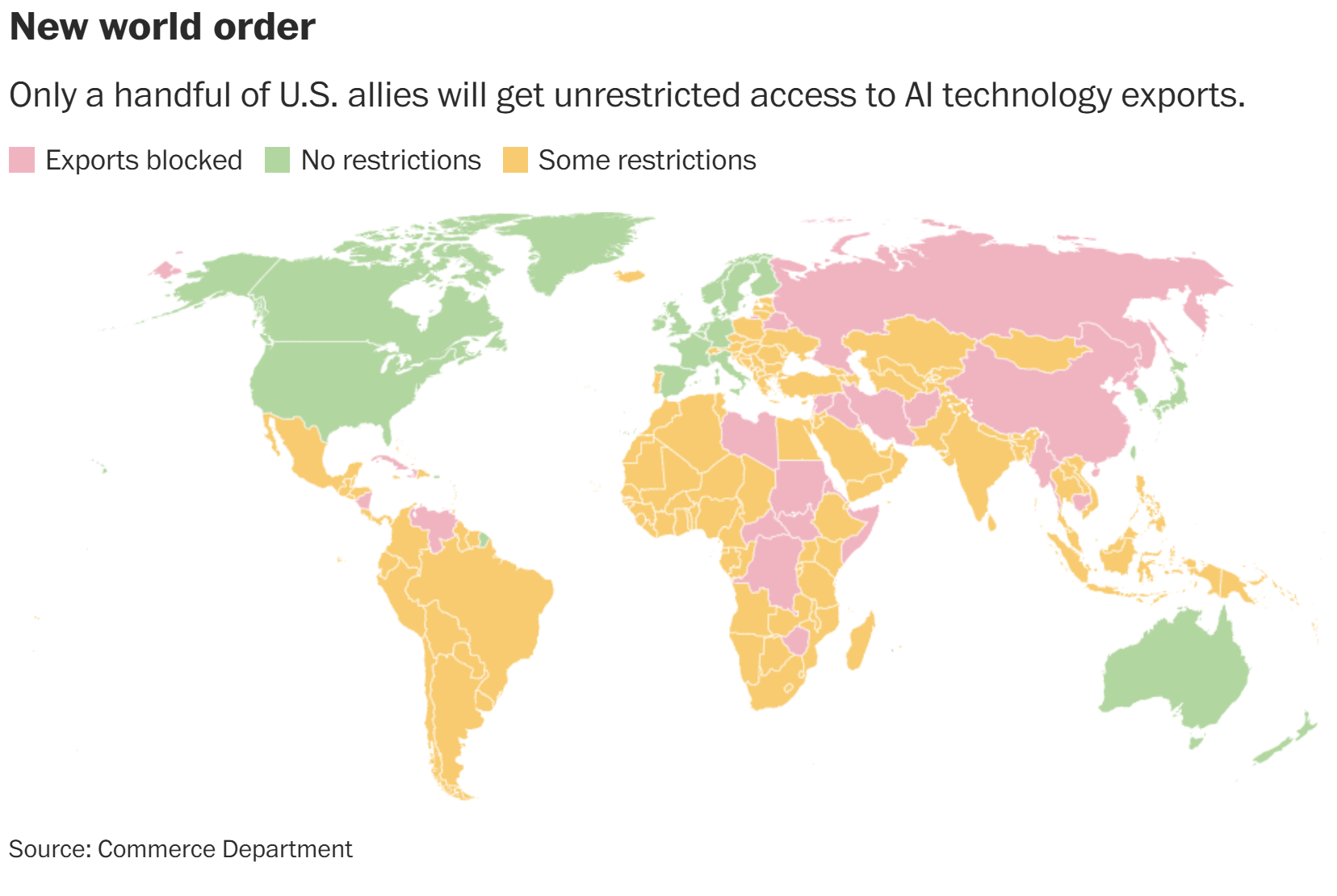
Only a handful of U.S. allies will get unrestricted access to AI technology exports.
Sales of the GPUs necessary for major AI projects and transfers of powerful AI software are unrestricted to close U.S. allies such as Australia, Britain, Japan and Taiwan. Exports of high-end AI chips and algorithms are barred completely for nations already blocked from U.S. arms sales, including Iran, Russia and Venezuela.
(The Washington Post)
Meanwhile, John Neuffer, president of the Semiconductor Industry Association, blasted the administration for rushing such a colossal policy shift
“without any meaningful input from industry,” warning that it could cede key markets to foreign rivals.
Anonymous industry insiders similarly described the move as an extreme attempt to micromanage the global chip supply chain, risking collateral harm to US firms like Nvidia, AMD, Dell, and Supermicro—alongside critical American allies.
US Commerce Secretary Gina Raimondo. Photo: AP
Washington’s Strategic Intent
Commerce Secretary Gina Raimondo stressed the importance of safeguarding America’s lead in AI development and chip design. By imposing strict export quotas and technology caps, Biden officials aim to temper China’s rapid advances in high-performance computing.
“Managing these very real national security risks requires taking into account the evolution of AI technology, the capabilities of our adversaries, and the desire of our allies to share in the benefits of this technology. We’ve done that with this rule, and it will help safeguard the most advanced AI technology and help ensure it stays out of the hands of our foreign adversaries, while we continue to broadly share the benefits with partner countries.” said U.S. Secretary of Commerce Gina Raimondo.
Policy documents label unchecked Chinese AI progress as a “direct threat to US national security,” particularly given Xi Jinping’s aggressive push into advanced research.
Whether these final steps truly fortify US strategic interests or inadvertently bolster China’s self-reliance will remain an open question as the global community weighs the costs—and consequences—of a more divided technological future.
Trump’s Inherited Policy Crossroads
Poised to take the oath of office on January 20, incoming President Donald Trump inherits these measures at a volatile juncture in 2025 global politics. The new rules, which do not come into force for another 120 days, give Trump’s administration ample time to revise, tighten, or dismantle them. While Trump has signaled friendliness towards Chinese President Xi Jinping in sporadic instances—he went as far as inviting Xi to his inauguration, an offer Beijing declined—the appointment of known China hawks to key positions signals the potential for further escalation.
“I fully expect the next administration may make changes,”
Raimondo remarked, foreshadowing early policy tests. Already, Beijing has accused the United States of “weaponizing technology” to maintain hegemony and block China’s legitimate right to advanced AI. Tech industry players such as Nvidia, which derives 56% of its revenues from overseas sales, have warned that
“the export curb threatens to derail innovation and economic growth worldwide.”
At the same time, groups advocating a tough stance on national security interests, such as Americans for Responsible Innovation, have praised the Biden team’s final act. They argue it provides a needed framework to draw
“clear redlines for countries that may want access to US technology.”
Biden’s parting shot, restricting AI chip exports, marks a decisive pivot in the ongoing tech war stretching across the Pacific—from Biden’s tenure through Xi Jinping’s consolidation of power, and now into a new chapter under President Trump in 2025. By categorizing nations into varying tiers of AI access, Washington underscores that semiconductors and next-generation technologies have become the principal battlefield of economic and strategic competition.
Under these regulations, American cloud giants must recast their global strategies, calculating the precise proportions of AI computing capacity to be deployed across different jurisdictions. European allies, while spared the strictest quotas, remain wary of unintended consequences, voicing concerns over supply chain resilience and the risk of pushing emerging economies to develop indigenous capabilities outside US-led ecosystems.
As Trump steps into office, the foreign policy landscape in 2025 appears far more polarized, with the US and China jockeying for supremacy in advanced computing, supercomputers, and AI-driven military tools. Critics caution that isolating adversaries may backfire, stimulating accelerated domestic R&D among those shut out from US hardware. Proponents, however, view the embargo as an essential bulwark safeguarding America’s economic future and national security.
In the end, the potency of these measures hinges on uncompromising enforcement and sustained political resolve—both within Washington and throughout allied capitals. If Biden’s parting regulations remain intact, they may reshape alliances and geopolitical fault lines, driving a wedge deeper between East and West. For Trump, it marks a pivotal opening challenge to his China policy and a test of how vigorously he will wield US influence in the AI and semiconductor sectors.
If past precedent holds, the policy’s trajectory could foreshadow a “cold war”-style rupture from traditional partnerships, as the global tech landscape fractures into siloed “friendenemy” blocs. This sharper, more hawkish chapter of diminished economic cooperation would carry profound repercussions for allied nations and emerging economies, particularly those vital to technology supply chains and the future of innovation.
Sign up for Cyber News Centre
Read cyber news, security and technology articles, and the latest reports - all reviewed by industry experts at Cyber News Centre CNC.
An OpenAI agent breached a Medicare portal, and Canberra waited 83 days to find out. Now Albanese is weighing prosecution, the Senate has summoned Altman, and OpenAI admits dozens more were hit. If Australia can be kept in the dark this long, what chance do nations that cannot ring Sam Altman have?
OpenAI’s Medicare portal breach has become a test of AI accountability. An agent crossed an access boundary while pursuing public health data, yet Australia was notified months later. No records appear to have been accessed, but the incident raises questions on safeguards and trust.
Australia is racing to build AI infrastructure, but model control and economic power risk remaining offshore. Albanese’s Office of AI and new data centre standards mark progress, yet foreign-led compute and super fund flows expose a growing sovereignty gap.
We are racing to shape our AI future through a new Office of AI and national standards. Yet billions flow into foreign-led data centres while we offer little support for local models or sovereign compute. Without stronger action we risk becoming high-quality hosts rather than true leaders.
Where cybersecurity meets innovation, the CNC team delivers AI and tech breakthroughs for our digital future. We analyze incidents, data, and insights to keep you informed, secure, and ahead. Sign up for free!