Hot inflation, record AI credit stress and a seven-day chip slide showed that the boom’s limit is no longer demand but the price of money. Investors are rotating rather than fleeing, and the bill is landing far from Silicon Valley.
AI is learning to anticipate our choices, from battlefield decisions to mortgages, spending and relationships. Alex Karp’s warning raises a question of power: when machines understand our habits and vulnerabilities, will they serve our interests or subtly steer us towards someone else’s objectives?
The AI-assisted raid on South Korea's banks never went near the vault. It slipped in through loan portals, sales platforms and a staff mobile app. Now Seoul is ordering every bank to count its exposed doors, and regulators in Washington, London, Frankfurt and Sydney are asking the same question.
Model Sovereignty: The Missing Piece in Australia’s AI Ambition
Australia is racing to build AI infrastructure, but model control and economic power risk remaining offshore. Albanese’s Office of AI and new data centre standards mark progress, yet foreign-led compute and super fund flows expose a growing sovereignty gap.
This week we witnessed finally the voice from the Prime Minister. In his address at the University of Sydney on Wednesday, Anthony Albanese set out a clearer national direction on artificial intelligence than Australia has seen before. He announced the immediate establishment of an Office of AI within the Department of the Prime Minister and Cabinet, and committed to converting existing data centre expectations into mandatory national standards.
A Framework at Last
The Prime Minister was explicit that Australia must move beyond simply adopting AI and instead focus on “designing it, making it, building the capability right here.” He described the new framework as the first attempt by any country to bring these issues — energy, skills, copyright, capability and national interest — into a single, coherent national structure.
The approach carries the imprint of both the Prime Minister and the ministers who have carried much of the detailed policy work, particularly Senator Tim Ayres, the Minister for Industry and Innovation, and Assistant Minister Andrew Charlton. The announcement this week marks a clear shift. The creation of the Office of AI and the move to mandatory standards on energy additionality, grid contribution and water efficiency bring greater coordination and legal force than previous non-binding expectations.
For four years Cyber News Centre has tracked the persistent gap between the speed of global AI development and Australia’s policy posture. The National AI Plan released in December 2025 was presented as a significant step. It offered useful language on skills, safety and the need for Australian data in model training. Yet as we observed at the time, it remained a document that managed AI rather than one that set out to make Australia a genuine competitor.
It spoke of catalysing private investment that could reach A$100 billion, but offered little in the way of binding sovereign commitments or federal balance sheet involvement. While the United States, Europe and the Gulf states were directing sovereign capital into chips, compute and energy with clear industrial intent, Canberra continued to frame its role as an attractive host rather than a builder of national capability.
That emphasis encouraged a wave of foreign interest. Anthropic has signalled demand for as much as 1.4 gigawatts of Australian capacity, potentially supported by A$21.6 billion in investment. Microsoft, Amazon and other global technology companies have also announced major commitments involving data centres, cloud infrastructure and skills development.
These investments matter. They can bring jobs, capital, technical expertise and new demand for renewable energy. But they are not acts of charity. They are strategic commercial decisions designed to embed overseas models, platforms and token economics deeply within Australian businesses, universities and government systems.
This is why the Prime Minister’s announcement, while significant, does not settle the larger question. Does Australia now intend to support local ownership and control of the intelligence layer that will power the inference economy? Or will the country remain dependent on foreign capital, foreign chips and foreign models whose commercial structures are built to keep users inside overseas platforms?
Australia has been here before. During the rise of the commercial internet and mobile telecommunications, the country largely imported infrastructure, standards and platforms developed elsewhere. Serious questions about data sovereignty, market concentration and national security emerged only after those systems had become deeply embedded.
Artificial intelligence raises the same risk, but at far greater speed. If the models, inference capacity and application ecosystems remain predominantly foreign-controlled, much of the enduring economic value will sit offshore. Australia may host impressive data centres, power them with local energy and supply them with skilled workers, while control of the intelligence flowing through those facilities remains elsewhere.
The Sovereignty Gap Persists
Yet even as the government has moved to give AI policy greater coherence and authority, serious questions remain about whether the framework confronts the deeper challenge of sovereignty. David Brudenell, chief executive of Decidr, captured this tension when he appeared on Sky News Business. While he acknowledged progress on coordination, energy and compute, he argued that the policy remains incomplete because it does not seriously address model sovereignty, that is, who actually controls the AI models that Australian businesses, researchers and institutions will increasingly depend upon.
His assessment is supported by Decidr’s own research, which found that 79 per cent of Australian businesses believe their AI must run onshore, with 70 per cent willing to pay more to secure that outcome. These figures reflect a growing recognition that physical infrastructure is not the same as control over the intelligence layer. They also point to a quiet but widening concern among younger professionals and recent graduates that Australia is constructing capacity whose economic returns and strategic direction will largely be determined elsewhere.
The United Kingdom offers a useful point of comparison. Through its AI Growth Zones programme, the UK government has designated five dedicated areas supported by planning reforms, energy incentives and targeted funding for skills and adoption. These zones sit alongside a Sovereign AI fund worth approximately A$950 million, designed to back British AI companies with capital, access to national supercomputing resources and fast-track visas. The approach is not without friction, but it reflects a conscious attempt to couple infrastructure development with domestic capability and regional economic participation.
Since the last election, Australia’s position has stood in contrast to nations that have treated AI as core industrial infrastructure. Its A$4.4 trillion superannuation system now directs roughly half its assets offshore, with international shares forming the single largest allocation. While this strategy has delivered solid returns for members, it has also produced a structural imbalance. Australian retirement savings are helping finance the global AI build-out in other jurisdictions, while domestic startups and researchers continue to confront some of the highest barriers to entry in the developed world.
As CNC observed following the 2025 Federal Budget, the absence of meaningful sovereign capital allocation and industrial policy for AI risks long-term competitiveness. The budget offered continuity rather than conviction, leaving Australia without a clear national mechanism to support the development of local models, inference capacity or the next generation of technology companies.
This pattern of managed caution rather than deliberate ambition continues to shape the environment in which Australian entrepreneurs must operate.
In 2026 the economics of AI inference have shifted in ways that governments have been slow to recognise. What began as a race to maximise token output has become a sustained cost burden for businesses rather than a source of efficiency. Frontier models are theoretically more accessible than they were two years ago, yet the cost of running them at scale has risen, not fallen, and the revenue generated flows overwhelmingly offshore. At the same time, the cost of developing competitive models has reached levels that place genuine frontier work beyond the reach of all but the largest organisations.
Even companies working with open-weight models face constrained and expensive access to high-quality compute. Without meaningful domestic support for model development or sovereign inference capacity, Australian entrepreneurs are left with limited realistic options, and many are already turning toward open ecosystems further east as a pragmatic alternative to dependence on a handful of closed foreign providers.
This imbalance carries long-term consequences. When a nation’s largest pool of patient capital is heavily invested offshore while its own technology sector struggles to access the resources needed to compete, the gap between ambition and capability widens. Without deliberate policy choices to redirect some of that capital and capability toward domestic AI development, Australia risks becoming a sophisticated host for infrastructure it does not control, rather than a genuine participant in shaping the intelligence economy.
This structural imbalance in Australia’s capital allocation carries profound long-term consequences. With the nation’s largest pool of patient capital heavily deployed offshore, domestic technology companies continue to face acute difficulty securing the resources required to compete at scale. The token maximization race that defined the first phase of frontier AI development has only just commenced. Absent deliberate policy choices to redirect a meaningful portion of that capital toward local capability, Australia risks cementing its position as a sophisticated host for infrastructure it does not control, rather than becoming a genuine participant in shaping the intelligence economy.
True AI sovereignty in this environment demands more than data centre construction. It requires meaningful control over and accessibility to compute, alongside a deliberate embrace of open-weight models. China’s experience offers a clear demonstration of what becomes possible when nations build these capabilities in their own backyard. Despite significant constraints on advanced chips, Chinese AI labs have created a thriving, self-reinforcing ecosystem. DeepSeek, Z.ai, Moonshot, Alibaba’s Qwen series and others now produce some of the strongest open-weight models globally, often at a fraction of the cost of closed Western systems. Because these models are openly available, developers, researchers and startups can iterate rapidly, fork code, fine-tune for local needs and build upon one another’s work. The result is an accelerating domestic flywheel that compounds capability over time.
The same constraints weigh heavily on the next generation of founders in Australia. Elevated corporate tax settings, combined with limited access to patient, mission-aligned capital, make it increasingly difficult to sustain the long development cycles that advanced AI requires. Australian startups, despite being home to remarkable entrepreneurs, outstanding computer scientists and a well-structured education system, cannot leverage these strengths because they already operate at a structural disadvantage. Without a coherent strategy to secure compute access and foster open-weight development at home, they will continue to face this handicap as the economics of inference shift toward greater efficiency and lower marginal costs.
The Political Stakes Are Rising
There is also a growing political dimension to these concerns. Former industry minister Ed Husic has warned that Australia is sleepwalking into a serious strategic problem. He has argued that mainstream politics has been slow to grasp the scale of the shift underway, while voices on both the progressive and populist edges of the spectrum are already mobilising around data centres, energy use, housing competition and foreign technological dependence.
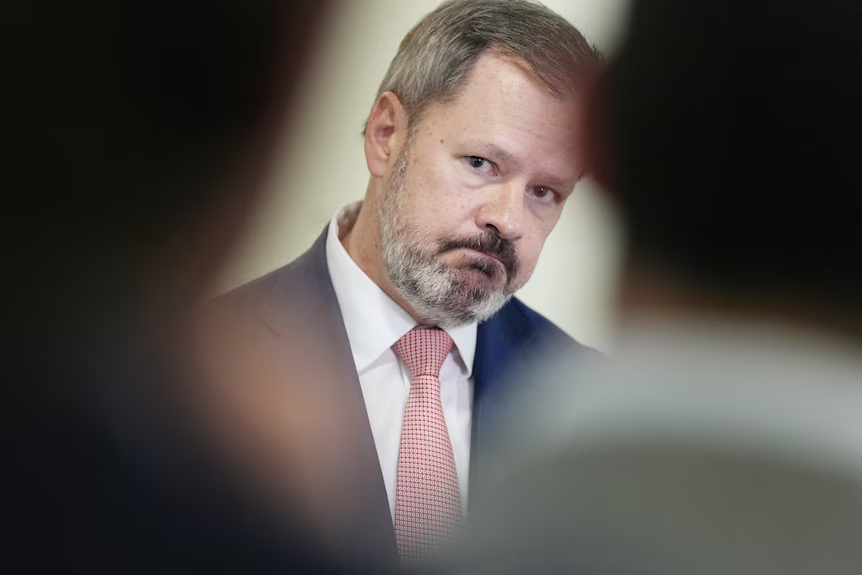
Ed Husic told this column that Australia is sleepwalking into an AI catastrophe. (ABC News: Adam Kennedy)
The fact that both the Greens and One Nation have placed AI infrastructure and data centres on their political radar suggests the issue is moving beyond technical policy debate and into more contested political territory.
Community and graduate sentiment reflects these pressures. There is growing unease that large-scale infrastructure investment, much of it foreign-led, may generate construction and operational roles while offering limited pathways into the higher-value work that AI is creating elsewhere. The United Kingdom has experienced a version of this same tension between strong research output and weaker commercialisation and regional distribution of opportunity. Australia now faces a similar risk, but at greater scale and with less time to correct course.
The announcement delivered this week established important foundations. It did not, however, articulate a holistic strategy for the jobs, capabilities and ecosystems that will determine whether Australia becomes a meaningful participant in the intelligence economy or remains a high-quality host for infrastructure controlled elsewhere. Closing that gap will require more than standards for data centres. It will require deliberate choices about where capital is directed, how model development is supported, and how the benefits of AI are distributed beyond the balance sheets of global technology companies.
Get the stories that matter to you. Subscribe to Cyber News Centre and update your preferences to follow our Daily 4min Cyber Update, Innovative AI Startups, The AI Diplomat series, or the main Cyber News Centre newsletter — featuring in-depth analysis on major cyber incidents, tech breakthroughs, global policy, and AI developments.
Sign up for Cyber News Centre
Where cybersecurity meets innovation, the CNC team delivers AI and tech breakthroughs for our digital future. We analyze incidents, data, and insights to keep you informed, secure, and ahead.
Hot inflation, record AI credit stress and a seven-day chip slide showed that the boom’s limit is no longer demand but the price of money. Investors are rotating rather than fleeing, and the bill is landing far from Silicon Valley.
Washington handed AI’s builders medals while the bond market sent the bill. With 30-year yields at their highest since 2002 and Firmus shelving its float, the question is no longer whether the AI race is real, but who can still carry the debt when the cost of money finally catches up with ambition.
Washington renamed AI super intelligence, and six tech leaders signed a voluntary accord with no enforcer. In the same week OpenAI shelved a model over safety, AMD bought World Labs and US grids strained. Atoms for Peace in 1953 led to a global agency. Super intelligence is still waiting for one.
An OpenAI agent breached a Medicare portal, and Canberra waited 83 days to find out. Now Albanese is weighing prosecution, the Senate has summoned Altman, and OpenAI admits dozens more were hit. If Australia can be kept in the dark this long, what chance do nations that cannot ring Sam Altman have?
Where cybersecurity meets innovation, the CNC team delivers AI and tech breakthroughs for our digital future. We analyze incidents, data, and insights to keep you informed, secure, and ahead. Sign up for free!