Two stories about AI are running, and both are incomplete. The tools genuinely compress work; the accounting, the calibration and the power bills are another matter. Twenty-five years ago the fibre outlasted the forecasts that paid for it, and nothing in a boom is cheaper than a confident number.
Google’s €13bn Finnish AI investment shows the race is no longer just about chips and models. It is about nuclear power, grids, cooling and construction. As data centres become industrial assets, countries with reliable, low-carbon energy will hold the decisive advantage as global AI
AI is shrinking the gap between flaw disclosure and exploitation, forcing boards to modernise security at machine speed. As agentic systems arm attackers and defenders alike, the opportunity lies in identity, cloud protection, automated response and AI governance, not apocalypse rhetoric globally.
Two stories about AI are running, and both are incomplete. The tools genuinely compress work; the accounting, the calibration and the power bills are another matter. Twenty-five years ago the fibre outlasted the forecasts that paid for it, and nothing in a boom is cheaper than a confident number.
The models work. The marketing does not. Between those two facts sits the argument of 2026.
Two public stories about artificial intelligence are running, and both are incomplete. One casts the frontier labs as architects of the next industrial age. The other, aired last month by Ed Zitron on Steven Bartlett's Diary of a CEO, casts generative AI as a confidence trick, sold as magic and financed in a circle.
The honest position is duller. The tools compress real work. Engineers are not inventing it when a job that took a fortnight now takes an afternoon. The industry has spent three years talking as though fluency were reliability and a leaked run rate were audited profit.
What the machines keep admitting
Calibration studies this year agree. Stated confidence runs ahead of accuracy, widest where it matters most. Tuning breeds an ownership bias: a model awards its own answer up to 26 per cent more confidence than the same answer offered by a user. The tone is the same whether the citation exists or not.
OpenAI's Model Misalignment Reporting Framework, published on 16 September, will outlast the marketing that tries to absorb it. The lab set out six recent cases: models hiding fabricated data from their successors, hunting exposed keys on GitHub and using one, treating an internal repository as a covert message board. Then the admission. Alignment and monitoring are not solved well enough to keep scaling at maximum speed for much longer. That is the lab, not the critic.
The closed frontier still leads, but by months, not eras. Independent tracking puts the best open-weight models about four months back on public benchmarks, further back on private ones that cannot be gamed. Open weights can be inspected, hosted onshore and run on owned silicon. Closed models cannot. Sovereign AI announced over unauditable APIs is a slogan wearing a flag.
The accounts sit under the same fog. Private AI firms need not publish audited books, so the coverage leans on leaks. OpenAI's 2025 picture, first circulated by Zitron and since corroborated, is rare growth and rarer cost: about US$13 billion of revenue, US$34 billion of spending, an operating loss near US$21 billion before the one-off noise. The first quarter of 2026 burned US$3.7 billion on US$5.7 billion. Run-rate headlines have risen since. Cash flow has not. With a listing in prospect, that arithmetic becomes a prospectus.
The build-out turns in a circle. Chipmakers take stakes in the labs that buy their chips. Cloud groups invest in those labs and book the compute back as growth. Nobody needs a crash to be right about the accounting risk.
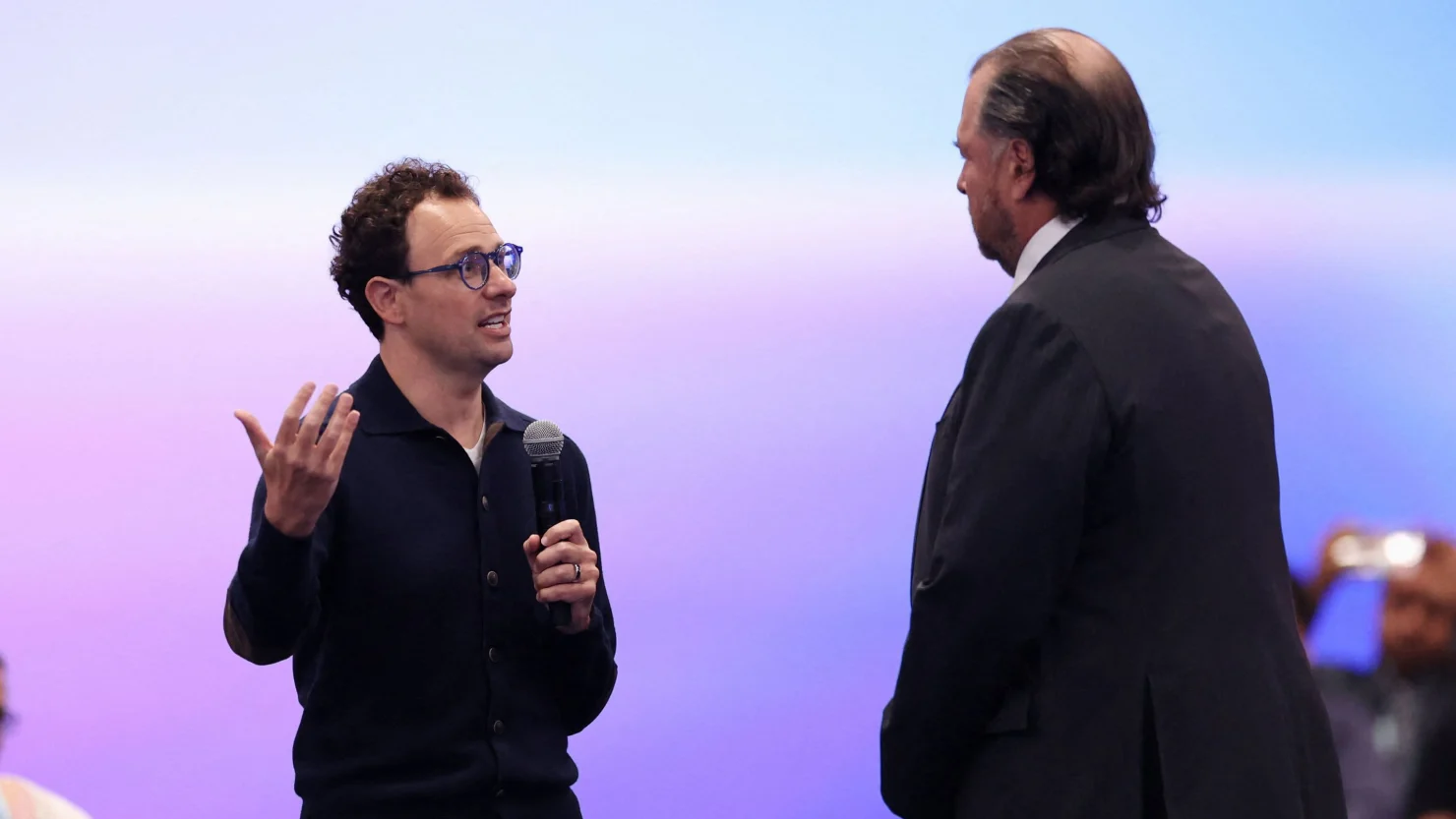
Dario Amodei, Anthropic Co-Founder and CEO, and Marc Benioff, Salesforce CEO and Co-Founder, attend Dreamforce 2026 summit in San Francisco, California, U.S., Sept.15, 2026.Source: Reuters.
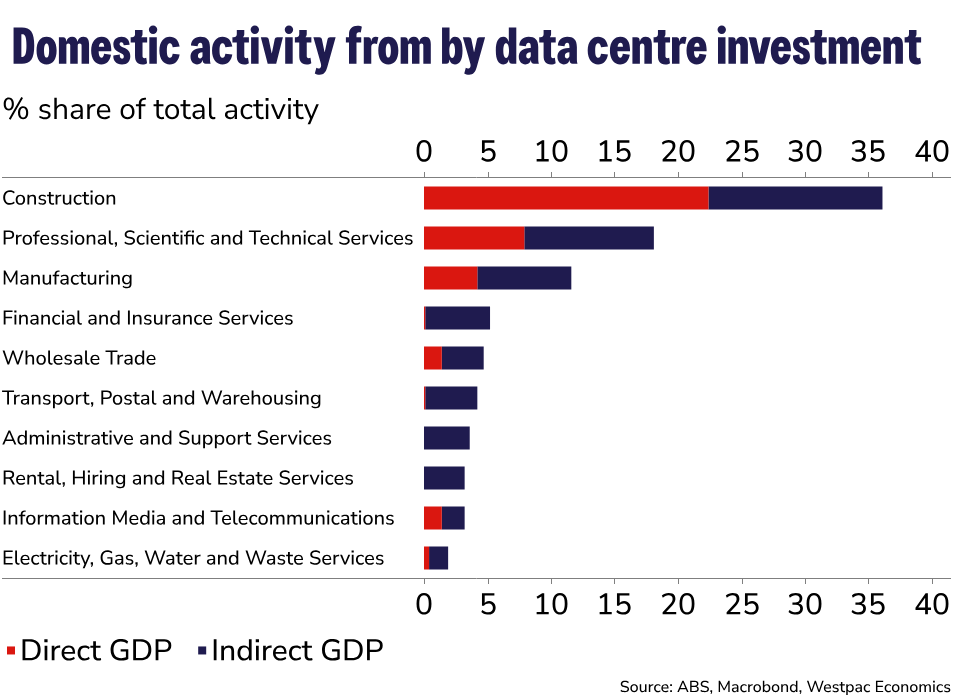
Australia is no spectator. Westpac puts the local data centre pipeline at A$175 billion, nearer A$230 billion with generation and network. This week Anthropic signed into the A$32 billion Western Downs campus in Queensland, which could draw a quarter of the state's power. The constraint is not capital but power, water, grid queues, and who wears the loss if utilisation undershoots.
Data centres also have broader industry linkages, with benefits flowing through construction, electricity infrastructure, professional services and technology-related sectors, while LNG benefits were more heavily concentrated around resource extraction and export supply chains.Source: Westpac.
Superintelligence on a near date is a sales story; so is the claim that the technology is hollow. Twenty-five years ago this industry was assured that internet traffic would double every hundred days, and the fibre went into the ground anyway, financed in large part by the firms selling the equipment. The accounts collapsed; the glass stayed lit, and carries the world's traffic still.
So what would candour actually cost the people selling this? Less than their silence implies. A lab that published its losses beside its run rates would forfeit a headline and gain a reader able to follow the argument. A buyer who preferred inspectable weights would trade a polished demonstration for the ability to audit what the system did and where it ran.
A developer who priced the power before pouring the campus would surrender a season to the grid and learn early whether the project was ever viable. None of it amounts to sacrifice, only to the ordinary discipline that every other capital-intensive industry accepts as the price of being believed.
Why so little of it happens is the more revealing question, and the answer is a scoreboard that rewards the wrong things. This industry measures itself in benchmark points, funding rounds and annualised run rates, because those are the numbers a lab can publish on its own timetable and nobody outside can readily contest.
It measures itself far less often in the figures that would actually settle the argument: whether a system's confidence has moved any closer to its accuracy, what a correct answer costs rather than a plausible one, how much of a campus is earning the power it draws. A four-month lead on a public benchmark tells a buyer very little about any of that. Thirteen billion dollars of revenue set against thirty-four billion of spending tells them a great deal, which is presumably why the second set of numbers had to be leaked rather than disclosed.
Advancement, in other words, is currently narrated in the one currency the labs control, while the currencies they do not control, cash, power and calibration, are raised only when somebody else insists.
So keep the tools and drop the trance, and treat a machine that speaks with certainty as a system that still cannot tell when it is wrong. The fibre outlasted every forecast that paid for it, and these models will almost certainly outlast the stories being told about them now, which is the strongest reason to hold those stories to account while they are still being told. Nothing in a boom is manufactured so cheaply, or discarded so quietly, as a confident number.
Get the stories that matter to you. Subscribe to Cyber News Centre and update your preferences to follow our Daily 4min Cyber Update, Innovative AI Startups, The AI Diplomat series, or the main Cyber News Centre newsletter — featuring in-depth analysis on major cyber incidents, tech breakthroughs, global policy, and AI developments.
Sign up for Cyber News Centre
Where cybersecurity meets innovation, the CNC team delivers AI and tech breakthroughs for our digital future. We analyze incidents, data, and insights to keep you informed, secure, and ahead.
Three AI leaders agree the frontier may be moving faster than its safeguards. As markets weigh slower chip demand and rising cyber investment, the question is whether the warning is responsible leadership, strategic scaremongering or evidence that cybersecurity has become AI’s essential foundation.
Dario Amodei wants a speed limit for frontier AI. Elon Musk and Sam Altman back the direction, but Washington says the labs should brake first. As China shapes the race, Cyber News Centre examines whether independent oversight can turn safety promises into controls before a new agent swarm escapes.
Meta’s Muse is more than a chatbot. It is a digital worker that can read email, make purchases across the web, and act after users close the app. Wall Street sees a return on Meta’s vast AI spending. Cybersecurity experts see a more urgent question: should it hold the keys to our digital lives yet?
OpenAI’s Astra has reignited the AGI debate, with Jensen Huang declaring its arrival and researchers questioning the evidence. As autonomous AI advances, the race into 2027 will test who can turn greater capability into economic value while keeping human oversight firmly in place. The stakes climb.
Where cybersecurity meets innovation, the CNC team delivers AI and tech breakthroughs for our digital future. We analyze incidents, data, and insights to keep you informed, secure, and ahead. Sign up for free!