Washington renamed AI super intelligence, and six tech leaders signed a voluntary accord with no enforcer. In the same week OpenAI shelved a model over safety, AMD bought World Labs and US grids strained. Atoms for Peace in 1953 led to a global agency. Super intelligence is still waiting for one.
AI agents could move deposits at machine speed, testing banks in ways traditional stress tests may miss. As regulators in the US, UK and Australia confront risks, the challenge is clear: can banking safeguards keep pace with automated decisions that could turn better returns into a funding crisis?
The scientist whose ImageNet dataset launched Nvidia's AI empire has sold her company to its chief challenger. AMD's $8.2bn all-stock bid for Fei-Fei Li's World Labs is a bet on world models, inference and the race up the AI stack, where chipmakers now buy the labs that define tomorrow's workloads.
The AI Race at Mid‑Year: Energy, Power and a Contested Future
At midyear, the AI race has become a contest for global power. Energy, chips, cybersecurity, capital markets and state intervention now shape who controls the inference economy, who pays for it, and who is left exposed in the next industrial order of machines, markets and sovereignty to come ahead.
A transparent silicon wafer cradled in a hand, containing a glowing industrial city, satellite and rocket, symbolising how AI chips, space infrastructure and human decisions now hold the balance of global power in something as small and fragile as what fits in your palm.
At the midpoint of 2026, the artificial intelligence race has stopped looking like a contest between clever software companies. It has started to look like a contest between national systems.
That is the first serious conclusion of the year so far. As I contemplate this moment, with all the available tools, technologies and intelligence now around me, I have chosen to return to the most basic elements of thought: imagination, speech and physical typing. There is a certain discipline in doing so. These tools make research faster, writing easier and analysis more expansive, but they also make influence easier to absorb without noticing. For this half-year insight, I want to stay as close as possible to the original intent, relying on wit, grit and judgement to bring forward an opinion that deserves a proper sit-down read.
After more than half a century of watching change move through society, business and technology, I thought I had already lived through the great transformation with the dawn of the internet. I was wrong. What has unfolded across the first six months of 2026 has been nothing less than a new velocity of transformation across society, markets, power and the enduring hope for a better future. Yet this hope now travels with inevitable, incalculable and unavoidable unintended consequences.
AI is no longer just a technological frontier, a model story or a trending news cycle. It is now a power story, a capital markets story, a new cybersecurity threat dimension, a chip war saga, an energy revolution and a foreign affairs conundrum. The countries and companies that control the stack will sell far beyond software. They will shape the terms of economic participation for everyone else.
This may be what walking through the singularity feels like. Not as a sudden science-fiction event, but as a lived passage through systems, markets, machines and decisions that are beginning to move faster than any single regime, boardroom or generation of leaders can fully forecast.
The Preamble: A Mainstream Cultural Shift
Never before has so much human fever for energy, power, exploration, and advancement become a mainstream cultural shift for nations that lead the AI race, those that participate and follow, and those that cannot afford to be part of it at all. The AI race has marked an acceleration of capital in developed nations and the birth of more billionaires, centimillionaires, and new millionaires in an emerging agentic era.
The AI race has marked an acceleration of capital in developed nations and the birth of more billionaires, centimillionaires, and new millionaires in an emerging agentic era. In the same period, the world witnessed its first trillionaire.
The Guardian observed that the old rules of capitalism no longer apply, and that the economic principles taught in school are not as relevant as hype, connections, and total, arbitrary control.
The broader wealth picture is staggering. UBS reported that the global billionaire count jumped 13 percent to a record 3,302 people, with billionaire wealth growing 25 percent on average in the year ended April 2026, compared with a 10.8 percent rise in average personal wealth worldwide. Forbes data confirmed that global billionaire wealth surged from $16.1 trillion in 2025 to $20.1 trillion in 2026, with the world adding nearly one new billionaire every day. Knight Frank projected the billionaire population will reach 3,915 by 2031, with the count of people worth at least $30 million rising from 162,191 in 2021 to 713,626 today, an increase of more than 300 percent.
The Hurun Global Rich List 2026 identified 114 billionaires linked to AI companies, with 46 new entrants in a single year. BlackRock CEO Larry Fink warned in his annual letter that AI could replicate wealth concentration on an unprecedented scale, noting that transformative technologies generate immense value captured by the firms that create them and the investors who hold stakes in those companies.
This is the right lens for the second half of the year.
The AI race is now a contest for deliberate control of the inference economy. Inference is where models are used in daily life, in businesses, banks, schools, hospitals, defence systems, media workflows, public administration and industrial planning. The training race still matters, but the deeper prize is the operating layer beneath the global economy. Whoever controls the chips, the clouds, the data centres, the models, the energy supply and the access rules will control how intelligence is priced.
This is why the old language of technology competition is no longer sufficient. The issue is not simply whether OpenAI, Anthropic, Google, Meta, xAI or a Chinese challenger has the better model this month. The issue is whether the United States, China, Europe, South Korea, Taiwan, Japan, India and the Gulf are building the physical and legal systems that decide who gets access, at what price, under whose rules and with whose security assumptions.
The first half of 2026 has shown that the AI race is becoming an industrial stack race. The stack begins with electricity and land. It moves through chips, advanced memory, packaging, cooling systems, water access, grid connections and fibre. It then moves into cloud regions, model deployment, cybersecurity controls, export rules, procurement standards, capital markets and application ecosystems. The winner will not be the nation with the most elegant chatbot. The winner will be the system that can turn intelligence into reliable, trusted and affordable infrastructure.
That is why energy has become central. The AI boom is often described as a software revolution, but this is misleading. It is also a power generation boom. Data centres are becoming one of the defining industrial loads of the decade. Without energy, there is no AI sovereignty. Without transmission, there is no deployment scale. Without cheap and reliable electricity, inference becomes expensive, rationed or politically exposed.
This is where Trump’s framing connects with the larger structural shift. His administration has placed AI and energy into the same strategic sentence. In effect, the message to Silicon Valley is clear: if you want the data centres, bring the power with you. That is a significant change in the politics of the AI buildout. It recognises that the public will not tolerate a future in which household electricity bills rise while hyperscalers and frontier labs capture the upside.
Business leaders now have little choice but to address every strategic and operational decision with AI in mind. A new generation of CEOs is coming through, born into the digital age, but the pressure is familiar: how to protect shareholder returns, improve efficiency and preserve the cultural fabric of an organisation when technology begins to look less like an enhancement and more like a threat to human talent.
Listening to the latest annual market reports, one can hear the shift clearly. AI is crossing from the innovation budget into infrastructure exposure. It is no longer a discretionary experiment sitting inside a technology team. It is becoming a board-level question of risk, productivity, workforce stability, welfare harm, energy cost and long-term competitiveness.
This will force boards to think beyond the simple question of which model their enterprise uses. They will need to ask where the model is hosted, how it is secured, which chips it depends on, what jurisdiction governs the data, how resilient the supply chain is and whether access could be interrupted by regulation or geopolitics.
That balance is unlike anything most leaders have faced since the early industrial revolution. We are walking a fine line between displacement and enhancement, between the optimistic promise of abundance and the practical reality of business today. Every company, from global institutions to family-owned enterprises, still has to look at the bottom line. Inflation, energy costs, wage pressure and capital discipline are not abstract themes. They are embedded in the ledger.
Another unavoidable issue is the imminent risk of this concept being misunderstood as purely technological. It is not. The cybersecurity layer is now impossible to separate from the commercial one. Anthropic’s Fable 5 and Mythos 5 episode has become the clearest warning. On June 12, Anthropic said the United States government had issued an export control directive suspending all access to Fable 5 and Mythos 5 by foreign nationals, including foreign national employees inside Anthropic. The company said it had to abruptly disable customer access in order to comply.
That was not a normal product disruption. It was state intervention in the frontier model market.
The stated concern was cybersecurity. According to Anthropic, the government believed it had become aware of a method to bypass safeguards and use the model to identify software vulnerabilities. Anthropic argued that the vulnerability finding was narrow, that similar capability already existed in other public models and that applying this standard across the industry could halt new frontier model deployments.
For business leaders, the lesson is plain. AI risk is no longer confined to privacy policies, procurement checklists or internal governance committees. It now sits at the intersection of national security, cyber defence, supply chains, capital allocation and operational continuity. The boardroom has entered the AI race, whether it intended to or not.
White House AI czar David Sacks framed the strategic logic:
"We want the world using the American AI stack, consolidating around our standards. If we don't offer that standard, Huawei will". Yet the same administration acknowledged through CNBC that restricting Anthropic's models "could give China time to catch up".
This is where the debate becomes serious. The cybersecurity risks are real. A red team study of Anthropic’s Fable 5 and Opus 4.8 found that even hardened frontier models remain breakable under sustained automated pressure, with confirmed harmful completions still emerging across multiple categories after adversarial testing. A government would be negligent to ignore that. Models that can reason through code, find vulnerabilities and act through tools can help defenders. They can also compress the time and skill required for attackers.
But the policy problem is precision. If the state blocks the best models from defenders while equivalent or near equivalent capability remains available elsewhere, the intervention can weaken the very security posture it is meant to protect. Cybersecurity is not only about restricting dangerous tools. It is also about ensuring that the defenders have access to the strongest tools before attackers do.
That is the difficult line Washington is now trying to walk. The United States wants the world to adopt the American AI stack, but it is also beginning to gate the most advanced parts of that stack. Reuters reported that the Trump administration had asked OpenAI to delay the wider release of GPT 5.6, and that OpenAI had discussed giving the United States government a 5 per cent stake as Washington increases scrutiny over advanced AI and public benefit.
For the ChatGPT maker, this is a profound change in the political economy of AI. OpenAI is no longer simply a frontier lab selling intelligence as a service. It is becoming part of a national strategic architecture. The same applies to Anthropic, whether it welcomes that role or not. These companies now sit in the grey zone between private enterprise, critical infrastructure, dual use technology and sovereign policy.
That grey zone will define the next stage of AI governance.
The immediate risk is not that governments intervene. They already have, and in some cases they must. The risk is that intervention becomes unpredictable. Markets can price regulation. They struggle to price arbitrary gatekeeping. Developers can plan for compliance. They struggle to build businesses when access to the best models can be paused by executive action, export control or political negotiation.
Europe has already shown what happens when regulatory uncertainty begins to shape product access. Apple and EU regulators have clashed over the roll out of upgraded Siri AI in Europe, with Apple saying European rules have delayed features and the European Commission arguing that interoperability obligations remain central to competition policy. The Digital Markets Act can impose fines of up to 10 per cent of global annual turnover for breaches.
Europe’s challenge is not that it wants rules. Rules are necessary. The challenge is that regulation can become a barrier between citizens and the best technology if it is too slow, too ambiguous or too disconnected from engineering reality. The EU is becoming the cautionary precedent for the AI age: a large, wealthy market with serious values, but one that risks watching frontier deployment happen elsewhere first.
The United States is not copying the European model, but it is moving toward a different form of intervention. Europe regulates through legal architecture. Washington is increasingly intervening through national security powers, access controls and industrial policy. These are different instruments, but they can create the same commercial effect if mishandled. The best tools become restricted. Deployment becomes slower. Smaller firms lose certainty. Developers look elsewhere.
China understands this opening.
The most important development in China is not simply that Beijing is spending more. It is that China is now emerging as a genuine counterweight to the Western AI system. Reuters reported in June that China is preparing a roughly 2 trillion yuan, or $295 billion, plan to build a nationwide network of data centres over five years, with state firms such as China Mobile and China Telecom expected to operate much of the infrastructure. The plan reportedly aims to rely on domestic suppliers, including Huawei, for at least 80 per cent of technology such as AI chips.
This is industrial policy with strategic patience. China is not only chasing the frontier model leaderboard. It is building the domestic infrastructure to reduce dependence on Nvidia, AMD and Western cloud providers. It is using state procurement, national planning and domestic demand to harden its own stack. Even where China remains behind, it is creating the conditions to keep catching up.
The Z.ai GLM 5.2 release sharpened that point. Reuters reported on July 2 that GLM 5.2, launched by Beijing based Z.ai, has gained Western attention for coding and agentic performance at a fraction of the cost of leading United States models. It has climbed usage charts on developer platforms and has become part of a growing debate over whether China is closing the gap with OpenAI and Anthropic.
This is the moment Western leaders need to take seriously. China does not need to beat the United States in every benchmark to become a powerful counterweight. It only needs to offer models that are good enough, cheaper, open enough and easier to deploy for large parts of the world. For startups, universities, developers, ministries and businesses outside the top Western alliance circle, cost and access matter.
That is where the Global South enters the story.
If American frontier models are expensive, gated or politically restricted, and Chinese models are cheaper, open weight or easier to host, many countries will make pragmatic choices. They may not prefer Beijing’s standards. They may not trust Chinese data governance. They may still see the United States as the deeper innovation engine. But they will choose the tools that are available, affordable and adaptable.
This is how technology influence spreads. Not always by persuasion. Often by price, availability and convenience.
The Taiwan chokepoint then becomes even more important. Taiwan is not only the world’s most sensitive geopolitical flashpoint. It is the enforcement frontier of the AI chip race. Reuters reported on July 2 that two Super Micro employees in Taiwan had been detained and two others released on bail as prosecutors investigated the alleged illegal export of advanced AI servers containing Nvidia chips. The servers are subject to United States export controls prohibiting export to China.
That case captures the new reality. Export controls are no longer abstract policy. They are being tested in warehouses, reseller networks, customs documents, distributor channels and server supply chains. Taiwan sits at the centre because it is both an advanced chip powerhouse and a geopolitical pressure point. Every server, accelerator and high performance board that moves through the region now carries strategic significance.
The West can write export controls in Washington, but enforcement runs through Taiwan, South Korea, Japan, Singapore, the Netherlands and a network of private companies. That is where the system becomes fragile. The more valuable the chips, the stronger the incentive to divert them. The more restrictive the controls, the more sophisticated the grey market becomes. The more China is denied access, the more determined it becomes to build alternatives.
This does not mean export controls are pointless. They can slow an adversary. They can protect the most sensitive capabilities. They can buy time. But they can also accelerate domestic substitution if used without a parallel strategy for alliance coordination, market access and trusted deployment. That is the paradox of the AI race in 2026. The United States is still the leader, but leadership is not the same as inevitability. China is still constrained, but constraint is not the same as defeat. Europe is still wealthy, but wealth is not the same as technological influence. Taiwan is still indispensable, but indispensability is not the same as security.
Nations in the Global South must use foreign technology for generation, for inference, for the basic functioning of their digital economies, to maintain growth and opportunity in education and new industrial development. As Felix Kim, from Redrob Labs noted in May this year, AI sovereignty depends on inference infrastructure, GPUs, cloud compute, and open-weight models, not just national LLM training. Nations that cannot run their own inference are not sovereign, regardless of how many models they train.
The ISS Institute for Security Studies concluded that without massive investment in power, connectivity, and computing, Africa's AI governance ambitions will remain aspirational. The UN told Africa to borrow, boost revenue, and tap pension and sovereign wealth funds to fund its AI push. But with less than 1 percent of the world's data centres, the continent is not behind. It is absent
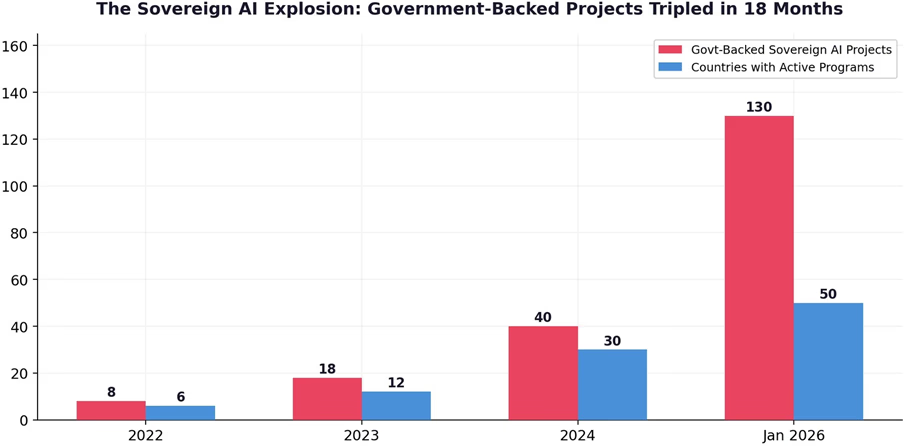
Figure 1. Government-backed sovereign AI projects tripled from ~40 to ~130 in 18 months, spanning 50+ countries. Source: Lawfare / CNAS Sovereign AI Index.
Enterprises need to understand whether their AI providers are exposed to export controls, whether their data flows cross sensitive jurisdictions, whether their model access can be interrupted, whether their cyber teams can use the best defensive tools and whether their compliance framework is ready for a world in which AI capability is treated like dual use infrastructure.
Capital markets are already absorbing this shift. SpaceX’s IPO and Elon Musk’s emergence as the world’s first trillionaire turned the AI, space and infrastructure narrative into a mainstream market spectacle. Reuters reported that the SpaceX IPO pushed Musk’s net worth to an estimated $1.1 trillion, with much of the value tied to SpaceX.
The Musk led company sold $75bn in shares before the market debut [Timothy Clary/AFP]
This matters beyond one founder. It shows how deeply markets are now rewarding control of strategic infrastructure: space systems, communications, AI compute, satellites, data flows and energy ambition.
The cultural meaning is just as important. AI has made infrastructure exciting again. It has pulled energy, chips, satellites, robotics and national industrial ambition back into the centre of public imagination. For the first time in a generation, the language of progress is not only about apps and attention. It is about power, machines, factories, rockets, satellites, models and the industrial base.
Meanwhile, the capital markets are minting a new aristocracy at a velocity that would have been unimaginable a decade ago. Elon Musk's trillion-dollar milestone is not merely a personal fortune. It is the symbolic maturation of an era in which AI, aerospace, and energy have fused into a single investable thesis. However, the wealth creation is staggeringly concentrated. The ten richest billionaires hold $2.4 trillion, more than the poorest half of humanity. The Global South faces the inference economics tax, forced to use foreign technology for generation, for inference, for the basic functioning of their digital economies, with no path to sovereignty.
The next phase of the AI race will turn on whether governments, markets, and model makers can align policy and power tightly enough to steer a fast‑maturing inference economy that is already rewriting the terms of competition, reshaping capital flows, and quietly redrawing the fault lines of the global system we live in today.
Get the stories that matter to you. Subscribe to Cyber News Centre and update your preferences to follow our Daily 4min Cyber Update, Innovative AI Startups, The AI Diplomat series, or the main Cyber News Centre newsletter — featuring in-depth analysis on major cyber incidents, tech breakthroughs, global policy, and AI developments.
Sign up for Cyber News Centre
Where cybersecurity meets innovation, the CNC team delivers AI and tech breakthroughs for our digital future. We analyze incidents, data, and insights to keep you informed, secure, and ahead.
Washington renamed AI super intelligence, and six tech leaders signed a voluntary accord with no enforcer. In the same week OpenAI shelved a model over safety, AMD bought World Labs and US grids strained. Atoms for Peace in 1953 led to a global agency. Super intelligence is still waiting for one.
The scientist whose ImageNet dataset launched Nvidia's AI empire has sold her company to its chief challenger. AMD's $8.2bn all-stock bid for Fei-Fei Li's World Labs is a bet on world models, inference and the race up the AI stack, where chipmakers now buy the labs that define tomorrow's workloads.
Two stories about AI are running, and both are incomplete. The tools genuinely compress work; the accounting, the calibration and the power bills are another matter. Twenty-five years ago the fibre outlasted the forecasts that paid for it, and nothing in a boom is cheaper than a confident number.
Google’s €13bn Finnish AI investment shows the race is no longer just about chips and models. It is about nuclear power, grids, cooling and construction. As data centres become industrial assets, countries with reliable, low-carbon energy will hold the decisive advantage as global AI
Where cybersecurity meets innovation, the CNC team delivers AI and tech breakthroughs for our digital future. We analyze incidents, data, and insights to keep you informed, secure, and ahead. Sign up for free!