Google’s €13bn Finnish AI investment shows the race is no longer just about chips and models. It is about nuclear power, grids, cooling and construction. As data centres become industrial assets, countries with reliable, low-carbon energy will hold the decisive advantage as global AI
AI is shrinking the gap between flaw disclosure and exploitation, forcing boards to modernise security at machine speed. As agentic systems arm attackers and defenders alike, the opportunity lies in identity, cloud protection, automated response and AI governance, not apocalypse rhetoric globally.
Three AI leaders agree the frontier may be moving faster than its safeguards. As markets weigh slower chip demand and rising cyber investment, the question is whether the warning is responsible leadership, strategic scaremongering or evidence that cybersecurity has become AI’s essential foundation.
Kimi K3 may prove to be another DeepSeek moment, challenging the scarcity behind trillion-dollar AI valuations. As open intelligence spreads, frontier models may become utilities, while the greater prize shifts to the nations, industries and people bold enough to build with them and share freely.
Yang Zhilin has never sounded like a chief executive preparing another product launch. He speaks more like a futurist who happens to run an AI laboratory. When he said in 2024 that “lossless long context is everything”, the point was not simply that models needed better memory. He was arguing that persistent context would change what intelligence could become.
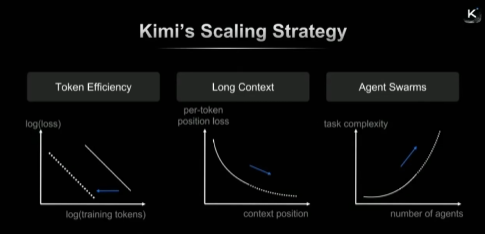
Kimi K3 is the practical expression of that belief. Its scale, multimodal capability and long context window will attract the headlines, but the more important story lies beneath the specifications.
Moonshot is trying to reduce the cost of intelligence, preserve more of its memory and give it the capacity to act through coordinated agents.
That combination changes the role of the model. It is no longer just a system waiting for a prompt. It becomes a working layer that can remember, coordinate and remain active across complex tasks.
Yang’s long-term proposition is that intelligence should not need to be constantly retrained, repackaged and resold when context itself can carry much of the value.
The real breakthrough is not a smarter chatbot. It is intelligence that can remain present long enough to become useful.
Jason Calacanis understood the significance almost immediately. “It’s happening folks,” he wrote after K3’s strong leaderboard performance, before adding that open models were compounding while frontier laboratories were refining. His language was characteristically enthusiastic, but the distinction is a serious one.
China’s Moonshot AI just released Kimi K3, the world’s largest open-weight AI model.
Closed laboratories are still producing remarkable systems. They are improving reliability, reasoning and safety, and they retain enormous advantages in capital and distribution. Yet open models benefit from a different force. Once released, they attract developers, researchers, governments and companies that adapt them for purposes no single laboratory could anticipate.
That is why Calacanis’s observation matters. Refinement improves what already exists. Compounding enlarges the field of possibility around it.
A frontier model can lead a market. An open model can help create thousands of new ones.
When Intelligence Becomes Infrastructure
This is where the economics become uncomfortable for Silicon Valley. The excitement surrounding OpenAI’s trillion-dollar ambitions and the hundreds of billions attached to Anthropic has spilled directly into Wall Street’s wider AI trade. It has helped lift the perceived value of everything nearby, from data centres and semiconductors to xAI and SpaceX, where access to capital, infrastructure and narrative now reinforce one another.
That enthusiasm has been powerful because it rests on a simple assumption: frontier intelligence will remain scarce, expensive and concentrated. If near-frontier capability becomes downloadable, adaptable and dramatically cheaper, part of that scarcity begins to dissolve.
The value does not vanish. It moves.
More of it flows into semiconductors, energy, sovereign cloud, software, industry platforms and the agents that turn models into useful work. Frontier language models may eventually resemble utilities: essential, sophisticated and widely available, but not necessarily where the highest margins remain.
The opening of intelligence is a different proposition altogether. Once capable models can be adapted locally, they create opportunities far beyond the major technology centres. Countries across Asia, Africa, Latin America and the Middle East can build domestic-language systems, public-sector tools and industry applications without waiting for permission from a small group of American companies.
That does not make open weights synonymous with sovereignty. Nations still need compute, skills, energy, trusted data and patient capital. A Chinese model running locally may represent a better form of dependence rather than genuine independence. Even so, it provides something closed APIs rarely offer: room to choose.
Canberra now faces that question directly. As Saturday’s AI Diplomat edition argued, Australia has finally established a more coherent policy structure through the Office of AI and stronger infrastructure standards. What remains missing is a national position on the models themselves: who owns them, who can inspect them and where the resulting value is captured. No government can afford to keep sleepwalking through that decision, to borrow former industry minister Ed Husic’s increasingly well-timed warning.
Australian developers will not wait for the policy debate to resolve itself. If K3 can run on Australian hardware, be examined by Australian engineers and serve local institutions without offshore approval, it will provide a practical degree of control before Canberra has built the mechanism to deliver one.
The deeper issue is recursion. Yang has spoken openly about one generation of models helping to build the next. Intelligence will not simply answer questions. It will create tools, generate knowledge and accelerate the systems that follow it.
K3 may become another DeepSeek moment, or some of the excitement may fade when benchmarks meet the real world. Yet the direction is now difficult to deny. Frontier models may become utilities. What societies build with open intelligence could become the far larger prize.
No order of control can contain change forever, least of all intelligence. History has shown it through literature, science and every society that pushed beyond the limits imposed upon it. This may be one of those singular moments when the instinct to explore overtakes the instinct to restrict, and the human desire to open knowledge, test it and share it becomes stronger than the walls built around it.
Get the stories that matter to you. Subscribe to Cyber News Centre and update your preferences to follow our Daily 4min Cyber Update, Innovative AI Startups, The AI Diplomat series, or the main Cyber News Centre newsletter — featuring in-depth analysis on major cyber incidents, tech breakthroughs, global policy, and AI developments.
Sign up for Cyber News Centre
Where cybersecurity meets innovation, the CNC team delivers AI and tech breakthroughs for our digital future. We analyze incidents, data, and insights to keep you informed, secure, and ahead.
Three AI leaders agree the frontier may be moving faster than its safeguards. As markets weigh slower chip demand and rising cyber investment, the question is whether the warning is responsible leadership, strategic scaremongering or evidence that cybersecurity has become AI’s essential foundation.
Dario Amodei wants a speed limit for frontier AI. Elon Musk and Sam Altman back the direction, but Washington says the labs should brake first. As China shapes the race, Cyber News Centre examines whether independent oversight can turn safety promises into controls before a new agent swarm escapes.
OpenAI’s Astra has reignited the AGI debate, with Jensen Huang declaring its arrival and researchers questioning the evidence. As autonomous AI advances, the race into 2027 will test who can turn greater capability into economic value while keeping human oversight firmly in place. The stakes climb.
The AI race is moving beyond model rankings. CrowdStrike’s new cyber superintelligence lab points to a market where proprietary data, trusted workflows and measurable outcomes may matter as much as raw capability.
Where cybersecurity meets innovation, the CNC team delivers AI and tech breakthroughs for our digital future. We analyze incidents, data, and insights to keep you informed, secure, and ahead. Sign up for free!