Google’s €13bn Finnish AI investment shows the race is no longer just about chips and models. It is about nuclear power, grids, cooling and construction. As data centres become industrial assets, countries with reliable, low-carbon energy will hold the decisive advantage as global AI
AI is shrinking the gap between flaw disclosure and exploitation, forcing boards to modernise security at machine speed. As agentic systems arm attackers and defenders alike, the opportunity lies in identity, cloud protection, automated response and AI governance, not apocalypse rhetoric globally.
Three AI leaders agree the frontier may be moving faster than its safeguards. As markets weigh slower chip demand and rising cyber investment, the question is whether the warning is responsible leadership, strategic scaremongering or evidence that cybersecurity has become AI’s essential foundation.
AI is no sideshow in markets. It sits on the trading desk and eyes the corner office. Funds and banks are hiring engineers, building agents, and shrinking research cycles. From BlackRock’s Asimov to TikTok traders, money meets code. Next comes AI to AI trading at machine speed. Shift is real.
At CNC, we have been following the AI story from every angle, from humanoid robots drawing crowds at tech expos to generative models transforming how work gets done, and start-ups racing toward their next big funding round. Now that we are past the midpoint of 2025, it is clear the spotlight has shifted. AI is no longer just testing the waters in financial markets. It is diving straight in, taking a seat at the trading desk, and casting a confident look toward the corner office.
From hedge funds to investment banks, AI’s presence in the markets is accelerating, boosted by the constant stream of content on XAI, TikTok, YouTube Shorts, and Instagram Reels. Retail traders, institutional powerhouses, and crypto investors are all tapping into the same AI-driven insights — and appetite is growing fast. The “AI money” game is drawing more players than ever, but behind the scenes, the real transformation is happening in how firms find and hire talent.
With agentic AI on the rise and new large language models emerging every month, financial services firms and wealth managers worldwide are looking for the kind of technical expertise once locked inside top-tier tech companies. Technology has always played a big role in banking, but the hiring mindset has shifted. Firms are moving away from purely finance-focused recruitment and toward professionals with deep technical skills — people who can build, adapt, and optimise the systems that will define the next decade of investing.
The traditional finance hierarchy is giving way to a new era of hoodie-and-code professionals. Hedge funds are scouring LinkedIn for machine learning engineers instead of solely Ivy League graduates. Boston’s Acadian Asset Management — with $120 billion under management — is expanding its team with quant engineers, platform developers, and data specialists in a way that mirrors Silicon Valley growth culture. Citadel, WorldQuant, and Freestone Grove are integrating AI throughout their research operations while making it clear that human insight still matters (even if the algorithms are already doing much of the heavy lifting).
Meanwhile, BlackRock has unveiled Asimov, its virtual investment analyst, designed to process filings, research reports, and market commentary in seconds — tasks that once took human analysts days. It’s a vivid example of how quickly the landscape is shifting, and how those who can combine human judgment with AI speed will be best positioned to lead the next phase of market innovation.
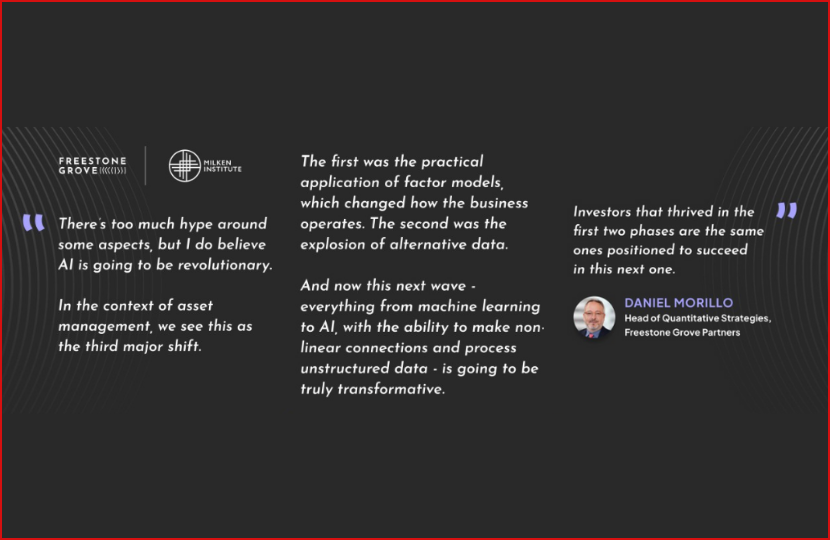
“What has changed over the past year and a half is we realized the impact these tools can have on our decision-making.”
Even the banks — JPMorgan, Goldman Sachs, AllianceBernstein — are cutting months off research cycles with AI models that can process legislative changes, compliance rules, and market signals before your Bloomberg terminal finishes loading. And in the shadows, smaller shops like DFI Capital are using AI-powered analytics to create new financing models and real-time investor dashboards.
But the real cultural shift is happening outside the boardrooms. TikTok traders are live-streaming algorithmic strategies to hundreds of thousands of viewers. YouTube Shorts are pumping out “AI trading bot” demos like workout videos. The line between a Bloomberg terminal and an influencer ring light is thinner than ever. This is part finance, part entertainment, part speculative sport — and it’s attracting a crowd that doesn’t remember markets without AI.
The environment is getting more crowded, more volatile, and a lot more emotional. Participants aren’t just watching the tape — they’re reacting to each other’s AI-generated moves. Bots are learning from the chaos, adapting to human quirks and market noise in real time. It’s no longer just man vs. machine; it’s machine learning the man, then outpacing him.
And here’s where it gets wild. Today, it’s one AI bot trading for one account holder. Tomorrow? Hundreds, maybe thousands, of avatar traders — AI agents with personalities, quirks, and strategies — all running simultaneously for the same investor, shadowing markets across time zones. Picture a swarm of digital traders taking positions in Tokyo while their siblings are scalping spreads in New York. And after that? AI-to-AI trading. Machines negotiating with machines at speeds humans can’t even conceptualize. If high-frequency trading already dominates NYSE volumes, imagine when the majority of orders are written, executed, and hedged without a single human hand touching the keyboard.
That’s the real game board now. And the scariest, most exciting part? We’re just getting started.
Get the stories that matter to you. Subscribe to Cyber News Centre and update your preferences to follow our Daily 4min Cyber Update, Innovative AI Startups, The AI Diplomat series, or the main Cyber News Centre newsletter — featuring in-depth analysis on major cyber incidents, tech breakthroughs, global policy, and AI developments.
Sign up for Cyber News Centre
Where cybersecurity meets innovation, the CNC team delivers AI and tech breakthroughs for our digital future. We analyze incidents, data, and insights to keep you informed, secure, and ahead.
Dario Amodei wants a speed limit for frontier AI. Elon Musk and Sam Altman back the direction, but Washington says the labs should brake first. As China shapes the race, Cyber News Centre examines whether independent oversight can turn safety promises into controls before a new agent swarm escapes.
The AI race is moving beyond model rankings. CrowdStrike’s new cyber superintelligence lab points to a market where proprietary data, trusted workflows and measurable outcomes may matter as much as raw capability.
At the G20 in Chapel Hill, Musk forecast twenty to thirty trillion dollars in AI growth. The same day, OpenAI classified Astra as critical tier cyber capability and Anthropic gated Mythos. Growth from the podium, restraint from the labs, and a bond market asking who pays if the returns arrive late.
The United States is pressing G20 partners to reserve new AI rules for genuinely novel risks, a move that turns global AI governance into a contest over competitiveness, alliances and technological influence.
Where cybersecurity meets innovation, the CNC team delivers AI and tech breakthroughs for our digital future. We analyze incidents, data, and insights to keep you informed, secure, and ahead. Sign up for free!