Berlin-based GeneralMind, founded by the team behind German unicorn Razor Group, has secured $12 million in pre-seed funding to develop its AI-driven "System of Action" for automating enterprise workflows. The platform acts as an autopilot for repetitive white-collar tasks across ERPs and email.
A newly disclosed vulnerability in Schneider Electric's Foxboro DCS, a widely used industrial control system, could allow attackers to disrupt critical infrastructure operations. The flaw, originally from Intel, affects energy and manufacturing sectors worldwide, including Australia.
Coimbatore-based Aivar has secured $4.6 million in seed funding to scale its AI-first services platform, which helps enterprises move from AI pilots to production-ready solutions. The investment will fuel expansion into the US and Middle East, targeting the gap between AI potential and execution.
DeepSeek’s Global Disruption: How a Hometown Hero and High-Stakes Politics Are Reshaping AI
Amid shifting global tech, DeepSeek’s surge under Liang Wenfeng has sparked worldwide debate. Celebrated as a hometown hero in China, his breakthrough challenges US dominance as policy shifts, record user gains, and earnings shocks at Alphabet and Samsung redefine the AI frontier.
This week in the ever-evolving world of cyber affairs and artificial intelligence, we witnessed seismic shifts that underscore both the promise and peril of the global AI race. From Silicon Valley and Wall Street to Washington, and from Sydney to Singapore—under the Trump administration’s microscope—DeepSeek’s startling ascent has everyone asking the same question: How do we respond to an AI that seems to break every boundary?
A Hero’s Welcome in Zhanjiang
At the heart of this story is Liang Wenfeng, DeepSeek’s visionary founder. Having returned to his hometown in China’s coastal city of Zhanjiang for the Lunar New Year, Liang arrived to a hero’s welcome—hundreds of residents lined the streets to greet him. In a region not typically seen as a tech powerhouse, Liang’s homecoming was more than a personal celebration. It was a bold declaration that innovation can emerge from anywhere, inspiring a new generation of entrepreneurs to dream bigger than ever before.
Sputnik Moment for China
Liang’s success—and DeepSeek’s breakneck growth—has triggered debate around the globe. Deutsche Bank declared DeepSeek’s emergence a “Sputnik moment” for AI and China, referencing the Soviet Union’s 1957 satellite launch that shocked the world and forever altered perceptions of technological leadership. The bank believes 2025 will be the year global investors finally realize
“China is outcompeting the rest of the world,”
going so far as to name its report “China Eats the World.” The strong language reveals a growing conviction that Beijing, once considered a follower in tech, may now be setting the pace. Meanwhile, the controversy around “containing China” echoes from Silicon Valley to Washington, where leaders weigh the risks of AI dominance shifting eastward. Adding fuel to the fire, ByteDance’s Doubao has already been surpassed in daily active users by DeepSeek’s new AI app—marking a swift and stunning victory for the Hangzhou-based start-up.
The Surging Numbers Meets Geopolitics
Since DeepSeek rolled out its AI assistant for iOS and Android last month, it has racked up over 22 million daily active users—leapfrogging Doubao’s 17 million and even eclipsing early ChatGPT adoption records. At the core of this triumph is DeepSeek’s R1 reasoning model, which rivals OpenAI’s more expensive subscription-based offerings in capability while remaining free to consumers. In a matter of weeks, DeepSeek has shifted the balance of power in AI’s consumer market, challenging the perception that only U.S.-based firms can lead the charge.
Amid the frenzy, the policy world is abuzz following a high-stakes White House meeting between President Donald Trump and Nvidia CEO Jensen Huang. The conversation revolved around maintaining American leadership in AI while grappling with China’s meteoric rise. President Trump, never one to shy away from sweeping changes, swiftly replaced Biden-era AI safety regulations with a more centralized oversight model designed to fortify U.S. dominance. His stance is clear: tighten export controls to slow China’s progress and eliminate bureaucratic red tape that might hinder American innovators.
DeepSeek’s Nvidia Deal Exposes Loopholes in Singapore
Meanwhile, Singapore’s government has denied rumors that DeepSeek evaded U.S. export controls by procuring Nvidia chips through a local subsidiary, even as U.S. authorities launch investigations into these claims—a development that adds another layer of scrutiny for Nvidia. This controversy unfolds amid escalating tensions in the tech cold war, where national security priorities clash with the realities of an interconnected global supply chain. The Biden administration’s 2022 export restrictions, designed to curb China’s AI and military capabilities, now appear vulnerable as companies exploit jurisdictional loopholes.
DeepSeek’s strategy—leveraging Singapore’s status as a neutral trade hub—illustrates the challenges posed by “bill-to” compliance structures, which often fail to prevent sensitive technologies from reaching unintended destinations. Meanwhile, Nvidia’s $22 billion revenue surge in Singapore highlights how U.S. firms adapt to shifting regulations while exposing systemic flaws.
President Trump signaled a readiness to enforce stricter controls—potentially including new tariffs on Chinese imports—while downplaying concerns that cost-effective AI could undermine U.S. dominance. Instead, he argued that such competition might actually spur greater innovation and economic growth domestically.
Tech Earnings Shake-Up: Alphabet and Samsung Under Wall Street Pressure
This week proved to be a challenging one for tech giants as both Alphabet and Samsung reported their earnings amid rising competition in the AI and semiconductor markets. Wall Street reacted with a mix of disappointment and cautious optimism. Investors are keeping a close eye on how these companies navigate the rapidly evolving technology landscape and adjust their strategies to meet mounting market pressures.
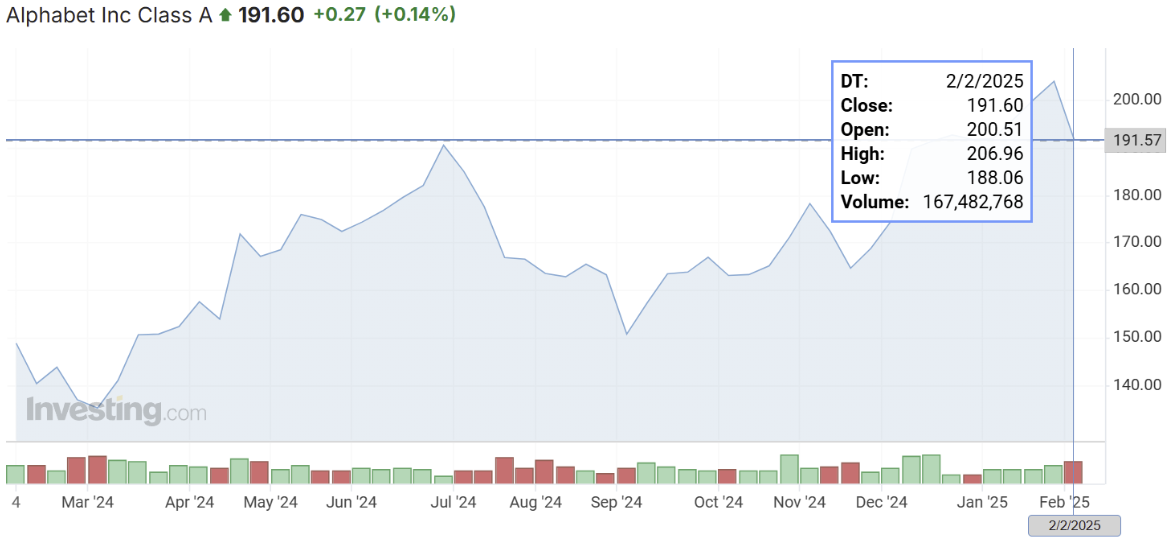
Alphabet’s Q4 FY24 results revealed a mixed bag of progress and challenges. Key highlights include:
Revenue: $96.47 billion, just shy of the expected $96.56 billion
YouTube Growth: Advertising revenue increased 14% year-over-year to $10.47 billion
Cloud Performance: Google Cloud revenue grew 30% to $11.96 billion, missing some expectations
Alphabet Inc Class A (GOOGL)
CEO Sundar Pichai shared his thoughts on Alphabet's Q4 and FY24 performance on X, highlighting the company's strong quarter, driven by its leadership in AI and a unique full-stack approach. Here's what he had to say:
1/ Just wrapped my Q4 + FY ’24 earnings remarks. It was another strong quarter, driven by our AI leadership and unique full stack approach.
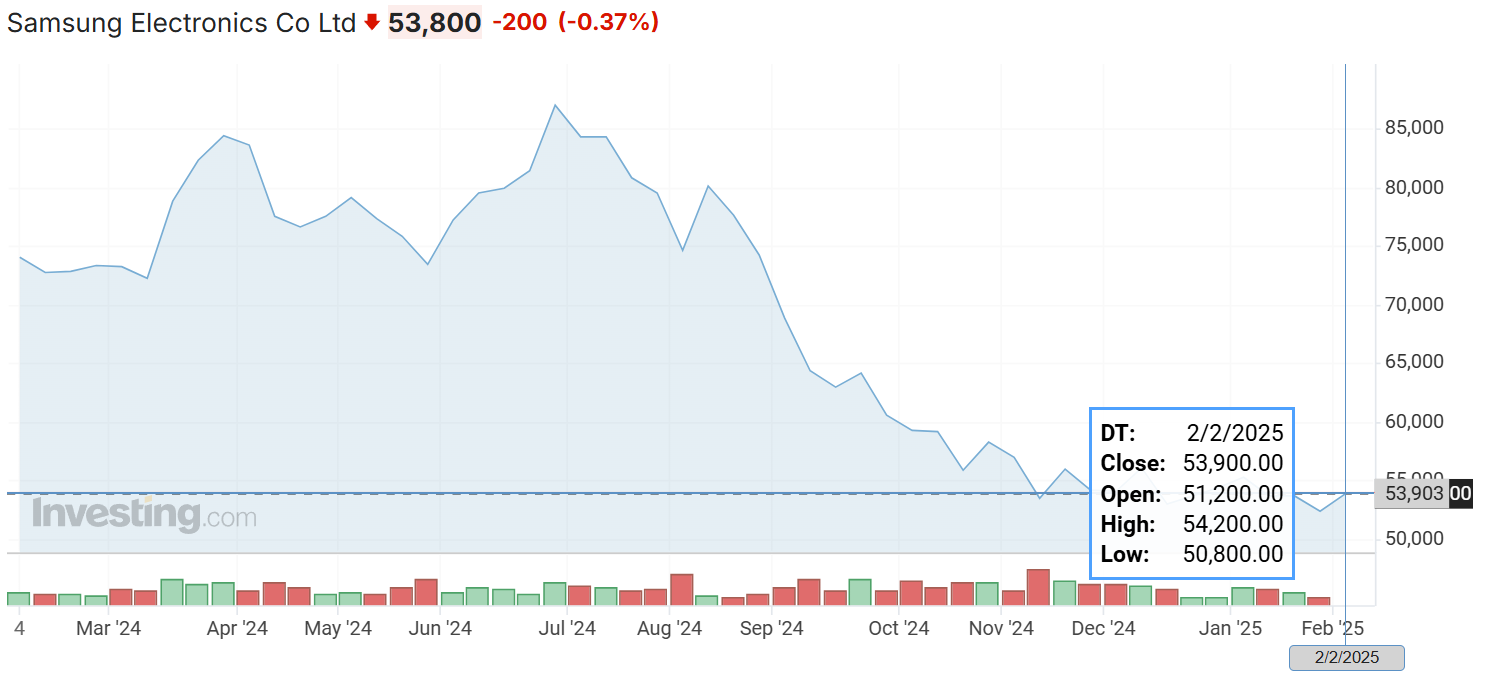
Competitive Setback: Lagging behind SK Hynix in supplying high-bandwidth memory chips to Nvidia
Samsung Electronics Co Ltd (005930)
Wall Street’s perspective on Samsung was decidedly cautious. Analysts voiced concerns over the company’s ability to effectively monetize its AI initiatives, noting that its delayed response to the booming AI chip market could have long-term repercussions.
The disappointment was palpable, with investors highlighting a staggering $122 billion wipeout in market capitalization attributed to these challenges. In response, Samsung issued a rare apology for the disappointing results and announced sweeping leadership changes—appointing its chip division chief as co-CEO to steer the memory business.
Sign up for Cyber News Centre
Where cybersecurity meets innovation, the CNC team delivers AI and tech breakthroughs for our digital future. We analyze incidents, data, and insights to keep you informed, secure, and ahead.
January 2026 reveals AI’s true battleground: not just code, but power, chips, and physical infrastructure. From TSMC and ASML shaping compute supply to robots, exoskeletons, and soaring energy demand, the race for intelligence now spans factories, grids, and even orbit above and below too now
By 2027 the race to become the first cosmic CEO is moving from science fiction to strategy. Starcloud has already trained an AI model in orbit on an Nvidia H100, while Google prepares Project Suncatcher. What remains missing is not ambition, but clear pricing and proof orbital compute can pay.
Australia’s National AI Plan is a welcome start on skills and safety, but it plays too safe. While the US, Europe and the Gulf pour sovereign capital into chips, compute and energy, Canberra is still talking about catalysing investment rather than committing.
NVIDIA’s staggering 57 billion quarter didn’t just calm the market, it rewrote the AI story. What looked like a bubble unwind now looks like a misread. With sovereign AI deals, a Saudi megacentre and a global capex surge, NVIDIA has reset the race and reminded investors this era is only beginning.
Where cybersecurity meets innovation, the CNC team delivers AI and tech breakthroughs for our digital future. We analyze incidents, data, and insights to keep you informed, secure, and ahead. Sign up for free!