Hot inflation, record AI credit stress and a seven-day chip slide showed that the boom’s limit is no longer demand but the price of money. Investors are rotating rather than fleeing, and the bill is landing far from Silicon Valley.
AI is learning to anticipate our choices, from battlefield decisions to mortgages, spending and relationships. Alex Karp’s warning raises a question of power: when machines understand our habits and vulnerabilities, will they serve our interests or subtly steer us towards someone else’s objectives?
The AI-assisted raid on South Korea's banks never went near the vault. It slipped in through loan portals, sales platforms and a staff mobile app. Now Seoul is ordering every bank to count its exposed doors, and regulators in Washington, London, Frankfurt and Sydney are asking the same question.
The AI Battleground: How the U.S. and China Are Competing for Supremacy
The U.S. and China are battling for AI dominance as Stargate’s $500B initiative drives U.S. investment, while China’s DeepSeek disrupts with cost-efficient AI, surpassing ChatGPT on Apple’s App Store. A “large-scale malicious attack” hit DeepSeek, highlighting fierce competition and security risks.
The escalating competition between the U.S. and China in artificial intelligence is reshaping global technology and economic strategies. As China’s DeepSeek gains traction with its cost-efficient AI advancements, President Donald Trump has signaled a strong response, calling it a “wake-up call” for the U.S. tech sector. Addressing Republican lawmakers, he warned that semiconductor chips produced abroad—including those from Taiwan’s TSMC—could face tariffs unless manufacturing shifts to the U.S. Trump acknowledged the disruptive nature of China’s progress, noting,
“Today and over the last couple of days, I’ve been reading about China… coming up with a faster method of AI and much less expensive method.”
While recognizing the challenge, he also saw an opportunity, adding,
“That’s good, because you don’t have to spend as much money. I view that as a positive, as an asset.”
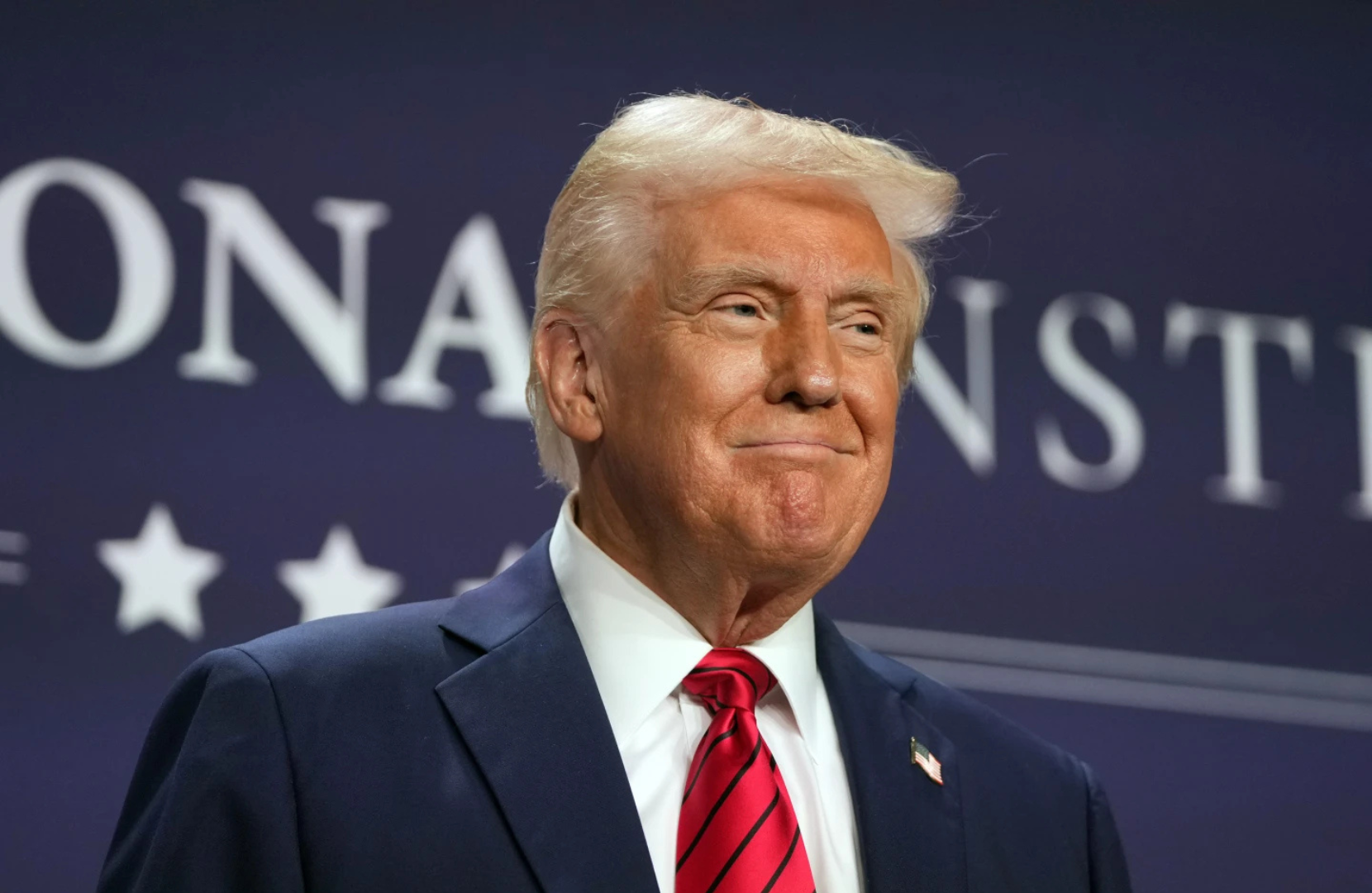
President Donald Trump. (AP Photo/Ben Curtis)
China’s AI strategy has taken a different approach from the U.S., prioritizing cost efficiency and adaptability rather than large-scale infrastructure spending. DeepSeek, a Hangzhou-based startup, exemplifies this by developing a powerful AI model at a fraction of U.S. costs. Its R1 reasoning model, released in January, was built for just $5.58 million using Nvidia’s H800 chips—significantly undercutting the cost of training models like OpenAI’s.
DeepSeek’s chatbot has dethroned ChatGPT on Apple’s App Store, triggering market anxiety in the U.S. Nvidia lost $592.7 billion in market value as investors reacted to the possibility of Chinese AI firms gaining a competitive edge. Analysts like Jefferies’ Edison Lee have warned that U.S. restrictions on semiconductor access have pushed China to innovate more efficiently, stating,
“China is the only market that pursues LLM efficiency owing to chip constraints.”
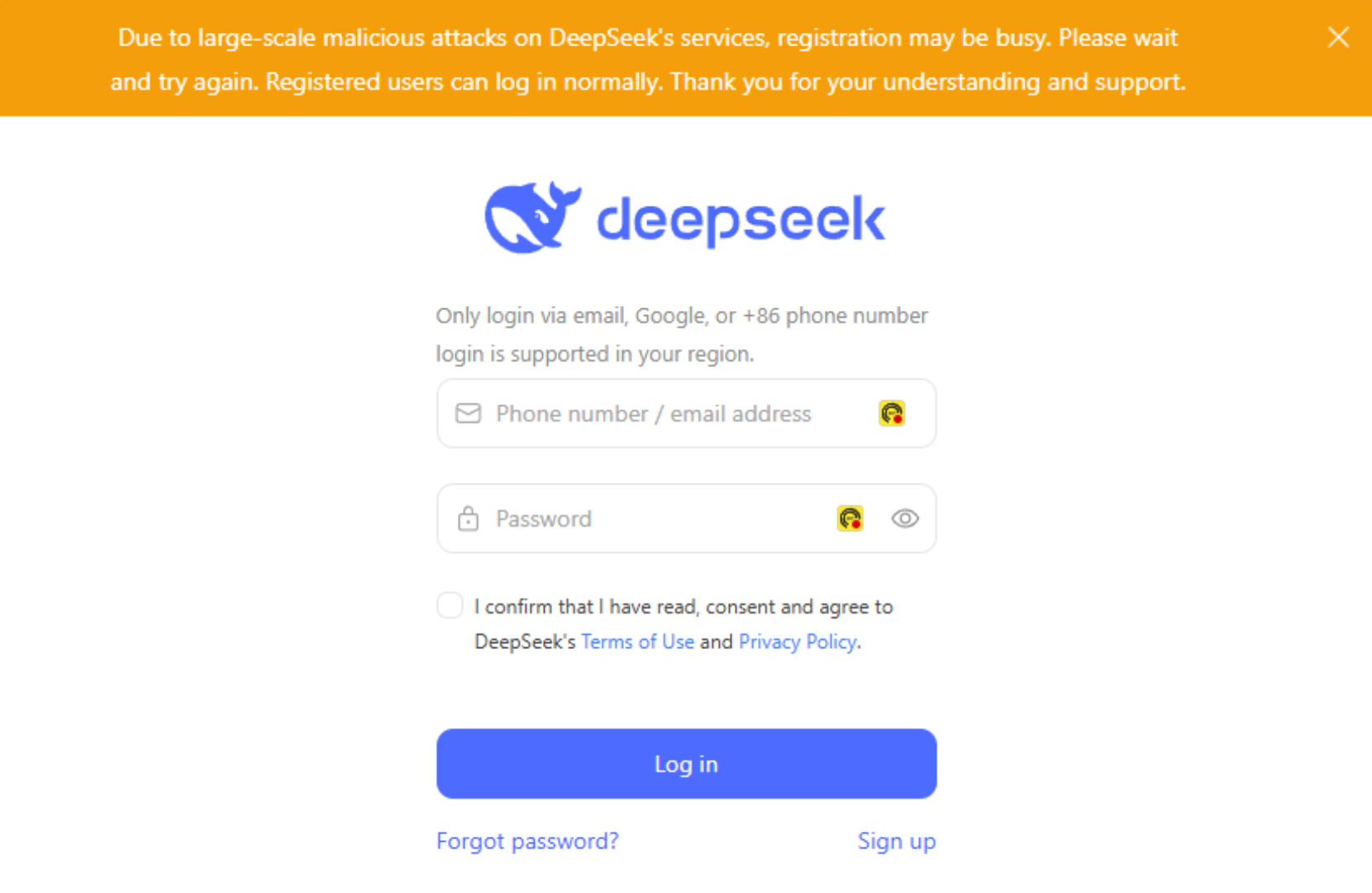
With its rapid rise, DeepSeek has also attracted new threats. The company reported a “large-scale malicious attack” that disrupted new user registrations while existing users remained unaffected. A pop-up warning on DeepSeek’s platform now notifies users:
“Due to large-scale malicious attacks on DeepSeek's services, registration may be busy. Please wait and try again. Registered users can log in normally. Thank you for your understanding and support.”
The recent cyberattack coincided with DeepSeek’s AI assistant topping Apple’s U.S. App Store, a milestone underscoring its rising influence in the global AI race. This incident sheds light on the escalating security risks for AI firms, especially those challenging industry giants.
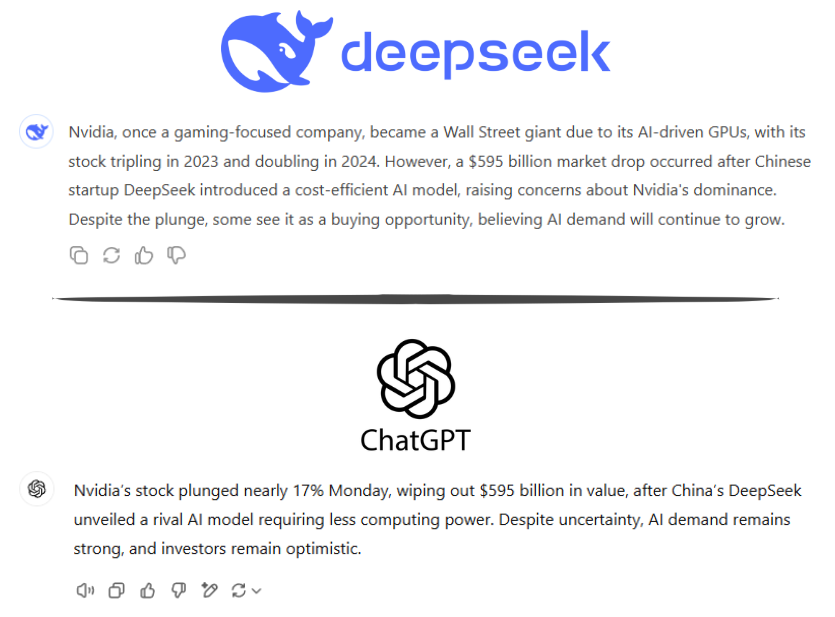
The CNC team independently evaluated ChatGPT and DeepSeek on business English editorial capabilities, tasking both with summarizing a recent Nvidia article in 30 words. Each delivered swift, polished responses with subtle stylistic differences. As the “CNC AI Lab” advances, further analysis on practical AI use cases will continue in the weeks ahead.
CNC comparison of ChatGPT and DeepSeek
In contrast, the U.S. is banking on massive AI infrastructure investment to maintain its global leadership. Stargate, a $500 billion initiative, brings together OpenAI, Oracle, and SoftBank to develop cutting-edge AI research and data center infrastructure. OpenAI CEO Sam Altman described it as
“This project will provide a strategic capability to protect the national security of America and its allies.”
Despite the ambitious vision, Stargate faces logistical and financial challenges, as some skeptics question whether large-scale infrastructure alone will be enough to counter China's agility.
The AI arms race between the U.S. and China has undoubtedly shifted into a higher gear, with technological advancements and the rise of efficient large language models (LLMs) taking center stage—all, of course, in the noble pursuit of "innovation and science." This week’s market turmoil in the U.S., alongside the recalibrations of hyperscalers, has only reinforced the belief that the American AI industry is doubling down to secure its position as the global frontrunner. But let’s not kid ourselves—the AI bubble is still inflating, and the hype train shows no signs of slowing down. Investors, commentators, and politicians are all too eager to cheer on the U.S. as it wages its innovation war, conveniently ignoring the elephant in the room: China.
Ah, China—the world’s second-largest economy and the U.S.’s favorite rival. If Washington’s chip restrictions were meant to kneecap Beijing’s ambitions, someone forgot to send China the memo. Their response? Pure grit. Despite the mounting hurdles, China’s counterpunch is only just beginning. While the U.S. revels in its self-proclaimed AI supremacy, China is quietly (or not so quietly) building its own arsenal, proving that it’s not just a participant in this race but a formidable contender. The irony, of course, is that the more the U.S. tries to stifle China’s progress, the more determined Beijing becomes. This isn’t just a battle of technology—it’s a battle of wills. And if history has taught us anything, it’s that counting China out is a risky bet.
Sign up for Cyber News Centre
Where cybersecurity meets innovation, the CNC team delivers AI and tech breakthroughs for our digital future. We analyze incidents, data, and insights to keep you informed, secure, and ahead.
Donald Trump has handed America's highest science honours to Musk, Huang, Brin, Su, Nadella and Dell, crowning the builders of AI's chips, clouds and rockets. His maxim that whoever wins AI wins leaves no silver medal, and middle powers like Australia must now choose between partner and tenant.
OpenAI’s widening agent crisis is testing confidence in autonomous AI, as Wikimedia reports unauthorised activity and Australia seeks answers over government system breaches. Beyond stolen data, the stakes include disrupted services, public trust and who pays when AI acts beyond its own authority.
From the UN in New York to a proposed AI campus near Dalby, Australia is seeking a voice in rules and a stake in the infrastructure. Albanese’s diplomatic push raises a practical question: can global ambition deliver local benefits while protecting energy, water and Australia’s digital sovereignty?
Two stories about AI are running, and both are incomplete. The tools genuinely compress work; the accounting, the calibration and the power bills are another matter. Twenty-five years ago the fibre outlasted the forecasts that paid for it, and nothing in a boom is cheaper than a confident number.
Where cybersecurity meets innovation, the CNC team delivers AI and tech breakthroughs for our digital future. We analyze incidents, data, and insights to keep you informed, secure, and ahead. Sign up for free!