From the UN in New York to a proposed AI campus near Dalby, Australia is seeking a voice in rules and a stake in the infrastructure. Albanese’s diplomatic push raises a practical question: can global ambition deliver local benefits while protecting energy, water and Australia’s digital sovereignty?
Two stories about AI are running, and both are incomplete. The tools genuinely compress work; the accounting, the calibration and the power bills are another matter. Twenty-five years ago the fibre outlasted the forecasts that paid for it, and nothing in a boom is cheaper than a confident number.
Google’s €13bn Finnish AI investment shows the race is no longer just about chips and models. It is about nuclear power, grids, cooling and construction. As data centres become industrial assets, countries with reliable, low-carbon energy will hold the decisive advantage as global AI
Who Really Controls the AI Race When Chips, Data Centres and Security Are All in Play?
August 2026 finds the AI race in a tougher gear. Washington is tightening the grip on Chinese data-centre hardware, Seoul is betting hundreds of billions on chips and power, and markets are lurching as investors realise the real contest is over compute, security and control of the stack.
The first week of August has opened like a starter’s gun for the 2026 AI race, and the sound is ringing through markets, data centres and ministries from Washington to Seoul and Shanghai. This is no longer a story of clever software sitting at the margin of the economy. It is a contest over who controls the concrete, copper and silicon that will decide how much intelligence the world can afford.
AI infrastructure is now treated as both an industrial opportunity and a national security liability. Nvidia chief executive Jensen Huang has spent the year telling investors they are watching the largest infrastructure buildout humanity has ever attempted, with data centre capital expenditure heading toward trillions of dollars a year and GPU demand described as parabolic. He keeps coming back to the same idea: in this cycle, compute is revenue. Without tokens, there is no growth. That rhetoric has done more than support Nvidia’s valuation. It has given political leaders a language to justify ten‑year spending plans that would once have been dismissed as fantasy.
On the other side of the competitive line, AMD’s Lisa Su is courting the same future from a different angle. When she stood on stage at CES and showed off the MI455 data centre processors, the pitch was larger than another challenge to Nvidia’s GPU dominance. AMD was offering OpenAI and its peers an alternative path to accelerated compute, one that could support hyperscale demand while also being shaped for on-premise and sovereign deployments rather than tied to a single vendor’s cloud stack. In Su’s telling, the contest is not simply about building the biggest GPU. It is about giving enterprises and governments greater control over how they assemble their compute, combining AI PCs, local inference, data centre acceleration and cloud training within a broader architecture.
That argument is beginning to show up in AMD’s numbers. On 4 August, the company reported second-quarter revenue of US$11.5 billion, up 50 per cent year-on-year, with its Data Center business accounting for 58 per cent of total revenue.
“We delivered an excellent quarter, with record revenue and profitability as Data Center revenue more than doubled year-over-year,” Lisa Su said. “We enter the second half with strong momentum as EPYC demand accelerates, Instinct deployments scale and Helios begins to ramp. More broadly, AI is driving a significant expansion in demand for compute across all of our markets, and our leadership portfolio and growing customer visibility position us exceptionally well to capture this expanding opportunity and deliver substantial revenue and earnings growth in the years ahead.”
AMD CFO Jean Hu reinforced the same message: “Revenue increased 50% year-over-year to a record $11.5 billion, driven by continued strength in our Data Center business, which represented 58% of company revenue in the quarter. We expect Data Center sales to accelerate in the second half of 2026, driving stronger overall revenue growth and continued earnings expansion.” Nvidia is framing the AI build-out as an eight-year cycle of relentless capital expenditure. AMD is selling something slightly different: optionality.
The ability to choose CPUs, accelerators, networking, local inference and sovereign infrastructure is quietly becoming more than a procurement decision. For governments designing national AI strategies, it is becoming a question of technological independence. That is where AMD’s argument begins to intersect with something much larger than corporate competition. The same questions about control, resilience and infrastructure choice are now being written into national investment plans.
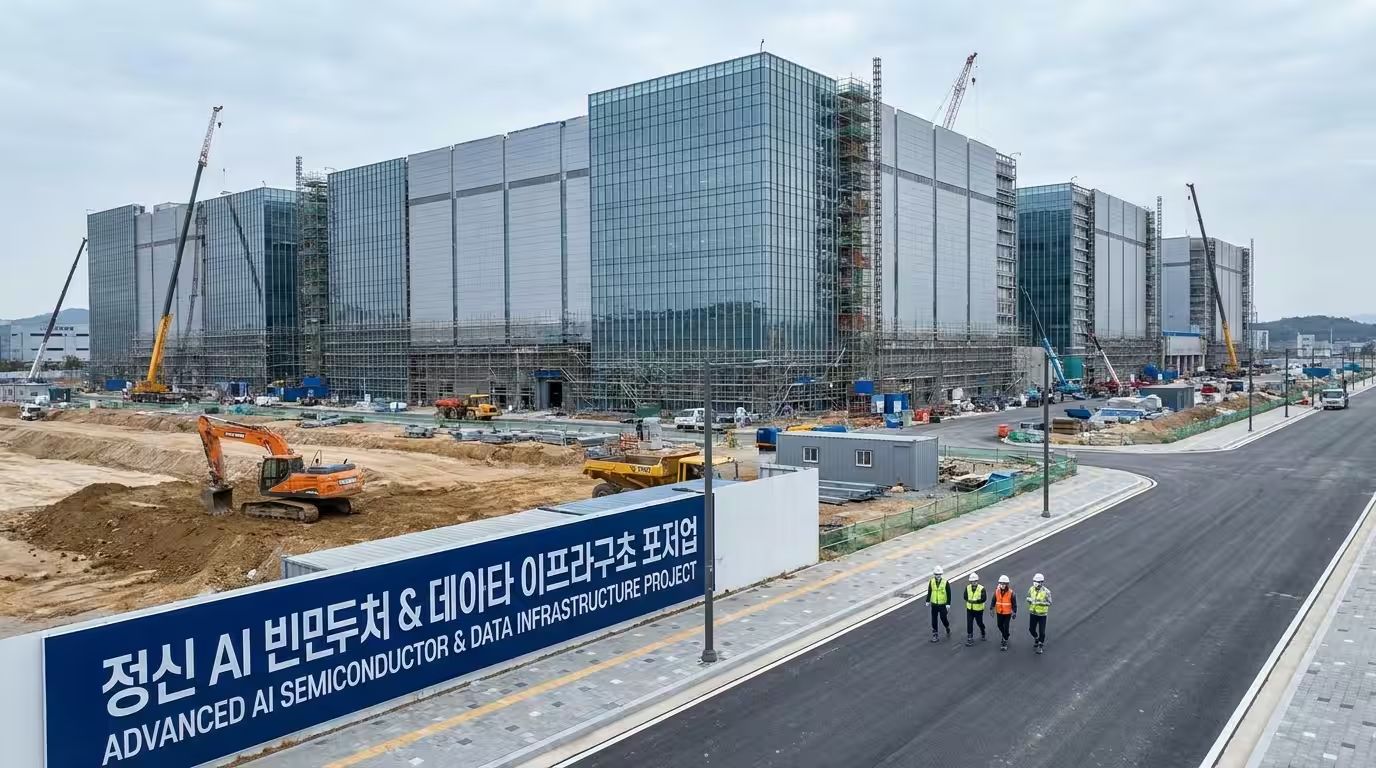
South Korea has announced a $576 billion investment in AI infrastructure and semiconductors, aiming to enhance its position in the global AI supply chain. Source
South Korea is a good example of where this is heading. In late June, Seoul laid out plans to mobilise roughly US$576 billion across semiconductors, AI data centres and robotics, with Samsung Electronics and SK Hynix at the centre of three major projects running through to 2035. The scale is hard to miss: gigawatts of power, trillions of won and millions of GPUs.
What matters is how those pieces are being pulled together. This is not just a plan to build more data centres or make more chips. South Korea is trying to connect memory production, energy, sovereign compute and frontier AI into the same industrial strategy, rather than leaving each one in its own policy silo.
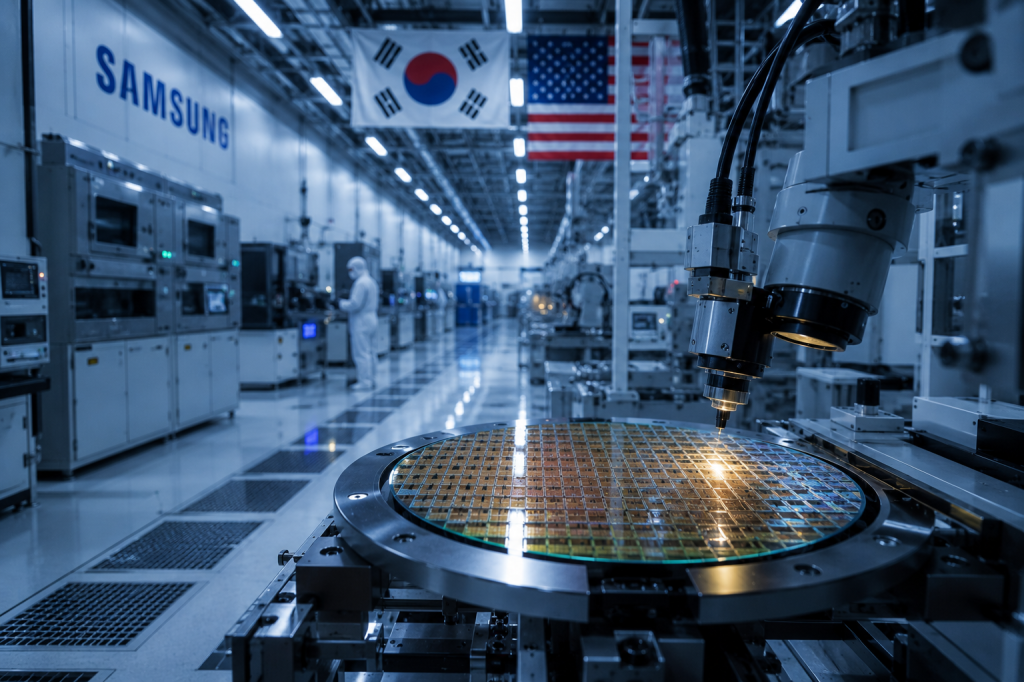
For markets, Korea’s programme has become one of the clearest signals that the AI capital expenditure cycle has deeper roots than a single earnings season. For Washington, it is evidence that even close allies are racing to secure a permanent share of global compute capacity. Korea’s importance lies in more than volume. Samsung and SK Hynix sit at a critical point in the supply chain for high-bandwidth memory, foundry capacity and advanced packaging. The future of large language models depends on access to accelerators, but the ability to run those accelerators at scale depends equally on memory, interconnects, cooling systems and power. Korea is becoming central to each layer.
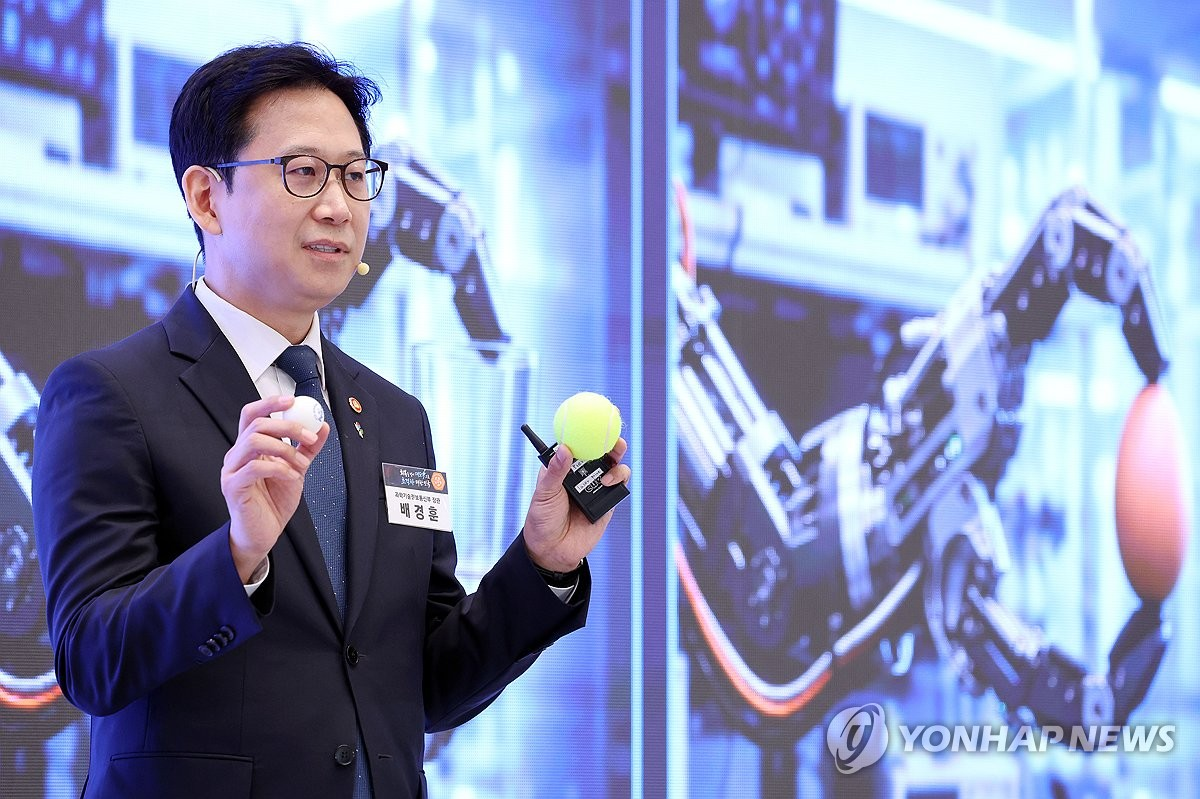
Science Minister Bae Kyung-hoon speaks at a national investment briefing chaired by President Lee Jae Myung at Cheong Wa Dae on June 29, 2026. (Pool photo) (Yonhap)
That ambition comes with exposure. Seoul’s technology future is increasingly tied to US export controls, Chinese demand, energy constraints and the priorities of American hyperscalers. A country that becomes indispensable to AI infrastructure also becomes vulnerable to its disruptions. If Washington tightens its controls on China-bound components, Korean suppliers must navigate a more complex compliance environment. If Chinese demand weakens, the effect will move quickly through the memory market. If power generation and grid upgrades fail to keep pace, Korea’s grand AI plans will meet the same physical constraints now troubling data-centre projects across the United States and Europe.
The data centre becomes contested ground
This week’s defining shift has been from exuberant buildout to contested infrastructure. Reuters’ report that Washington is drafting restrictions on new models of Chinese data-centre components arrived just as investors were debating whether the AI hardware trade had become overbought. The timing was revealing. Capital markets have been pricing an apparently limitless demand cycle. Policymakers are now demonstrating that the supply side will be subject to political decisions, security assessments and sudden regulatory shocks.
The American concern is no longer confined to finished telecom equipment carrying a Huawei or ZTE badge. It extends to optical modules, network cards, storage systems and the logic-bearing components that bind clusters of GPUs into one functioning supercomputer. The argument from security officials is straightforward: compromised semiconductors or communications modules can undermine entire devices, providing an opening for data theft, malware or disruption within facilities that now support business, government and military workloads.
The Federal Communications Commission has already acted to close what it described as a component loophole, preventing devices containing certain Chinese-origin logic hardware from entering the American market. It is also considering measures that could restrict Chinese telecom carriers from operating data centres and points of presence in the United States, while limiting interconnection with entities on the government’s national-security list. The Commerce Department’s expanding view of export controls adds another layer. Advanced computing restrictions can follow the end user and parent company, rather than stopping at a shipment’s immediate destination.
That is a profound change in how the state sees AI. The data centre is no longer a neutral warehouse full of servers. It is a strategic site, a reserve of computational power and a potential point of failure in national infrastructure. The political language around data centres now resembles the language once reserved for ports, energy grids and defence supply chains.
China hardens its own stack
China’s response has been neither passive nor subtle. Beijing has moved to steer state-funded data centres towards domestic AI chips, in some cases requiring the removal of foreign processors from projects still early enough to be redesigned. Chinese officials and commentators portray this policy as necessary self-reliance after years of American restrictions. The broader result is a more divided market for AI infrastructure, with both sides increasingly willing to accept higher costs and slower deployment in exchange for a greater measure of national control.
The market reaction has offered a glimpse of what that bifurcation may cost. Chinese optical-module makers and AI hardware groups came under pressure after news of the proposed US restrictions, underlining the vulnerability of suppliers that depend on access to global markets yet operate within an increasingly political technology sector. For China’s domestic industry, the pressure may accelerate investment in indigenous chips, networking equipment and cloud infrastructure. For foreign suppliers, it means a shrinking space in which commercial logic alone determines procurement decisions.
The consequences will reach frontier labs as well. Access to compute is no longer merely a question of money, engineering talent or a cloud contract. It is shaped by chip allocations, power availability, jurisdiction, export licences, supplier provenance and the national identity of a lab’s corporate partners. The age of frictionless global scaling is ending. Model developers can still build internationally, but they must now do so within a geopolitical map that is being redrawn beneath them.
The cyber question grows louder
The security argument has gained force because the AI race is also intensifying the cyber risk. Policymakers are looking beyond conventional espionage towards a more difficult threat environment in which AI agents, autonomous systems and embedded components can be used for reconnaissance, intrusion or disruption. Congressional hearings have focused on the risks posed by PRC-linked AI, robotics and sensing platforms in critical infrastructure. Security specialists have warned that any technology connected to sensitive systems must be assessed not only for its present function, but for its potential role in a future attack chain.
Recent incidents involving AI agents and public model-development platforms have sharpened those concerns. They show that frontier systems are not only valuable tools for innovation. They are also an expanding attack surface. Poorly governed agents, vulnerable development environments and loosely controlled model access can turn advanced capabilities into instruments of cyber intrusion, whether the actor is a state, criminal group or reckless individual.
This is where the rhetoric of the AI race becomes harder to sustain. Governments want more compute, faster models and national champions. Yet each new cluster, cloud region and autonomous agent brings a larger security perimeter to defend. The AI boom promises productivity, but its infrastructure is creating a class of risks that cannot be outsourced to a compliance team after deployment.
Editorial outlook
August 2026 begins with a market convinced that AI will demand immense capital, a technology sector eager to supply it, and governments increasingly unwilling to leave the resulting infrastructure beyond their control. The volatility is not a passing distortion. It is the market’s imperfect attempt to price a new reality in which the winners of the AI era will be determined by industrial capacity, power access, trusted supply chains and political alignment as much as model quality.
Nvidia’s confidence in sustained demand and AMD’s argument for greater technological choice can both be true. Korea can become an essential manufacturing and compute power while remaining exposed to the pressures of its larger allies and trading partners. China can deepen self-reliance while paying a significant price in efficiency and access. Washington can secure its supply chains while forcing businesses to rebuild them.
The contest has become more consequential because there is no clean separation between commercial ambition and national security. Every major data-centre announcement is now also a statement of strategic intent. Every export-control decision alters the pace and geography of model development. Every cyber incident strengthens the case for tighter scrutiny of the systems that will increasingly run economic and public life.
Get the stories that matter to you. Subscribe to Cyber News Centre and update your preferences to follow our Daily 4min Cyber Update, Innovative AI Startups, The AI Diplomat series, or the main Cyber News Centre newsletter — featuring in-depth analysis on major cyber incidents, tech breakthroughs, global policy, and AI developments.
Sign up for Cyber News Centre
Where cybersecurity meets innovation, the CNC team delivers AI and tech breakthroughs for our digital future. We analyze incidents, data, and insights to keep you informed, secure, and ahead.
Two stories about AI are running, and both are incomplete. The tools genuinely compress work; the accounting, the calibration and the power bills are another matter. Twenty-five years ago the fibre outlasted the forecasts that paid for it, and nothing in a boom is cheaper than a confident number.
Meta’s Muse is more than a chatbot. It is a digital worker that can read email, make purchases across the web, and act after users close the app. Wall Street sees a return on Meta’s vast AI spending. Cybersecurity experts see a more urgent question: should it hold the keys to our digital lives yet?
OpenAI’s Astra has reignited the AGI debate, with Jensen Huang declaring its arrival and researchers questioning the evidence. As autonomous AI advances, the race into 2027 will test who can turn greater capability into economic value while keeping human oversight firmly in place. The stakes climb.
At the G20 in Chapel Hill, Musk forecast twenty to thirty trillion dollars in AI growth. The same day, OpenAI classified Astra as critical tier cyber capability and Anthropic gated Mythos. Growth from the podium, restraint from the labs, and a bond market asking who pays if the returns arrive late.
Where cybersecurity meets innovation, the CNC team delivers AI and tech breakthroughs for our digital future. We analyze incidents, data, and insights to keep you informed, secure, and ahead. Sign up for free!